Link Copied!
Gustave Flaubert Quotes (1821-1880)
Writer, King
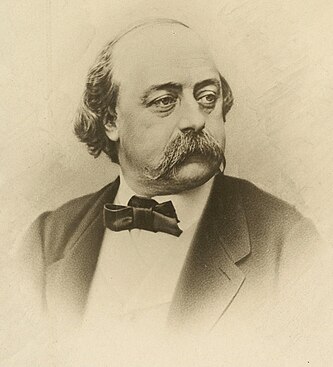






About Gustave Flaubert
Gustave Flaubert (December 12 1821 – May 8 1880) was an influential French writer who was perhaps the leading exponent of literary realism of his country. He is known especially for his first published novel, Madame Bovary (1857), for his Correspondence, and for his scrupulous devotion to his style and aesthetics.
Best Gustave Flaubert Quotes
Shortest
Earliest
Explore our curated collection of the most famous and impactful Gustave Flaubert quotes.
“There is no 'true'. There are merely ways of perceiving truth.”


“One must not always think that feeling is everything. Art is nothing without form. (12 August 1846)”
“Rien n'est humiliant comme de voir les sots réussir dans les entreprises où l'on échoue.”
“An author in his book must be like God in the universe, present everywhere and visible nowhere. (9 December 1852)”


“Everything one invents is true, you may be perfectly sure of that. Poetry is as precise as geometry. (14 August 1853)”

“Do not read as children do to enjoy themselves, or, as the ambitious do to educate themselves. No, read to live. (June 1857)”
“To be stupid, selfish, and have good health are three requirements for happiness, though if stupidity is lacking, all is lost. (13 August 1846)”

“The artist must be in his work as God is in creation, invisible and all-powerful; one must sense him everywhere but never see him. (18 March 1857)”
“You can calculate the worth of a man by the number of his enemies, and the importance of a work of art by the harm that is spoken of it. (14 June 1853)”

“The idea of bringing someone into the world fills me with horror. I would curse myself if I were a father. A son of mine! Oh no, no, no! May my entire flesh perish and may I transmit to no one the aggravations and the disgrace of existence. (11 December 1852)”

“Without ideality, there is no grandeur; without grandeur there is no beauty. Olympus is a mountain. The most effective monument will always be the Pyramids. Exuberance is better than taste; the desert is better than a streetpavement, and a savage is surely better than a hairdresser!”
“Axiom: hatred of the bourgeois is the beginning of wisdom. But I include in the word bourgeois, the bourgeois in blouses as well the bourgeois in coats. It is we and we alone, that is to say the literary men, who are the people, or to say it better: the tradition of humanity. (10 May 1867)”

“For some men, the stronger their desire, the more difficult it is for them to act. They are hampered by mistrust of themselves, daunted by the fear of giving offence; besides, deep feelings of affection are like respectable women; they are afraid of being found out and they go through life with downcast eyes.”
“The brazen arms were working more quickly. They paused no longer. Every time that a child was placed in them the priests of Moloch spread out their hands upon him to burden him with the crimes of the people, vociferating: "They are not men but oxen!" and the multitude round about repeated: "Oxen! oxen!" The devout exclaimed: "Lord! Eat!"”
“Don't talk to me about your hideous reality! What does it mean — reality? Some see things black, others blue — the multitude sees them brute-fashion. There is nothing less natural than Michael Angelo; there is nothing more powerful! The anxiety about eternal truth is a mark of contemporary baseness; and art will become, if things go on in that way, a sort of poor joke as much below religion as it is below poetry, and as much below politics as it is below business. You will never reach its end — yes, its end! — which is to cause within us an impersonal exaltation, with petty works, in spite of all your finished execution.”

Gustave Flaubert Quotes by Topic
Find exactly what you are looking for by browsing this categorized list of Gustave Flaubert quotes by topic.
Gustave Flaubert on Bourgeoisie 2 quotes
“The whole dream of democracy is to raise the proletarian to the level of bourgeois stupidity.”

Gustave Flaubert on Antinatalism 2 quotes
“The idea of bringing someone into the world fills me with horror. I would curse myself if I were a father. A son of mine! Oh no, no, no! May my entire flesh perish and may I transmit to no one the aggravations and the disgrace of existence.”

Gustave Flaubert on Naples
“A Mediterranean Paris. Such is Naples.”

Gustave Flaubert on Seafood
Gustave Flaubert on Democracy
“The whole dream of democracy is to raise the proletarian to the level of bourgeois stupidity.”

Gustave Flaubert on Poetry
“Everything one invents is true, you may be perfectly sure of that. Poetry is as precise as geometry.”

Gustave Flaubert on Authors
“An author in his book must be like God in the universe, present everywhere and visible nowhere. (9 December 1852)”
Gustave Flaubert on Worth
“You can calculate the worth of a man by the number of his enemies, and the importance of a work of art by the harm that is spoken of it.”
Gustave Flaubert on Boredom
Gustave Flaubert on Art
“You can calculate the worth of a man by the number of his enemies, and the importance of a work of art by the harm that is spoken of it. (14 June 1853).”

Gustave Flaubert on Piano
Gustave Flaubert on Chemistry
“Chemistry, Madame Lefrancois....the composition of manures, the fermentation of liquids, the analysis of gases and the influence of miasmata- what, I put it to you, is all this, but chemistry pure and simple?”

What Gustave Flaubert Said About Others
Discover personal opinions Gustave Flaubert shared regarding contemporaries.
Gustave Flaubert on Baruch Spinoza 2 quotes
“...Yes, you must read Spinoza. Those who accuse him of atheism are asses. Goethe said, 'When I am upset or troubled I reread the Ethics.' Perhaps like Goethe you will find calm in the reading of this great book. Ten years ago I lost the friend I had loved more than any other, Alfred Le Poittevin. Fatally ill, he spent his last nights reading Spinoza. [Original in French: A propos de Spinoza (un fort grand homme, celui-là), tâchez de vous procurer sa biographie par Boulainvilliers. Elle est dans l'édition latine de Leipsick. Emile Saisset a traduit, je crois, l'Éthique. Il faut lire cela. L'article de Mme Coignet, dans la Revue de Paris était bien insuffisant. Oui, il faut lire Spinoza. Les gens qui l'accusent d'athéisme sont des ânes. Goethe disait: « Quand je me sens troublé, je relis l'Éthique ». Il vous arrivera peut-être, comme à Goethe, d'être calmée par cette grande lecture. J'ai perdu, il y a dix ans, l'homme que j'ai le plus aimé au monde, Alfred Le Poittevin. Dans sa maladie dernière, il passait ses nuits à lire Spinoza.]”

Gustave Flaubert on Virgil
Gustave Flaubert on Frédéric Bastiat
Gustave Flaubert on Kenneth Rexroth
“As we turn over the pages of nineteenth century literature, we are constantly confronted with the question of alienation. Baudelaire, Marx, Kierkegaard, Chateaubriand, Cardinal Newman — it does not matter whether the voice comes from the Left or the Right; all are agreed in their rejection of the values of the prevailing ethic. Yet we never get a clear definition of alienation: what is man alienated from, and why? Perhaps it is precisely the democratic society, the growing affluence and education, that have revealed the natural state of man — much as the development of medicine has enabled greater accuracy of diagnosis, with the resultant tremendous increase in the record of certain diseases. Perhaps the discovery of human self-alienation was simply a statistical refinement made possible by the spread of the privileges of culture to the middle classes.”
Quotes About Gustave Flaubert
Gain deeper perspective through quotes about Gustave Flaubert from others.
Nadine Gordimer on Gustave Flaubert
“I see now, looking at this little book, November, by Flaubert, so many of the themes that he was going to explore so wonderfully later are just touched upon, he didn’t have the skill to carry them any further. And then, as his life went by, he followed them, he followed these dark tunnels.”

Osip Mandelstam THE NINETEENTH CENTURY translated into English on Gustave Flaubert
“Madame Bovary is written entirely according to the system of tanka. Flaubert wrote it so slowly and painstakingly, because he had to begin it anew after every fifth word.”
Jean-Paul Sartre on Gustave Flaubert
“Thus Flaubert has two quite different conceptions of himself. One is at the level of banal description, for example when he writes to his mistress Louise: ‘What am I? Am I intelligent or am I stupid? Am I sensitive or am I stolid? Am I mean or am I generous? Am I selfish or am I selfless? I have no idea, I suppose I am like everyone else, I waver between all these. . . .’ In other words, at this level he is completely lost. Why? Because none of these notions has any meaning in themselves. They only acquire a meaning from inter-subjectivity, in other words what I have called in the Critique the ‘objective spirit’ within which each member of a group or society refers to himself and appears to others, establishing relations of interiority between persons which derive from the same information or the same context. Yet one cannot say that Flaubert did not have, at the very height of his activity, a comprehension of the most obscure origins of his own history. He once wrote a remarkable sentence: ‘You are doubtless like myself, you all have the same terrifying and tedious depths’—les mêmes profondeurs terribles et ennuyeuses. What could be a better formula for the whole world of psychoanalysis, in which one makes terrifying discoveries, yet which always tediously come to the same thing? His awareness of these depths was not an intellectual one. He later wrote that he often had fulgurating intuitions, akin to a dazzling bolt of lightning in which one simultaneously sees nothing and sees everything. Each time they went out, he tried to retrace the paths revealed to him by this blinding light, stumbling and falling in the subsequent darkness.”

Misattributed Quotes
Quotes mistakenly credited to Gustave Flaubert
“As a rule we disbelieve all the facts and theories for which we have no use.”
About Gustave Flaubert
Gustave Flaubert (December 12 1821 – May 8 1880) was an influential French writer who was perhaps the leading exponent of literary realism of his country. He is known especially for his first published novel, Madame Bovary (1857), for his Correspondence, and for his scrupulous devotion to his style and aesthetics.