...Aside from a little Spinoza and Plutarch, I have read nothing since my return, as I am quite occupied by my present work. ...I have read lately some amazing theological things, which I have intermingled with a little of Plutarch and Spinoza. ...Just now, I am reading in the evening, Kant's Critique of Pure Reason, translated by Barni, and I am freshening up my Spinoza. [Original in French: Présentement je lis, le soir, le Critique de la raison pure, de Kant, traduit par Barni et je repasse mon Spinoza.] ...If only I do not make a failure also of Saint-Antoine. I am going to start working on it again in a week, when I have finished with Kant and Hegel. These two great men are helping to stupefy me, and when I leave them I fall with eagerness upon my old and thrice great Spinoza. What genius, how fine a work the Ethics is! [Original in French: Pourvu que je ne rate pas aussi saint Antoine! Je vais m'y remettre dans une huitaine quand j'en aurai fini avec Kant et avec Hegel! Ces deux grands hommes continuent à m'abrutir et, quand je sors de leur compagnie, je tombe avec voracité sur mon vieux et trois fois grand Spinoza! Quel génie! quelle œuvre que l'Éthique!] ...I knew Spinoza's Ethics, but not the Tractatus Theologico-Politicus. The book astounds me; I am dazzled, and transported with admiration. My God, what a man! what an intellect! what learning and what a mind! [Original in French: Je connaissais l'Éthique de Spinoza, mais pas du tout le Tractatus théologico-politicus, lequel m'épate, m'éblouit, me transporte d'admiration. Nom de Dieu, quel homme! quel cerveau! quelle science et quel esprit!]
What It Means
This is a placeholder explanation generated by the low-overhead model. It interprets "...Aside from a little Spinoza and Plutarch, I have read nothing since my return, as I am quite occupied by my present work. ...I have read lately some amazing theological things, which I have intermingled with a little of Plutarch and Spinoza. ...Just now, I am reading in the evening, Kant's Critique of Pure Reason, translated by Barni, and I am freshening up my Spinoza. [Original in French: Présentement je lis, le soir, le Critique de la raison pure, de Kant, traduit par Barni et je repasse mon Spinoza.] ...If only I do not make a failure also of Saint-Antoine. I am going to start working on it again in a week, when I have finished with Kant and Hegel. These two great men are helping to stupefy me, and when I leave them I fall with eagerness upon my old and thrice great Spinoza. What genius, how fine a work the Ethics is! [Original in French: Pourvu que je ne rate pas aussi saint Antoine! Je vais m'y remettre dans une huitaine quand j'en aurai fini avec Kant et avec Hegel! Ces deux grands hommes continuent à m'abrutir et, quand je sors de leur compagnie, je tombe avec voracité sur mon vieux et trois fois grand Spinoza! Quel génie! quelle œuvre que l'Éthique!] ...I knew Spinoza's Ethics, but not the Tractatus Theologico-Politicus. The book astounds me; I am dazzled, and transported with admiration. My God, what a man! what an intellect! what learning and what a mind! [Original in French: Je connaissais l'Éthique de Spinoza, mais pas du tout le Tractatus théologico-politicus, lequel m'épate, m'éblouit, me transporte d'admiration. Nom de Dieu, quel homme! quel cerveau! quelle science et quel esprit!]" in the context of "Gustave Flaubert, in his letters to George Sand, 1870–72 [original in French]" to mean that wisdom is timeless.

Tags
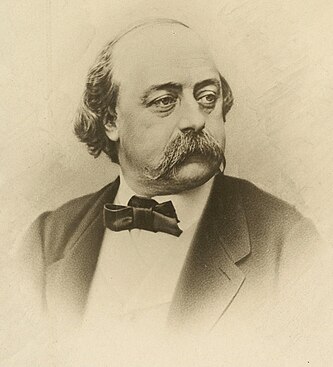
About Gustave Flaubert