Link Copied!
James K. Polk Quotes (1795-1849)
President, Leader
About James K. Polk
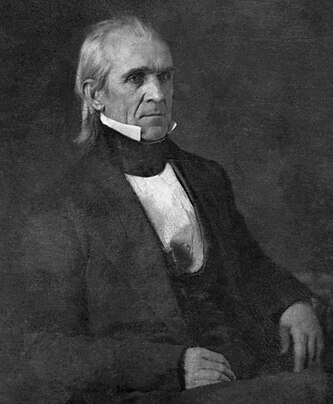
James Knox Polk (2 November 1795 - 15 June 1849) was the 11th president of the United States (1845–49). A Democrat, Polk served as the 13th speaker of the House of Representatives (1835–39) — the only president to have served as House speaker — and governor of Tennessee (1839–41). Polk was the surprise (dark horse) candidate for president in 1844, defeating Henry Clay of the rival Whig Party by promising to annex Texas. Polk was a leader of Jacksonian Democracy during the Second Party System. His nickname was "Young Hickory" because of his close association with "Old Hickory", Andrew Jackson.
Best James K. Polk Quotes
Shortest
Earliest
Explore our curated collection of the most famous and impactful James K. Polk quotes.

“The world has nothing to fear from military ambition in our Government.”

“With me it is emphatically true that the presidency is "no bed of roses."”

“Foreign powers do not seem to appreciate the true character of our Government.”
“Thank God, under our Constitution there was no connection between church and state.”

“There is more selfishness and less principle among members of Congress, as well as others, than I had any conception [of], before I became President of the U.S.”

“It becomes us, in humility, to make our devout acknowledgments to the Supreme Ruler of the Universe, for the inestimable civil and religious blessings with which we are favored.”
“Well may the boldest fear and the wisest tremble when incurring responsibilities on which may depend our country's peace and prosperity, and in some degree the hopes and happiness of the whole human family.”

“The passion for office among members of Congress is very great, if not absolutely disreputable, and greatly embarrasses the operations of the government. They create offices by their own votes and then seek to fill them themselves.”
“No president who performs his duties faithfully and conscientiously can have any leisure. If he entrusts the details and smaller matters to subordinates constant errors will occur. I prefer to supervise the whole operations of the government myself rather than entrust the public business to subordinates, and this makes my duties very great. ”
“By the theory of our Government majorities rule, but this right is not an arbitrary or unlimited one. It is a right to be exercised in subordination to the Constitution and in conformity to it. One great object of the Constitution was to restrain majorities from oppressing minorities or encroaching upon their just rights. Minorities have a right to appeal to the Constitution as a shield against such oppression.”
“Under the benignant providence of Almighty God the representatives of the States and of the people are again brought together to deliberate for the public good. The gratitude of the nation to the sovereign arbiter of all human events should be commensurate with the boundless blessings which we enjoy.
Peace, plenty, and contentment reign throughout our borders, and our beloved country presents a sublime moral spectacle to the world.”
Peace, plenty, and contentment reign throughout our borders, and our beloved country presents a sublime moral spectacle to the world.”

“Although in our country the Chief Magistrate must almost of necessity be chosen by a party and stand pledged to its principles and measures, yet in his official action he should not be the President of a part only, but of the whole people of the United States. While he executes the laws with an impartial hand, shrinks from no proper responsibility, and faithfully carries out in the executive department of the Government the principles and policy of those who have chosen him, he should not be unmindful that our fellow-citizens who have differed with him in opinion are entitled to the full and free exercise of their opinions and judgments, and that the rights of all are entitled to respect and regard.”

Quotes About James K. Polk
Gain deeper perspective through quotes about James K. Polk from others.
Winston Churchill on James K. Polk 2 quotes
“For the next ten years the question of the admission of Texas as a state of the Union was a burning issue in American politics. As each new state demanded entry into the Union so the feeling for and against slavery ran higher. The great Abolitionist journalist, William Lloyd Garrison, called for a secession of the Northern states if the slave state of Texas was admitted to the Union. The Southerners, realising that Texan votes would give them a majority in the Senate if this vast territory was admitted as a number of separate states, clamoured for annexation. The capitalists of the East were committed, through the formation of land companies, to exploit Texas, and besides the issue of dubious stocks by these bodies vast quantities of paper notes and bonds of the new Texan Republic were floated in the United States. The speculation in these helped to split the political opposition of the Northern states to the annexation. Even more important was the conversion of many Northerners to belief in the “Manifest Destiny” of the United States. This meant that their destiny was to spread across the whole of the North American continent. The Democratic Party in the election of 1844 called for the occupation of Oregon as well as the annexation of Texas, thus holding out to the North the promise of Oregon as a counterweight to Southern Texas. The victory of the Democratic candidate, James K. Polk, was interpreted as a mandate for admitting Texas, and this was done by joint resolution of Congress in February 1845.”

William B. DeGregorio on James K. Polk
“Polk was by nature an introvert but out of political necessity forced himself to mingle. He had few genuinely close friends. Still, he was generally well liked. A classic overachiever, he was very ambitious. Biographer Charles C. Sellers attributed his "feverish drive" to "early physical inferiority," "frustrations of his boyish ambitions," and "his mother's stern gospel of duty." To compensate for a lack of brilliance and charisma, he, according to sellers, "drove himself ruthlessly, exploiting the abilities and energies he did possess to an extent that few men can equal." Yet he kept a firm rein on his ambition, never letting it threaten his career.”
Roxanne Dunbar-Ortiz on James K. Polk
“President James K. Polk, who presided over the invasion of Mexico, saw its significance as an example of how a democracy could carry on and win a foreign war with as much "vigor" as authoritarian governments were able to do. He believed that an elected civilian government with its volunteer people's army was even more effective than European monarchies in the quest for empire. The victory over Mexico proved to the European powers, he felt, that the United States was their equal. Standing tall through military victory over a weak country: it was not Ronald Reagan or George W. Bush who thought up that idea. The tradition is as old as the United States itself.”

About James K. Polk
James Knox Polk (2 November 1795 - 15 June 1849) was the 11th president of the United States (1845–49). A Democrat, Polk served as the 13th speaker of the House of Representatives (1835–39) — the only president to have served as House speaker — and governor of Tennessee (1839–41). Polk was the surprise (dark horse) candidate for president in 1844, defeating Henry Clay of the rival Whig Party by promising to annex Texas. Polk was a leader of Jacksonian Democracy during the Second Party System. His nickname was "Young Hickory" because of his close association with "Old Hickory", Andrew Jackson.