Link Copied!
H. H. Asquith Quotes (1852-1928)
Leader, King
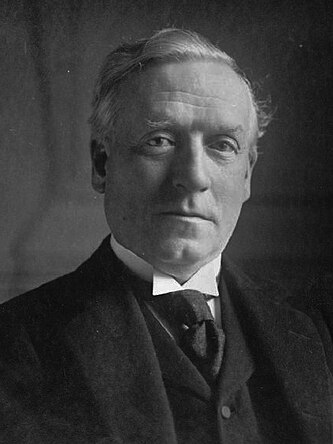
About H. H. Asquith
Herbert Henry Asquith, 1st Earl of Oxford and Asquith, KG, PC (12 September 1852 – 15 February 1928) was Prime Minister of the United Kingdom from 1908 to 1916. As Prime Minister, his Liberal Party government passed social legislation beginning the modern British welfare state and reducing the power of the House of Lords. He was the leader of the country during World War I and formed a wartime coalition with the Conservative Party. He was was forced to resign in favor of David Lloyd George due to disagreements over military strategy and conscription, leading to a split between the two that began the decline of the Liberal Party.
Best H. H. Asquith Quotes
Shortest
Earliest
Explore our curated collection of the most famous and impactful H. H. Asquith quotes.

“[A] return to more thrifty and economical administration [is] the first and paramount duty of the Government.”

“[T]he bond which united them, if their critics were to be believed, might be a tranquil consciousness of effortless superiority.”

“The severance of Ulster from the rest of Ireland is a geographical, and, therefore, a political impossibility. ... The Union is safe so long as Ulster is loyal.”

“I have realised from the first that if it could not be proved that social reform (not Socialism) can be financed on a Free Trade line, a return to Protection is a moral certainty.”


“[I]f a Labour Government is ever to be tried in this country, as it will be, sooner or later, it could hardly be tried under safer conditions.”
“The military domination of Prussia, with all that it involved to the fortunes of the secular struggle between force upon the one side and right upon the other, that domination has been once and for all and for ever overthrown.”

“[O]ne thing is certain, that the Budget of next year will stand at the very centre of our work, by which, I was going to say, we shall stand or fall, by which certainly we shall be judged in the estimation both of the present and of posterity.”
“What is the use of talking of Empire if here, at its very centre, there is always to be found a mass of people stunted in education, prey to intemperance, huddled and congested beyond the possibility of realising in any true sense either social or domestic life”

“[W]here we were obliged to part company with our friends was here—that we held and still hold that war was neither intended nor desired by the Government and the people of Great Britain, but that it was forced upon us without adequate reason, entirely against our will.”
“[W]e claim to start from and to maintain in all our political action this fundamental principle—that the interests of the community as a whole ought to be paramount over the interests of any class, any interest, or any section which that community contains. That is the root and spring of Liberalism.”

“Excerpts from a Leader's speech delivered in Manchester in 1918 http://web.archive.org/web/20160315133414/http://www.britishpoliticalspeech.org/speech-archive.htm?speech=18”
“In view of this grave and unprecedented outrage, the House may be assured that his Majesty's Government will take without delay appropriate steps to vindicate the authority of the law and to protect officers and servants of the King and his Majesty's subjects in the exercise of their duties and in the enjoyment of their legal rights.”
“So far from enjoying the undisputed hegemony which was so confidently predicted for British trade 50 years ago, there was not now an inch of ground in any one of the international markets for which we were not fighting with all our available strength. We had long ceased to enjoy that relative superiority in natural advantages with which we started upon the race.”
“[F]or us here, 43,000,000 of people in these two small islands, dependent as we are upon extraneous sources of supply for the food of the people and the materials of the industry, the one free, open, untrammelled market in the whole world—for us, I say, free trade is the breath of life, and there is no social reform that would not be dearly purchased by its sacrifice.”
“Peace we all desire. Peace can only come—peace, I mean, that is worth the name and that satisfies the definition of the word—peace will only come on terms that atonement is made for past wrongs, that the weak and downtrodden are restored, that the faith of treaties is observed, and that the sovereignty of public law is securely enthroned over the nations of the world.”

“Is Germany prepared not only to evacuate Belgium, not only to make full reparation for the colossal mischief and damage which have accompanied her devastating occupation of the country, and her practical enslavement, so far as she can carry it out, of large portions of the population...but to restore to Belgium not the pretence of liberty, but complete and unfettered and absolute independence?”

“More important still, perhaps, the sanctity of treaties and of the public law of Europe has been finally vindicated; and last, and most important of all, we have set up in the League of Nations a new international polity which promises, if it is given free scope and full authority, first to bring about progressive disarmament, and next to provide in future a rational and humane substitute for the ruinous arbitrament of war.”
“I...am not what is called a Socialist. I believe in the right of every man face to face with the State to make the best of himself, and, subject to the limitation that he does not become a nuisance or a danger to the community, to make less than the best of himself. ... [B]ut...there is nothing that calls so loudly or so imperiously as the possibilities of social reform.”
“We shall never sheathe the sword, which we have not lightly drawn, until Belgium recovers in full measure all, and more than all, that she has sacrificed; until France is adequately secured against the menace of aggression; until the rights of the smaller nationalities of Europe are placed upon an unassailable foundation; and until the military domination of Prussia is wholly and finally destroyed.”
“Let them take the debate which had recently been carried on with so much vivacity on the subject of Imperial expansion. There was a process of expansion which was as normal, as necessary, as inseparable, and unmistakable a sign of vitality in a nation as the corresponding processes in the growing human body. We might control and direct it by oversight and by means adapted to the end, but we could not arrest it. ... it was not part of the most illustrious apostles and disciples of Liberalism to condemn expansion in the sense which he had described it.”
“Everyone desires outrages to cease, and its perpetrators, from whatever camp they proceed, to be detected and punished. (Hear, hear.) But this cannot be too clearly said—it is possible for the State to pay too high a price for what is called the vindication of the law. The price is too high, far too high, when it involves the enthronement in the seat of justice of revenge, and the borrowing by the Executive of the criminals' own methods of indiscriminate robbery, arson, and murder. (Cheers.)”

“[T]hree of the most important resolutions, namely, those relating to the Most-Favoured-Nation treatment, protection against dumping or unfair competition, and the adoption of measures to render the Allies independent of enemy countries as regards essential industries, were proposed by the British delegates and passed at the Conference in the form in which they were put forward.”

H. H. Asquith Quotes by Topic
Find exactly what you are looking for by browsing this categorized list of H. H. Asquith quotes by topic.
H. H. Asquith on Second Boer War
“[W]here we were obliged to part company with our friends was here—that we held and still hold that war was neither intended nor desired by the Government and the people of Great Britain, but that it was forced upon us without adequate reason, entirely against our will.”
H. H. Asquith on League of Nations
“[M]ost important of all, we have set up in the League of Nations a new international polity which promises, if it is given free scope and full authority, first to bring about progressive disarmament, and next to provide in future a rational and humane substitute for the ruinous arbitrament of war.”

H. H. Asquith on Liberalism
“[W]e claim to start from and to maintain in all our political action this fundamental principle—that the interests of the community as a whole ought to be paramount over the interests of any class, any interest, or any section which that community contains. That is the root and spring of Liberalism.”

H. H. Asquith on Imperialism
“Let them take the debate which had recently been carried on with so much vivacity on the subject of Imperial expansion. There was a process of expansion which was as normal, as necessary, as inseparable, and unmistakable a sign of vitality in a nation as the corresponding processes in the growing human body. We might control and direct it by oversight and by means adapted to the end, but we could not arrest it. ... [I]t was not part of the most illustrious apostles and disciples of Liberalism to condemn expansion in the sense which he had described it.”

H. H. Asquith on General strike
“The socialization or nationalization of production and distribution and the extinction of what is called Capitalism—by whatever name the ideal, and the process for its attainment, is called—would starve the resources, and, in time, drain away the life-blood of the great productive industries which depend for their efficiency on the free play of initiative and enterprise. And Labour is becoming more and more a class organization, an expression and embodiment of what is called “class-consciousness.” That again was significantly illustrated in the general strike, which was directed by organized Labour, and which was countenanced—it is true, in a somewhat shamefaced fashion—by the Parliamentary Labour Party leaders.”

What H. H. Asquith Said About Others
Discover personal opinions H. H. Asquith shared regarding contemporaries.
H. H. Asquith on Joseph Chamberlain 2 quotes
“That he never held the title of Leader of this House or of the head of the Government is felt, by friends and by foes alike, to be an accident in his career.”

H. H. Asquith on Winston Churchill
“I wish I knew as much about anything as that young man knows about everything.”

H. H. Asquith on William Ewart Gladstone
“Mr. Gladstone once said to me: “If you ever have to form a Government, you must steel your nerves, and act the butcher”: a piece of very sound advice (as I learned from experience).”

H. H. Asquith on James Bryce, 1st Viscount Bryce
“No one in our time has contributed more largely to create and foster this temper between the two great kindred peoples than our distinguished Ambassador, now once more at home among us, Mr. Bryce.”
H. H. Asquith on Benjamin Jowett
“Jowett, in his day, did probably more than any other single man to let some fresh air into the exhausted atmosphere of the [Oxford] common rooms, and to widen the intellectual horizons of the place.”

H. H. Asquith on Stanley Baldwin
“In regard to yourself, let me say that I have never found, and could never desire, a more straightforward and scrupulously honourable opponent, or one who more completely satisfied my ideal of an English gentleman.”

H. H. Asquith on Charles James Fox
“Charles James Fox, who, though through some of the perverse fortunes and accidents of political life, only held high office twice in his life, and in each case for a very brief time, was acknowledged by all good judges to be second to none among the Parliamentary speakers in what we are accustomed, and rightly, to describe as the Golden Age of British eloquence.”

H. H. Asquith on John Morley, 1st Viscount Morley of Blackburn
“This is not a tragedy, but it means the disappearance of the last survivor of the heroic age. He was my first political mentor, and for more than fifty years a wise counsellor, the best of comrades, and in these last years an unfailing and devoted revered friend. Only last week I had from him an affectionate letter which I shall always treasure. English literature and the great traditions of public life are impoverished by his loss.”
H. H. Asquith on Lytton Strachey
“In a recently published volume—the most trenchant and brilliant series of biographical and historical studies which I have read for a long time—Mr. Lytton Strachey, under the modest title 'Eminent Victorians', has put on his canvas four figures (as unlike one another as any four people could be), Cardinal Manning, Florence Nightingale, Dr. Arnold, and General Gordon. None of the four can be said to have contributed much of permanent importance to the literature or art or science of their time; but each of them, in his or her day, was a prominent and potent personality; and perhaps one may be allowed to say that they are in less danger than ever of being forgotten, now that they have been re-created for the English readers of the future (not in a spirit of blind hero-worship) by Mr. Strachey's subtle and suggestive art.”

Quotes About H. H. Asquith
Gain deeper perspective through quotes about H. H. Asquith from others.
Lord Beaverbrook on H. H. Asquith 3 quotes
“It was not Mr. Asquith's judgement that I distrusted; it was that of the kind of barnacles, especially in the general staff, which had affixed themselves to his administration. I believed with good reason as the event showed, that Mr. Lloyd George's military opinions were better than those of Sir William Robertson and the War Office, and that the united command and all else was impossible unless the generals could be put under proper control by the Secretary of State for War and the Prime Minister. That was the real struggle and I regretted the dénouement as much as did the present Prime Minister. But we feel that we were battling for the National existence.”
Viscount Cecil of Chelwood on H. H. Asquith 2 quotes
“To me personally he was always most friendly—very easy of access, with a marvellous memory and a loyalty to his colleagues which it is impossible to over-praise. But as the chief of a War Cabinet he was not quite in his element. He was an excellent chairman, quick to understand any point raised, unfailingly courteous to all his colleagues, but apparently regarding it as no part of his duty to initiate solutions of any difficulty or to make suggestions for a new departure in policy. The result was that Cabinet discussions under him were models of propriety and decorum but a little wanting in that liveliness and resource necessary to cope with the prodigious difficulties with which we faced.”
Austen Chamberlain on H. H. Asquith
“He has taken his choice, and he has by that choice constituted his own immortality. He will go down to history as the last Prime Minister of a Liberal Administration. He has sung the swan song of the Liberal party. When next the country is called upon for a decision, if it wants a Socialist Government, it will vote for a Socialist; if it does not want a Socialist Government, it will vote for a Unionist. It will not vote again for those who denatured its mandate and betrayed its trust.”
Winston Churchill on H. H. Asquith 2 quotes
“It was reserved for Mr. Asquith to cast away a second opportunity. After the general election men of all parties turned cordially and even eagerly to a veteran statesman whose sterling qualities, though tried by both extremes of fortune, have always commanded respect. But Mr. Asquith would not help. He proclaimed himself first and last a party man. Assuming airs of superiority for which there was little warrant, Mr. Asquith and his friends declared that all common action with Conservatives was improper, immoral, degrading in the last degree, and not to be thought of in any circumstances. Farther than that, they would place and keep a Socialist minority in office and beg in the most humane manner for any crumb which might fall from their table. Under this guidance the Liberal party deliberately cast away their opportunity of rendering an immense service to the public, and delivered themselves over bound hand and foot to their implacable Socialist foes. How swift are time’s revenges? Only a few months have passed, but now they can appreciate the almost fatal consequences of their failure to place country before party at a fateful juncture.”
Duff Cooper on H. H. Asquith
“The impression of Mr. Asquith that remains with me is of a man of great dignity, somewhat aloof and Olympian. He belonged to the Victorian age. He would have thought it ill-bred to discuss current politics at the dinner-table, or to criticise other politicians. The guests who were staying in his house, especially those who claimed to know him best, would tell you what he was thinking, but his own conversation never gave a clue. I have an entry in my diary for June 25th 1916, when I was staying at The Wharf: "They say the Prime Minister is worried about having made Lloyd George Secretary of State for War. He thinks it is the mistake of his life." Perhaps it was.”
Lord Curzon on H. H. Asquith 2 quotes
“The present Prime Minister, Mr. Asquith, represents a type of public speaking carried to higher perfection than by anyone else in modern times. Possessed of a copious vocabulary, an extraordinary and effortless command of the right word, a remarkable gift of lucidity and compression, and a resonant voice, he produces an overpowering effect of Parliamentary and forensic strength. Whether in exposition or declamation, in opening or in reply, on a great subject or a small, he never falls below a certain stately level, even though he never soars above it into passion or kindles an audience into flame.”
Anthony Eden on H. H. Asquith
“In my first year in the House of Commons, Mr. Asquith was leader of the Liberal Party and I give him pride of place among the parliamentary debaters of that time. His speeches were models of lucidity and brevity, with the English language at its best. In an age when prolixity was already becoming a substitute for conviction, he never wasted a word.”

Lord Halifax on H. H. Asquith
“I always regretted then, as I regret now, that I never knew Asquith... Although party feelings were strained in those pre-war years and he necessarily stood out as the principal actor to most of what party loyalty impelled us to condemn, I never listened to him making a speech without being greatly impressed by the strength of the qualities that he could command. Complete mastery of his case, and perfect choice of language appropriate to its deployment before an intelligent and critical audience, went with what looked like an equally complete indifference, once his decision had been taken, to the opposition that might be aroused. However unwillingly, such qualities extorted admiration from his most bitter opponents. But whether because of this sort of feeling or in spite of it, he always remained for me a figure aloof, alarming and unapproachable.”
Max Hastings on H. H. Asquith 2 quotes
“The Liberals whom Asquith led formed one of the most talented administrations in British history, dominated in 1914 by such figures as Lloyd George, Chancellor of the Exchequer; Winston Churchill, First Lord of the Admiralty; Richard Haldane, a former reforming war minister, now Lord Chancellor. The prime minister himself was a survivor of an earlier era, old enough to have seen, as a boy of twelve in 1864, the bodies of five murderers dangling from the gallows outside Newgate, their heads concealed by white hoods. A lawyer of modest middle-class origins, 'a Roman reserve was always natural to Asquith,' in the words of his biographer. He fought against any expression of his stronger feelings.' George Dangerfield went further, asserting that Asquith lacked imagination and compassion; that, for all his high intelligence, he failed convincingly to address any of the great crises which overtook Britain during his years of office 'He was ingenious but not subtle, he could improvise quite brilliantly on somebody else's theme, He was moderately imperialist, moderately progressive, moderately humorous, and being the most fastidious of Liberal politicians, only moderately evasive.' If this judgment was cynical, it was plain that by August 1914 Asquith was a tired old man.”
Bonar Law on H. H. Asquith
David Lloyd George on Asquith on H. H. Asquith
David Lloyd George on H. H. Asquith 3 quotes
“I recollect Lord Morley once saying to me: “Asquith ought to have been a judge. He would have made a great one. I remember,” he said, “a conversation I had recently with Arthur Acland about early days when Acland, Asquith and I used to meet together often to discuss politics, and I said what a pleasant fellow he was. Acland replied, ‘Yes, but did you ever hear him make any suggestion of his own?’ I had to confess that although he discussed every proposition advanced by others with great intelligence and force, he never submitted any ideas of his own for our consideration.” Asquith undoubtedly had not only the mind, but the temperament of a judge.”

About H. H. Asquith
Herbert Henry Asquith, 1st Earl of Oxford and Asquith, KG, PC (12 September 1852 – 15 February 1928) was Prime Minister of the United Kingdom from 1908 to 1916. As Prime Minister, his Liberal Party government passed social legislation beginning the modern British welfare state and reducing the power of the House of Lords. He was the leader of the country during World War I and formed a wartime coalition with the Conservative Party. He was was forced to resign in favor of David Lloyd George due to disagreements over military strategy and conscription, leading to a split between the two that began the decline of the Liberal Party.