Link Copied!
Charles E. Sorensen Quotes (1881-1968)




About Charles E. Sorensen
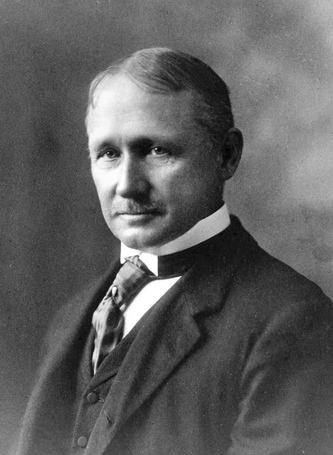
Charles Emil Sorensen (7 September 1881 – 11 August 1968) was a Danish-American principal of the Ford Motor Company during its first four decades. Like most other managers at Ford during those decades, he did not have an official job title, but he served functionally as a patternmaker, foundry engineer, mechanical engineer, industrial engineer, production manager, and executive in charge of all production.
Best Charles E. Sorensen Quotes
Shortest
Earliest
Explore our curated collection of the most famous and impactful Charles E. Sorensen quotes.
“Ed Martin, who was plant superintendent, and I practically lived at the Rouge.”
“It isn't the incompetent who destroy an organization. The incompetent never get into a position to destroy it. It is those who have achieved something and want to rest upon their achievements who are forever clogging things up.”

“By March, 1908, we were ready to announce Model T, but not to produce it, On October 1 of that year the first car was introduced to the public. From Joe Galamb's little room on the third floor had come a revolutionary vehicle. In the next eighteen years, out of Piquette Avenue, Highland Park, River Rouge, and from assembly plants all over the United States came 15,000,000 more.”
“Without titles and tier of officials how could one build an organization? When Flanders resigned as production manager taking with him his assistant Walborn, to work for a newly formed company, Henry Ford called Ed Martin and me to his office. "Ed and Charlie," he said, "Flanders and Walborn are leaving, and I want you to take their places. You Ed, will be plant superintendent and you Charlie, will be assistant superintendent. Just go out there and run the plant. I know you can do it. But there's one thing I want to add: work together as one. I don't ever want to hear that you can't work together. And don't worry about titles."”

“Actually it took four years and more to develop Model T. Previous models were the guinea pigs, one might say, for experimentation and development of a car which would realize Henry Ford's dream of a car which anyone could afford to buy, which anyone could drive anywhere, and which almost anyone could keep in repair. Many of the world's greatest mechanical discoveries were accidents in the course of other experimentation. Not so Model T, which ushered in the motor transport age and set off a chain reaction of machine production now known as automation. All our experimentation at Ford in the early days was toward a fixed and, then wildly fantastic goal.”
“It took only a few days to block off the little room on the third floor back of the Piquette Avenue plant and to set up a few simple power tools and Joe Galamb's two blackboards. The blackboards were a good idea. They gave a king-sized drawing which, when all initial refinements had been made, could be photographed for two purposes: as a protection against patent suits attempting to prove prior claim to originality and as a substitute for blueprints. A little more than a year later Model T, the product of that cluttered little room, was announced to the world. But another half year passed before the first Model T was ready for what had already become a clamorous market...”
“Early one morning in the winter of 1906-7, Henry Ford dropped in at the pattern department of the Piquette Avenue plant to see me. 'Come with me, Charlie,' he said, 'I want to show you something.'
I followed him to the third floor and its north end, which was not fully occupied for assembly work. He looked about and said, 'Charlie, I'd like to have a room finished off right here in this space. Put up a wall with a door in big enough to run a car in and out. Get a good lock for the door, and when you're ready, we'll have Joe Galamb come up in here. We're going to start a completely new job.'
The room he had in mind became the maternity ward for Model T.”
“One of the hardest-to-down myths about the evolution of mass production at Ford is one which credits much of the accomplishment to 'scientific management.' No one at Ford—not Mr. Ford, Couzens, Flanders, Wills, Pete Martin, nor I—was acquainted with the theories of the 'father of scientific management,' Frederick W. Taylor. Years later I ran across a quotation from a two-volume book about Taylor by Frank Barkley Copley, who reports a visit Taylor made to Detroit late in 1914, nearly a year after the moving assembly line had been installed at our Highland Park plant. Taylor expressed surprise to find that Detroit industrialists 'had undertaken to install the principles of scientific management without the aid of experts.' To my mind this unconscious admission by an expert is expert testimony on the futility of too great reliance on experts and should forever dispose of the legend that Taylor's ideas had any influence at Ford.”

“By August, 1913, all links in the chain of moving assembly lines were complete except the last and most spectacular one - the one we had first experimented with one Sunday morning just five years before. Again a towrope was hitched to a chassis, this time pulled by a capstan. Each part was attached to the moving chassis in order, from axles at the beginning to bodies at the end of the line. Some parts took longer to attach than others; so, to keep an even pull on the towrope, there must be differently spaced intervals between delivery of the parts along the line. This called for patient timing and rearrangement until the flow of parts and the speed and intervals along the assembly line meshed into a perfectly synchronized operation throughout all stages of production. Before the end of the year a power-driven assembly line was in operation, and New Year's saw three more installed. Ford mass production and a new era in industrial history had begun.”
“The summer before, Mr. Ford told me to block off the experimental room for Joe Galamb, a momentous event occurred which would affect the entire automotive industry. The first heat of vanadium steel in the country was poured at the United Steel Company's plant in Canton, Ohio.
Early that year we had several visits from J. Kent Smith, a noted English metallurgist from a country which had been in the forefront of steel development...
Ford, Wills, and I listened to him and examined his data. We had already read about this English vanadium steel. It had a tensile strength nearly three times that of steels we were using, but we'd never seen it. Smith demonstrated its toughness and showed that despite its strength it could be machined more easily than plain steel. Immediately Mr. Ford sensed the great possibilities of this shock-resisting steel. "Charlie," he said to me after Smith left, "this means entirely new design requirements, and we can get a better, lighter, and cheaper car as a result of it."”

Charles E. Sorensen Quotes by Topic
Find exactly what you are looking for by browsing this categorized list of Charles E. Sorensen quotes by topic.
Charles E. Sorensen on Organization
“It isn't the incompetent who destroy an organization. The incompetent never get into a position to destroy it. It is those who have achieved something and want to rest upon their achievements who are forever clogging things up.”
Charles E. Sorensen on Mass production
“One of the hardest-to-down myths about the evolution of mass production at Ford is one which credits much of the accomplishment to 'scientific management.' No one at Ford—not Mr. Ford, Couzens, Flanders, Wills, Pete Martin, nor I—was acquainted with the theories of the 'father of scientific management,' Frederick W. Taylor. Years later I ran across a quotation from a two-volume book about Taylor by Frank Barkley Copley, who reports a visit Taylor made to Detroit late in 1914, nearly a year after the moving assembly line had been installed at our Highland Park plant. Taylor expressed surprise to find that Detroit industrialists 'had undertaken to install the principles of scientific management without the aid of experts.' To my mind this unconscious admission by an expert is expert testimony on the futility of too great reliance on experts and should forever dispose of the legend that Taylor's ideas had any influence at Ford.”

Charles E. Sorensen on Ford Motor Company
“One of the hardest-to-down myths about the evolution of mass production at Ford is one which credits much of the accomplishment to 'scientific management.' No one at Ford—not Mr. Ford, Couzens, Flanders, Wills, Pete Martin, nor I—was acquainted with the theories of the 'father of scientific management,' Frederick W. Taylor. Years later I ran across a quotation from a two-volume book about Taylor by Frank Barkley Copley, who reports a visit Taylor made to Detroit late in 1914, nearly a year after the moving assembly line had been installed at our Highland Park plant. Taylor expressed surprise to find that Detroit industrialists 'had undertaken to install the principles of scientific management without the aid of experts.' To my mind this unconscious admission by an expert is expert testimony on the futility of too great reliance on experts and should forever dispose of the legend that Taylor's ideas had any influence at Ford.”

What Charles E. Sorensen Said About Others
Discover personal opinions Charles E. Sorensen shared regarding contemporaries.
Charles E. Sorensen on Frederick Winslow Taylor
“One of the hardest-to-down myths about the evolution of mass production at Ford is one which credits much of the accomplishment to 'scientific management.' No one at Ford—not Mr. Ford, Couzens, Flanders, Wills, Pete Martin, nor I—was acquainted with the theories of the 'father of scientific management,' Frederick W. Taylor. Years later I ran across a quotation from a two-volume book about Taylor by Frank Barkley Copley, who reports a visit Taylor made to Detroit late in 1914, nearly a year after the moving assembly line had been installed at our Highland Park plant. Taylor expressed surprise to find that Detroit industrialists 'had undertaken to install the principles of scientific management without the aid of experts.' To my mind this unconscious admission by an expert is expert testimony on the futility of too great reliance on experts and should forever dispose of the legend that Taylor's ideas had any influence at Ford.”
Quotes About Charles E. Sorensen
Gain deeper perspective through quotes about Charles E. Sorensen from others.
Allan Nevins on Charles E. Sorensen
“As Ford reduced prices on cars, there was inevitable pressure from Sorensen down to weed out men, to keep the vast plant moving at its maximum pace. The entire 70,000 felt the strain. The pace was never too fast for accomplishment, but it was fast enough to make the job relentless, harassing, and to many hateful. Yet despite its sinister aspect, which organized labor and more enlightened management would in time cure, the Rouge stood out as a pioneering accomplishment in industry which affected both automotive and other manufacturing processes.”
Production, on Charles E. Sorensen
“CHARLES E. SORENSEN was production boss of the Ford Motor Company until 1945. He is something of a legendary figure today, but hardly more so than when he directed the world's biggest mass production operation.”

Richard H. Stout on Charles E. Sorensen
“Charles E. Sorensen was hired by Henry Ford in 1905 as a pattern maker, a highly skilled craft of cutting exacting wood patterns from blueprints and creating a three-dimensional representation for foundry castings. "Cast-Iron Charlie," so nicknamed by Henry Ford for his foundry expertise, was master of the River Rouge empire. Fearless and ruthless, he personally was as tough as "Cast-Iron" and not hesitant to display the fact. Though respectful of the Ford family, his loyalty was to Henry, as Edsel had known only too well.”
Harry Bennett on Charles E. Sorensen
“In all the years I knew Sorensen, he was never a politician in the plant. He was a cold aloof man, and never had any social relations with anyone in the company - myself included.”
Ford R. Bryan on Charles E. Sorensen
“A production genius and loyal servant of Henry Ford for thirty-nine years, Charles E. Sorensen is probably the best known of Ford's many lieutenants. His crowning achievement was design of the production layout of the mammoth Willow Run plant at Ypsilanti, Michigan, where giant B-24 bombers were produced during World War II at the phenomenal rate of one every hour.”
About Charles E. Sorensen
Charles Emil Sorensen (7 September 1881 – 11 August 1968) was a Danish-American principal of the Ford Motor Company during its first four decades. Like most other managers at Ford during those decades, he did not have an official job title, but he served functionally as a patternmaker, foundry engineer, mechanical engineer, industrial engineer, production manager, and executive in charge of all production.