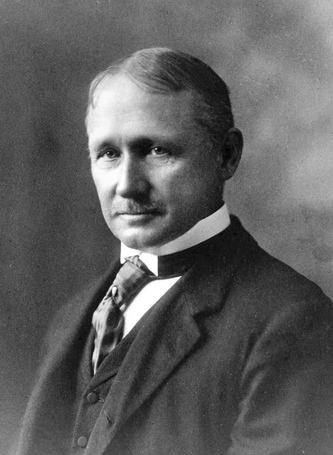
One of the hardest-to-down myths about the evolution of mass production at Ford is one which credits much of the accomplishment to 'scientific management.' No one at Ford—not Mr. Ford, Couzens, Flanders, Wills, Pete Martin, nor I—was acquainted with the theories of the 'father of scientific management,' Frederick W. Taylor. Years later I ran across a quotation from a two-volume book about Taylor by Frank Barkley Copley, who reports a visit Taylor made to Detroit late in 1914, nearly a year after the moving assembly line had been installed at our Highland Park plant. Taylor expressed surprise to find that Detroit industrialists 'had undertaken to install the principles of scientific management without the aid of experts.' To my mind this unconscious admission by an expert is expert testimony on the futility of too great reliance on experts and should forever dispose of the legend that Taylor's ideas had any influence at Ford.
What It Means
This is a placeholder explanation generated by the low-overhead model. It interprets "One of the hardest-to-down myths about the evolution of mass production at Ford is one which credits much of the accomplishment to 'scientific management.' No one at Ford—not Mr. Ford, Couzens, Flanders, Wills, Pete Martin, nor I—was acquainted with the theories of the 'father of scientific management,' Frederick W. Taylor. Years later I ran across a quotation from a two-volume book about Taylor by Frank Barkley Copley, who reports a visit Taylor made to Detroit late in 1914, nearly a year after the moving assembly line had been installed at our Highland Park plant. Taylor expressed surprise to find that Detroit industrialists 'had undertaken to install the principles of scientific management without the aid of experts.' To my mind this unconscious admission by an expert is expert testimony on the futility of too great reliance on experts and should forever dispose of the legend that Taylor's ideas had any influence at Ford." in the context of "Charles E. Sorensen (1956) My Forty Years with Ford, New York, New York, USA: Norton. p. 41." to mean that wisdom is timeless.
Tags

About Charles E. Sorensen