Link Copied!
Shakti Quotes (0-)
About Shakti
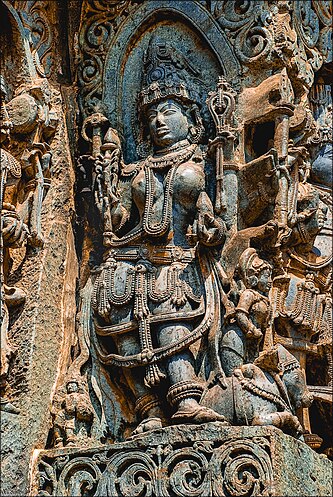
Shakti (Sanskrit pronunciation: ˈʃʌktɪ) (Devanagari: शक्ति; from Sanskrit shak, "to be able"), meaning "Power" or "empowerment," is the primordial cosmic energy and represents the dynamic forces that are thought to move through the entire universe in Hinduism.
Best Shakti Quotes
Shortest
Earliest
Explore our curated collection of the most famous and impactful Shakti quotes.


“The Dharma of the Westerners is worship of Shakti – the Creative Power regarded as the Female Principle.”
“All the objects in the external world are definitely projections of shakti, the power of consciousness, but the waking state is not a product of your mind.”

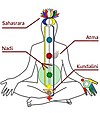
“There is a triangular cavity at the base of the spinal column where sleeps kundalini shakti, called power of powers, coiled some say 2 ½ feet but definitely 3 ½ times.”
“Shakti worship, especially the worship of God as Mother, is a personal property of India. The great scholar and illumined soul Swami Abhedananda also says, ‘India is in fact the only place in the world where God is worshipped as Mother’.”

“Although conceived as female in nature, Shakti is not an individual goddess, but rather a dynamic quality that all goddesses (and even all women, at least within the Shakta Tatric tradition) are said to possess. Unbridled, uncontainable.”
“There was the other idea in the old Vedic hymn to the Goddess: ‘I am the light. I am the light of the sun and moon; I am the air which animates all beings.’ This is the germ which afterwards develops into Mother-worship. By Mother-worship is not meant difference between father and mother. The first idea connoted by it is that of energy—I am the power that is in all beings.”

“In an old Veda is found the mantra, ‘I am the empress of all that lives, the power in everything. ’Mother-worship is a distinct philosophy in itself. Power is the first of our ideas. It impinges upon man at every step; power felt within is the soul; without, nature. And the battle between the two makes human life. All that we know or feel is but the resultant of these two forces. Man saw that the sun shines on the good and evil alike.”

“The first and ultimate principle of the Universe is a feminine power, Shakti, whose personified form is Beauty and whose essential nature is consciousness and bliss. It exists eternally associated with the male principle, Shiva, who plays a secondary role. The “Srichakra” is the diagrammatic representation of their union.”
“The concept of shakti is indivisibly connected with Mother worship (shakti sadhana). Generally the worship of Durga, Kali, Sarasvati and other goddesses is considered Shakti worship. But the worship of Narayana, Shiva, Ganesha and other gods, too, is the worship of Shakti Herself. Whatever the means - image, symbol or yantra - the worship is only of Shakti. This is because, in the use of all these means there is a superimposition of the creation - preservation - destruction aspects of Shakti either fully or partially. So in a wider sense all worshippers are Shakti worshippers.”

“India of the ages is not dead nor has She spoken Her last creative word; she lives and has still something to do for herself and the human peoples. And that which She must seek now to awake, is not an Anglicized oriental people, docile people of the West and doomed to repeat the cycle of Occident’s success and failure, but still the ancient immemorial Shakti recovering Her deepest self, lifting Her head higher towards the supreme source of light and strength and turning to discover the complete meaning and Vaster form of Her Dharma.”
“The Guru [Nagaji, Ramakrishna’s] would, never condescend to admit of Maya or Shakti. Brahman only exists – this was his refrain. Ramakrishna on the other hand, had begun his spiritual ascent by his devotion to Shakti standing in the form of the idol of Kali in the temple. To him Shakti was equally real and equally important. Without any argument, or any effort on his part, his guru was caught in the vice like grip of Shakti or Maya.”
“So from where does our lineage of tradition flow? The first is Brahmadeva, the lotus-born one. Then came Vasishta, Lord Rama’s Guru. This indicates that tradition is older than the Ramayana. After Vasishta comes Shakti, then Parasara, followed by Vyasa, author of the epic Mahabharata, and then Shuka.”

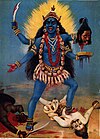
“There is a deeper symbolism. The black image of Kali is standing on the white image of Lord Shiva. Shiva is Brahman and Kali is Brahman’s energy, Shakti. Brahman is passive while Shakti – Kali –is active. The images so stand that Shiva looks at Kali and Kali at Shiva. This symbolizes the fact that every action, big or small, of destruction or creation, performed by Kali at the instance of Shiva. Kali, as it were, is the working organ of Shiva. Shiva and Kali, Brahman and Shakti, the source and energy, are essential one.”
“Sri Ramakrishna experienced Shakti, the presence of the Divine Mother in everything. And lo! The whole scene, doors, windows, the temple itself vanished. It seemed as if nothing existed anymore. Instead I saw an ocean of the Spirit, boundless, dazzling. In whatever direction I turned, great luminous waves were rising. They bore down upon me with a loud roar as if to swallow me up. In an instant they were upon me. They broke over me, they engulfed me. I was suffocated. I lost consciousness and I fell... How I passed that day and the next I know not. Round me rolled an ocean of ineffable joy. And in the depths of my being I was conscious of the presence of the Divine Mother.”
“Shakti: the Mother Goddess, power or energy, originating, perhaps, in the non-Aryan culture of the Indus Valley. Mythologically Shakti is equated with the Goddesses Kali, Parvati and Durga, consorts of Shiva. The cult of Shakti flourished since the fifth century A.D.”
“Mother is the first manifestation of power and is considered a higher idea than father. With the name of Mother comes the idea of Shakti, Divine Energy and Omnipotence, just as the baby believes its mother to be all powerful, able to do anything. The Divine Mother is the Kundalini (“coiled up power”) sleeping in us; without worshipping Her we can never know ourselves....Every manifestation of power in the universe is ‘Mother’. She is life, She is intelligence, She is love....A bit of Mother, a drop, was Krishna, another was Buddha, another was Christ....Worship Her if you want love and wisdom.”
“The Shakti or Power of Brahman is the manifest aspect of the unmanifest Brahman, the personal aspect of Impersonal Brahman. Brahman and Shakti are inseparable: they are static and dynamic, like energy bottled up and energy released. The one cannot be conceived of without the other: Brahman is inconceivable without Shakti, Shakti is inconceivable without Brahman. It follows that Brahman is a cosmic and cosmic as well as transcendental and relative. These seemingly opposing aspects — unmanifest and manifest, static and dynamic, acosmic and cosmic, transcendental and relative—are identical. In each case the same Being is seen from different viewpoints which balance and supplement each other. Both concepts, Brahman and Shakti, are indispensable to the health and fullness of spiritual life.”

“This world is all alike the play of Mother. But we forget this. Even misery can be enjoyed when there is no selfishness, when we have become the witness of our own lives. The thinker of this philosophy has been struck by the idea that one power is behind all phenomena. In our thought of God, there is human limitation, personality: with Shakti comes the idea of One Universal Power. ‘I stretch the bow of Rudra when He desires to kill’ [‘to destroy evil,’ Rigveda, X. 125, Devi-Sukta], says Shakti. The Upanishads did not develop this thought; for Vedanta does not care for the God-idea. But in the Gita comes the significant saying to Arjuna, ‘I am the real, and I am the unreal. I bring good, and I bring evil.’ (Gità, IX: 19, X: 4-)”

“Why is it that our country is the weakest and the most backward of all countries? Because Shakti is held in dishonour. Without the grace of Shakti nothing is to be accomplished... To me, Mother's grace is a hundred times more valuable than Father's... fie on him who has no devotion for the Mother....If an Indian woman in Indian dress preaches the religion which fell from the lips of the Rishis of India, it will inundate the Western world. Will there be no women in the land of Maitreyi, Khana, Lilavati, Savitri and Ubhayabharati?”
Shakti Quotes by Topic
Find exactly what you are looking for by browsing this categorized list of Shakti quotes by topic.
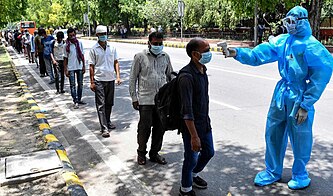
Shakti on COVID-19 pandemic in India
“It is a matter of great sadness that India has fallen behind the 77th position among the countries of the world, in the list of administering a single dose of corona vaccine in every hundred people.. The Congress President, Smt. Sonia Gandhi, in her previous letter to the Prime Minister, has reiterated the need to procure vaccines centrally from global and domestic sources and begin a free, universal mass vaccination campaign across the country... Centre does not like to listen to the advice of scientists and Scientific Advisor.”

About Shakti
Shakti (Sanskrit pronunciation: ˈʃʌktɪ) (Devanagari: शक्ति; from Sanskrit shak, "to be able"), meaning "Power" or "empowerment," is the primordial cosmic energy and represents the dynamic forces that are thought to move through the entire universe in Hinduism.