Link Copied!
Female genital mutilation Quotes (2016-)
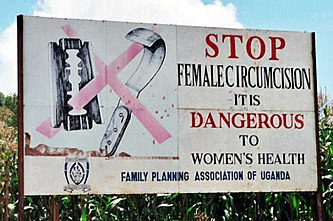
About Female genital mutilation
Female genital mutilation (FGM), also known as female genital cutting and female circumcision, is the ritual removal of some or all of the external female genitalia. UNICEF estimated in 2016 that 200 million women had undergone the procedures in 27 countries in Africa, as well as in Indonesia, Iraqi Kurdistan and Yemen, with a rate of 80–98 percent within the 15–49 age group in Djibouti, Egypt, Eritrea, Guinea, Mali, Sierra Leone, Somalia and Sudan. The practice is also found elsewhere in Asia, the Middle East, and among communities from these areas around the world.
Best Female genital mutilation Quotes
Shortest
Earliest
Explore our curated collection of the most famous and impactful Female genital mutilation quotes.
“Although it is a symbol of life, the female body is unfortunately not rarely attacked and disfigured, even by those who should be its protector and life companion.”

“The traditional form of excision is a practice totally banned by Islam because of the compelling evidence of the extensive damage it causes to women's bodies and minds.”
“Narrated Umm Atiyyah al-Ansariyyah: A woman used to perform circumcision in Medina. The Prophet (peace be upon him) said to her: Do not cut severely as that is better for a woman and more desirable for a husband.”
“Circumcision is obligatory (for every male and female) by cutting off the piece of skin on the glans of the penis of the male, but circumcision of the female is by cutting out the clitoris (this is called Hufaad)”
“I’m tired of being told that Islam is a “Religion of Peace,” when every day I can read dozens of stories of ... Muslims mutilating the genitals of little girls; all in the name of Allah, because the Qur’an and Shari’a law tells them to.”

“Tostan has for over 13 years chosen the term female genital cutting (FGC) based on what communities that are giving up the practice have told us: the term “cutting” allows them to accomplish more than the others because it is less judgmental and value-laden.”
“Female Genital Mutilation concerns us all. It is a crime that is being committed in many countries. With my worldwide campaign I want to raise awareness of this cruel practice. I want to contribute all I can to make it possible to finally eradicate FGM worldwide"”
“As we do all of this work to counter the Islamist extremist ideology, let’s also recognise that we will have to enter some pretty uncomfortable debates – especially cultural ones. Too often we have lacked the confidence to enforce our values, for fear of causing offence. The failure in the past to confront the horrors of forced marriage I view as a case in point. So is the utter brutality of Female Genital Mutilation (FGM).”
“FGC has traditionally been called "female circumcision," which implies that it is similar to male circumcision. The recognition of FGC's harmful physical, psychological and human rights consequences, however, has led to the use of the term "female genital mutilation" or "FGM," which distinguishes this practice from the much milder practice of male circumcision. Many women who have undergone FGC do not consider themselves to be mutilated and have become offended by the term "FGM." Recently, other terms such as "female genital cutting" (FGC) have increasingly been used.”
“The man, who was probably an itinerant traditional circumciser from the blacksmith clan, picked up a pair of scissors. With the other hand, he caught hold of the place between my legs and started tweaking it, like Grandma milking a goat. "There it is, the kintir," one of the women said. Then the scissors went down between my legs and the man cut off my inner labia and clitoris. I heard it, like a butcher snipping the fat off a piece of meat. A piercing pain shot up between my legs, indescribable, and I howled. Then came the sewing: the long, blunt needle clumsily pushed into my bleeding outer labia, my loud and anguished protests, Grandma's words of comfort and encouragement. "It's just this once in your life, Ayaan. Be brave, it's almost finished." When the sewing was finished, he cut the thread off with his teeth.”
About Female genital mutilation
Female genital mutilation (FGM), also known as female genital cutting and female circumcision, is the ritual removal of some or all of the external female genitalia. UNICEF estimated in 2016 that 200 million women had undergone the procedures in 27 countries in Africa, as well as in Indonesia, Iraqi Kurdistan and Yemen, with a rate of 80–98 percent within the 15–49 age group in Djibouti, Egypt, Eritrea, Guinea, Mali, Sierra Leone, Somalia and Sudan. The practice is also found elsewhere in Asia, the Middle East, and among communities from these areas around the world.