Link Copied!
George Gamow Quotes (1904-1968)
Physicist
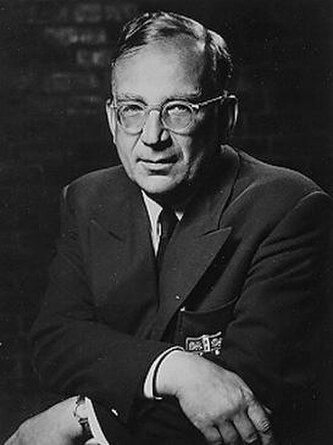
About George Gamow
George Gamow pronounced "GAM-off" (March 4 1904 – August 19 1968) was an American physicist and cosmologist of Russian descent. He developed the Big Bang theory of cosmology, using it to predict the existence of Cosmic background radiation, and his insight that DNA nucleotides probably formed "a triplet code of four symbols" was influential on very important research and discoveries in genetics.
Best George Gamow Quotes
Shortest
Earliest
Explore our curated collection of the most famous and impactful George Gamow quotes.
“I feel that matter has properties which physics tells you.”

“I decided to get Ph.D. in experimental physics because experimental physicists have their own room in the Institute where they can hang their coat, whereas theoretical physicists have to hang their coat at the entrance.”
“If the expansion of the space of the universe is uniform in all directions, an observer located in anyone of the galaxies will see all other galaxies running away from him at velocities proportional to their distances from the observer.”
“'''''There was a young fellow from Trinity,
Who took the square root of infinity.'''
But the number of digits, Gave him the fidgets;
He dropped Math and took up Divinity.''”
Who took the square root of infinity.'''
But the number of digits, Gave him the fidgets;
He dropped Math and took up Divinity.''”

“It was a bank holiday, and Mr Tompkins, the little clerk of a big city bank, slept late and had a leisurely breakfast. Trying to plan his day, he first thought about going to some afternoon movie and, opening the morning paper, turned to the entertainment page. But none of the films looked attractive to him. He detested all this Hollywood stuff, with infinite romances between popular stars.
If only there were at least one film with some real adventure, something unusual and maybe even fantastic about it. But there was none. Unexpectedly, his eye fell on a little notice in the corner of the page. The local university was announcing a series of lectures on the problems of modern physics, and this afternoon's lecture was to be about Einstein's Theory of Relativity. Well, that might be something!”
If only there were at least one film with some real adventure, something unusual and maybe even fantastic about it. But there was none. Unexpectedly, his eye fell on a little notice in the corner of the page. The local university was announcing a series of lectures on the problems of modern physics, and this afternoon's lecture was to be about Einstein's Theory of Relativity. Well, that might be something!”
“It is well known that theoretical physicists cannot handle experimental equipment; it breaks whenever they touch it. Pauli was such a good theoretical physicist that something usually broke in the lab whenever he merely stepped across the threshold. A mysterious event that did not seem at first to be connected with Pauli's presence once occurred in Professor J. Franck's laboratory in Göttingen. Early one afternoon, without apparent cause, a complicated apparatus for the study of atomic phenomena collapsed. Franck wrote humorously about this to Pauli at his Zürich address and, after some delay, received an answer in an envelope with a Danish stamp. Pauli wrote that he had gone to visit Bohr and at the time of the mishap in Franck's laboratory his train was stopped for a few minutes at the Göttingen railroad station. You may believe this anecdote or not, but there are many other observations concerning the reality of the Pauli Effect!”

“With very few exceptions, philosophers do not know much science and do not understand it, which is quite natural because science lies beyond the boundaries of typical philosophical subjects such as ethics, aestetics, and gnosiology. But while in the free countries philosophers are quite harmless, in the dictatorial countries they constitute a great danger for the development of science. In Russia, state philosophers are bred in the Communist Academy in Moscow and are placed in all the educational and research institutions to prevent the professors and researchers from falling into idealistic, capitalistic heresies. The state philosophers are usually familiar with the subject of the research institution they are going to supervise, being either former schoolteachers or having taken in the academy a one-semester course on the subject in question. But they rank in the their power above the scientific directors of the institution and can veto any research project on publication which deviates from the correct ideology. One notable example of philosophical dictatorship in Russian science was the prohibition of Einstein's theory of relativity on the ground that it denied world ether, "the existence of which follows directly from the philosophy of dialectical materialism". It is interesting to note that the existence of the "world ether" was doubted long before Einstein by Engels, who in one of his letter to friend wrote "...the world ether, if it exists".”

George Gamow Quotes by Topic
Find exactly what you are looking for by browsing this categorized list of George Gamow quotes by topic.
George Gamow on Cosmological constant
“Much later, when I was discussing cosmological problems with Einstein, he remarked that the introduction of the cosmological term was the biggest blunder he ever made in his life.”

George Gamow on Synchronicity
“It is well known that theoretical physicists cannot handle experimental equipment; it breaks whenever they touch it. Pauli was such a good theoretical physicist that something usually broke in the lab whenever he merely stepped across the threshold. A mysterious event that did not seem at first to be connected with Pauli's presence once occurred in Professor J. Franck's laboratory in Göttingen. Early one afternoon, without apparent cause, a complicated apparatus for the study of atomic phenomena collapsed. Franck wrote humorously about this to Pauli at his Zürich address and, after some delay, received an answer in an envelope with a Danish stamp. Pauli wrote that he had gone to visit Bohr and at the time of the mishap in Franck's laboratory his train was stopped for a few minutes at the Göttingen railroad station. You may believe this anecdote or not, but there are many other observations concerning the reality of the Pauli Effect!”

George Gamow on Censorship
“With very few exceptions, philosophers do not know much science and do not understand it, which is quite natural because science lies beyond the boundaries of typical philosophical subjects such as ethics, aestetics, and gnosiology. But while in the free countries philosophers are quite harmless, in the dictatorial countries they constitute a great danger for the development of science. In Russia, state philosophers are bred in the Communist Academy in Moscow and are placed in all the educational and research institutions to prevent the professors and researchers from falling into idealistic, capitalistic heresies. The state philosophers are usually familiar with the subject of the research institution they are going to supervise, being either former schoolteachers or having taken in the academy a one-semester course on the subject in question. But they rank in the their power above the scientific directors of the institution and can veto any research project on publication which deviates from the correct ideology. One notable example of philosophical dictatorship in Russian science was the prohibition of Einstein's theory of relativity on the ground that it denied world ether, "the existence of which follows directly from the philosophy of dialectical materialism". It is interesting to note that the existence of the "world ether" was doubted long before Einstein by Engels, who in one of his letter to friend wrote "...the world ether, if it exists".”

What George Gamow Said About Others
Discover personal opinions George Gamow shared regarding contemporaries.
George Gamow on Albert Einstein
“Much later, when I was discussing cosmological problems with Einstein, he remarked that the introduction of the cosmological term was the biggest blunder he ever made in his life.”
George Gamow on Fred Hoyle
“God was very much disappointed, and wanted first to contract the universe again, and to start all over from the beginning. But it would be much too simple. Thus being almighty, God decided to correct His mistake in a most impossible way. And God said: "Let there be Hoyle." And there was Hoyle. And God looked at Hoyle … and told him to make heavy elements in any way he pleased. And Hoyle decided to make heavy elements in stars, and to spread them around by supernovae explosions.”

George Gamow on Wolfgang Pauli
“It is well known that theoretical physicists cannot handle experimental equipment; it breaks whenever they touch it. Pauli was such a good theoretical physicist that something usually broke in the lab whenever he merely stepped across the threshold. A mysterious event that did not seem at first to be connected with Pauli's presence once occurred in Professor J. Franck's laboratory in Göttingen. Early one afternoon, without apparent cause, a complicated apparatus for the study of atomic phenomena collapsed. Franck wrote humorously about this to Pauli at his Zürich address and, after some delay, received an answer in an envelope with a Danish stamp. Pauli wrote that he had gone to visit Bohr and at the time of the mishap in Franck's laboratory his train was stopped for a few minutes at the Göttingen railroad station. You may believe this anecdote or not, but there are many other observations concerning the reality of the Pauli Effect!”
George Gamow on Niels Bohr
“It is practically impossible to describe Niels Bohr to a person who has never worked with him. Probably his most characteristic property was the slowness of his thinking and comprehension. When, in the late twenties and early thirties, the author of this book was one of the "Bohr boys" working in his Institute in Copenhagen on a Carlsberg (the best beer in the world!) fellowship, he had many a chance to observe it. In the evening, when a handful of Bohr's students were "working" in the Paa Blegdamsvejen Institute, discussing the latest problems of the quantum theory, or playing Ping-pong on the library table with coffee cups placed on it to make the game more difficult, Bohr would appear, complaining that he was very tired, and would like to "do something." To "do something" inevitably meant to go to the movies, and the only movies Bohr liked were those called The Gun Fight at the Lazy Gee Ranch or The Lone Ranger and a Sioux Girl. But it was hard to go with Bohr to the movies. He could not follow the plot, and was constantly asking us, to the great annoyance of the rest of the audience, questions like this: "Is that the sister of that cowboy who shot the Indian who tried to steal a herd of cattle belonging to her brother-in-law?" The same slowness of reaction was apparent at scientific meetings. Many a time, a visiting young physicist (most physicists visiting Copenhagen were young) would deliver a brilliant talk about his recent calculations on some intricate problem of the quantum theory. Everybody in the audience would understand the argument quite clearly, but Bohr wouldn't. So everybody would start to explain to Bohr the simple point he had missed, and in the resulting turmoil everybody would stop understanding anything. Finally, after a considerable period of time, Bohr would begin to understand, and it would turn out that what he understood about the problem presented by the visitor was quite different from what the visitor meant, and was correct, while the visitor's interpretation was wrong.”

Quotes About George Gamow
Gain deeper perspective through quotes about George Gamow from others.
Rudolf Arnheim on George Gamow
“The physicist George Gamow was also an entertaining popularizer. He once told the story of how with his wife and their baby daughter he visited the Leaning Tower of Pisa. As they climbed the steps, they noticed an increasingly musty smell, which they first attributed to the ancient walls of the building. Then, however, they began to suspect their little girl, and by the time they reached the top it was clear that she needed immediate attention. “And from the very place,” explained Gamow, raising his arm and his voice dramatically, “where Galileo launched his experimental objects, we also propelled…””
Freeman Dyson on George Gamow
“Rutherford did not pretend to understand quantum mechanics, but he understood that the Gamow formula would give his accelerator a crucial advantage. Even particles accelerated at much lower energies... would be able to penetrate into nuclei. Rutherford invited Gamow to Cambridge in January 1929... [They] became firm friends and Gamow's insight gave Rutherford the impetus to go full steam ahead with the building of his accelerator.”

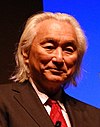
Michio Kaku on George Gamow
“Take a look at George Gamow, who is now recognized as one of the great cosmologists of the last hundred years. I speculate that he probably didn't win the Nobel Prize because people could not take him seriously. He wrote children's books. His colleagues have publicly stated his writing children's books on science had an adverse effect on his scientific reputation, and people could not take him seriously when he and his colleagues proposed that there should be a cosmic background radiation, which we now know to be one of the greatest discoveries of 20th-century physics.”
Paul Dirac on George Gamow
“Gamow was rather childlike, always wanting to play, and introducing a sort of light humor into all occasions. He was very fond of drawing pictures of Mickey Mouse. He added a lot to the entertainment that we had. He had some good ideas, applications which led to important developments in quantum theory, but I do not think he did any work which was very deep.”

Professor William C. Parke on George Gamow
“If contribution in life is measured by the influence of a person's best ideas, then George Gamow's contribution has been immense. He explained radioactive decay, described reaction mechanisms and rates in the interior of stars, proposed how the elements were made, and suggested how DNA might provide the code for protein synthesis. Those topics have evolved into major fields of science...”
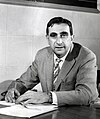
Edward Teller on George Gamow
“Gamow was fantastic in his ideas. He was right, he was wrong. More often wrong than right. Always interesting; … and when his idea was not wrong it was not only right, it was new.”
Stanislaw Ulam on George Gamow
“By an incredible coincidence, Gamow and Edward Condon, who had discovered simultaneously and independently the explanation of radioactivity (one in Russia, the other in this country), came to spend the last ten years of their lives within a hundred yards of each other in Boulder.”

About George Gamow
George Gamow pronounced "GAM-off" (March 4 1904 – August 19 1968) was an American physicist and cosmologist of Russian descent. He developed the Big Bang theory of cosmology, using it to predict the existence of Cosmic background radiation, and his insight that DNA nucleotides probably formed "a triplet code of four symbols" was influential on very important research and discoveries in genetics.