Link Copied!
W. Brian Arthur Quotes (1946-)
Author

About W. Brian Arthur
William Brian Arthur (born 21 July 1946) is an economist, Emeritus Professor of Economics and Population Studies at Stanford University, external faculty member at the Santa Fe Institute, and a Visiting Researcher at the Intelligent Systems Lab at PARC. He is an authority on economics in relation to complexity theory, technology and financial markets, and is credited with influencing and describing the modern theory of increasing returns, and the invention of the El Farol Bar problem.
Best W. Brian Arthur Quotes
Shortest
Earliest
Explore our curated collection of the most famous and impactful W. Brian Arthur quotes.
“[Market outcomes] depends on the cumulation of random events.”
“More than anything else technology creates our world. It creates our wealth, our economy, our very way of being.”

“Increasing-returns economics has roots that go back 70 years or more, but its application to the economy as a whole is largely new.”
“A technology that by chance gains an early lead in adoption may eventually 'corner the market' of potential adopters, with the other technologies becoming locked out.”
“Where we observe the predominance of one technology or one economic outcome over its competitors we should thus be cautious of any exercise that seeks the means by which the winner's innate 'superiority' came to be translated into adoption.”
“As we begin to understand complex systems, we begin to understand that we’re part of an ever-changing, interlocking, non-linear, kaleidoscopic world.”
“Right after we published our first findings, we started getting letters from all over the country saying, "You know, all you guys have done is rediscover Austrian economics"… I admit I wasn't familiar with Hayek and von Mises at the time. But now that I've read them, I can see that this is essentially true.”
“Our deepest hope as humans lies in technology; but our deepest trust lies in nature. These forces are like tectonic plates grinding inexorably into each other in one, long, slow collision.
This collision is not new, but more than anything else it is defining our era. Technology is steadily creating the dominant issues and upheavals of our time.”
This collision is not new, but more than anything else it is defining our era. Technology is steadily creating the dominant issues and upheavals of our time.”
“This paper has attempted to go beyond the usual static analysis of increasing-returns problems by examining the dynamical process that 'selects' an equilibrium from multiple candidates, by the interaction of economic forces and random 'historical events'. It shows how dynamically, increasing returns can cause the economy gradually to lock itself in to an outcome not necessarily superior to alternatives, not easily altered, and not entirely predictable in advance.”

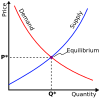
“In many parts of the economy, stabilizing forces appear not to operate. Instead, positive feedback magnifies the effects of small economic shifts; the economic models that describe such effects differ vastly from the conventional ones. Diminishing returns imply a single equilibrium point for the economy, but positive feedback – increasing returns – makes for many possible equilibrium points. There is no guarantee that the particular economic outcome selected from among the many alternatives will be the “best” one.”
“Conventional economic theory is built is built on the assumption of diminishing returns. Economic actions engender a negative feedback that leads to a predictable equilibrium for prices and market shares. Such feedback tends to stabilize the economy because any major changes will be offset by the very reactions they generate. The high oil prices of the 1970s encouraged energy conservation and increased oil exploration, precipitating a predictable drop in prices by the early 1980s. According to conventional theory, the equilibrium marks the “best” outcome possible under the circumstances: the most efficient use and allocation of resources.”
“The type of rationality we assume in economics — perfect, logical, deductive rationality — is extremely useful in generating solutions to theoretical problems. But it demands much of human behavior — much more in fact than it can usually deliver. If we were to imagine the vast collection of decision problems economic agents might conceivably deal with as a sea or an ocean, with the easier problems on top and more complicated ones at increasing depth, then deductive rationality would describe human behavior accurately only within a few feet of the surface. For example, the game Tic-Tac-Toe is simple, and we can readily find a perfectly rational, minimax solution to it. But we do not find rational “solutions” at the depth of Checkers; and certainly not at the still modest depths of Chess and Go.”
“Complexity theory is really a movement of the sciences. Standard sciences tend to see the world as mechanistic. That sort of science puts things under a finer and finer microscope. In biology the investigations go from classifying organisms to functions of organisms, then organs themselves, then cells, and then organelles, right down to protein and enzymes, metabolic pathways, and DNA. This is finer and finer reductionist thinking.
The movement that started complexity looks in the other direction. It’s asking, how do things assemble themselves? How do patterns emerge from these interacting elements? Complexity is looking at interacting elements and asking how they form patterns and how the patterns unfold. It’s important to point out that the patterns may never be finished. They’re open-ended. In standard science this hit some things that most scientists have a negative reaction to. Science doesn’t like perpetual novelty.”
The movement that started complexity looks in the other direction. It’s asking, how do things assemble themselves? How do patterns emerge from these interacting elements? Complexity is looking at interacting elements and asking how they form patterns and how the patterns unfold. It’s important to point out that the patterns may never be finished. They’re open-ended. In standard science this hit some things that most scientists have a negative reaction to. Science doesn’t like perpetual novelty.”

“Our understanding of how markets and businesses operate was passed down to us more than a century ago by a handful of European economists — Alfred Marshall in England and a few of his contemporaries on the continent. It is an understanding based squarely upon the assumption of diminishing returns: products or companies that get ahead in a market eventually run into limitations, so that a predictable equilibrium of prices and market shares is reached. The theory was roughly valid for the bulk-processing, smokestack economy of Marshall’s day. And it still thrives in today’s economics textbooks. But steadily and continuously in this century, Western economies have undergone a transformation from bulk - material manufacturing to design and use of technology — from processing of resources to processing of information, from application of raw energy to application of ideas. As this shift has occurred, the underlying mechanisms that determine economic behavior have shifted from ones of diminishing to ones of increasing returns.”

“The inductive-reasoning system I have described above consists of a multitude of “elements” in the form of belief-models or hypotheses that adapt to the aggregate environment they jointly create. Thus it qualifies as an adaptive complex system. After some initial learning time, the hypotheses or mental models in use are mutually co-adapted. Thus we can think of a consistent set of mental models as a set of hypotheses that work well with each other under some criterion—that have a high degree of mutual adaptedness. Sometimes there is a unique such set, it corresponds to a standard rational expectations equilibrium, and beliefs gravitate into it. More often there is a high, possibly very high, multiplicity of such sets. In this case we might expect inductive reasoning systems in the economy—whether in stock-market speculating, in negotiating, in poker games, in oligopoly pricing, in positioning products in the market—to cycle through or temporarily lock into psychological patterns that may be non-recurrent, path-dependent, and increasingly complicated. The possibilities are rich.”
W. Brian Arthur Quotes by Topic
Find exactly what you are looking for by browsing this categorized list of W. Brian Arthur quotes by topic.
W. Brian Arthur on Complexity economics 2 quotes
“Right after we published our first findings, we started getting letters from all over the country saying, "You know, all you guys have done is rediscover Austrian economics"… I admit I wasn't familiar with Hayek and von Mises as the time. But now that I've read them, I can see that this is essentially true.”

W. Brian Arthur on Pattern
“Complexity is looking at interacting elements and asking how they form patterns and how the patterns unfold. It’s important to point out that the patterns may never be finished. They’re open-ended. In standard science this hit some things that most scientists have a negative reaction to. Science doesn’t like perpetual novelty.”

W. Brian Arthur on Economic model
“In many parts of the economy, stabilizing forces appear not to operate. Instead, positive feedback magnifies the effects of small economic shifts; the economic models that describe such effects differ vastly from the conventional ones. Diminishing returns imply a single equilibrium point for the economy, but positive feedback – increasing returns – makes for many possible equilibrium points. There is no guarantee that the particular economic outcome selected from among the many alternatives will be the “best” one.”

W. Brian Arthur on Decision-making
“The type of rationality we assume in economics — perfect, logical, deductive rationality — is extremely useful in generating solutions to theoretical problems. But it demands much of human behavior — much more in fact than it can usually deliver. If we were to imagine the vast collection of decision problems economic agents might conceivably deal with as a sea or an ocean, with the easier problems on top and more complicated ones at increasing depth, then deductive rationality would describe human behavior accurately only within a few feet of the surface. For example, the game Tic-Tac-Toe is simple, and we can readily find a perfectly rational, minimax solution to it. But we do not find rational “solutions” at the depth of Checkers; and certainly not at the still modest depths of Chess and Go.”
W. Brian Arthur on Bounded rationality
“The type of rationality we assume in economics — perfect, logical, deductive rationality — is extremely useful in generating solutions to theoretical problems. But it demands much of human behavior — much more in fact than it can usually deliver. If we were to imagine the vast collection of decision problems economic agents might conceivably deal with as a sea or an ocean, with the easier problems on top and more complicated ones at increasing depth, then deductive rationality would describe human behavior accurately only within a few feet of the surface. For example, the game Tic-Tac-Toe is simple, and we can readily find a perfectly rational, minimax solution to it. But we do not find rational “solutions” at the depth of Checkers; and certainly not at the still modest depths of Chess and Go.”

W. Brian Arthur on Systems theory
“Complexity theory is really a movement of the sciences. Standard sciences tend to see the world as mechanistic. That sort of science puts things under a finer and finer microscope. In biology the investigations go from classifying organisms to functions of organisms, then organs themselves, then cells, and then organelles, right down to protein and enzymes, metabolic pathways, and DNA. This is finer and finer reductionist thinking. The movement that started complexity looks in the other direction. It’s asking, how do things assemble themselves? How do patterns emerge from these interacting elements? Complexity is looking at interacting elements and asking how they form patterns and how the patterns unfold. It’s important to point out that the patterns may never be finished. They’re open-ended. In standard science this hit some things that most scientists have a negative reaction to. Science doesn’t like perpetual novelty.”
W. Brian Arthur on Complexity
“Complexity theory is really a movement of the sciences. Standard sciences tend to see the world as mechanistic. That sort of science puts things under a finer and finer microscope. In biology the investigations go from classifying organisms to functions of organisms, then organs themselves, then cells, and then organelles, right down to protein and enzymes, metabolic pathways, and DNA. This is finer and finer reductionist thinking. The movement that started complexity looks in the other direction. It’s asking, how do things assemble themselves? How do patterns emerge from these interacting elements? Complexity is looking at interacting elements and asking how they form patterns and how the patterns unfold. It’s important to point out that the patterns may never be finished. They’re open-ended. In standard science this hit some things that most scientists have a negative reaction to. Science doesn’t like perpetual novelty.”
W. Brian Arthur on Complex adaptive systems
“The inductive-reasoning system I have described above consists of a multitude of “elements” in the form of belief-models or hypotheses that adapt to the aggregate environment they jointly create. Thus it qualifies as an adaptive complex system. After some initial learning time, the hypotheses or mental models in use are mutually co-adapted. Thus we can think of a consistent set of mental models as a set of hypotheses that work well with each other under some criterion—that have a high degree of mutual adaptedness. Sometimes there is a unique such set, it corresponds to a standard rational expectations equilibrium, and beliefs gravitate into it. More often there is a high, possibly very high, multiplicity of such sets. In this case we might expect inductive reasoning systems in the economy—whether in stock-market speculating, in negotiating, in poker games, in oligopoly pricing, in positioning products in the market—to cycle through or temporarily lock into psychological patterns that may be non-recurrent, path-dependent, and increasingly complicated. The possibilities are rich.”

What W. Brian Arthur Said About Others
Discover personal opinions W. Brian Arthur shared regarding contemporaries.
W. Brian Arthur on Friedrich Hayek
“Right after we published our first findings, we started getting letters from all over the country saying, "You know, all you guys have done is rediscover Austrian economics" … I admit I wasn't familiar with Hayek and von Mises as the time. But now that I've read them, I can see that this is essentially true.”

W. Brian Arthur on Alfred Marshall
“Our understanding of how markets and businesses operate was passed down to us more than a century ago by a handful of European economists — Alfred Marshall in England and a few of his contemporaries on the continent. It is an understanding based squarely upon the assumption of diminishing returns: products or companies that get ahead in a market eventually run into limitations, so that a predictable equilibrium of prices and market shares is reached. The theory was roughly valid for the bulk-processing, smokestack economy of Marshall’s day. And it still thrives in today’s economics textbooks. But steadily and continuously in this century, Western economies have undergone a transformation from bulk - material manufacturing to design and use of technology — from processing of resources to processing of information, from application of raw energy to application of ideas. As this shift has occurred, the underlying mechanisms that determine economic behavior have shifted from ones of diminishing to ones of increasing returns.”

Quotes About W. Brian Arthur
Gain deeper perspective through quotes about W. Brian Arthur from others.
Kenneth J. Arrow on W. Brian Arthur
“Paul Krugman's attack on Brian Arthur ("The Legend of Arthur") requires a correction of its misrepresentations of fact. Arthur is a reputable and significant scholar whose work is indeed having influence in the field of industrial organization and in particular public policy toward antitrust policy in hightech industries. Krugman admits that he wrote the article because he was "just pissed off," not a very good state for a judicious statement of facts, as his column shows.”
Russell C. Eberhart on W. Brian Arthur
“The El Farol Bar problem Economist Brian Arthur (1994) noted that it is impossible for people to reason deductively in complex situations; there are just too many linkages of facts for anyone to keep them straight.”
About W. Brian Arthur
William Brian Arthur (born 21 July 1946) is an economist, Emeritus Professor of Economics and Population Studies at Stanford University, external faculty member at the Santa Fe Institute, and a Visiting Researcher at the Intelligent Systems Lab at PARC. He is an authority on economics in relation to complexity theory, technology and financial markets, and is credited with influencing and describing the modern theory of increasing returns, and the invention of the El Farol Bar problem.