Link Copied!
Timur Quotes (1336-1405)
Leader, Mathematician


About Timur
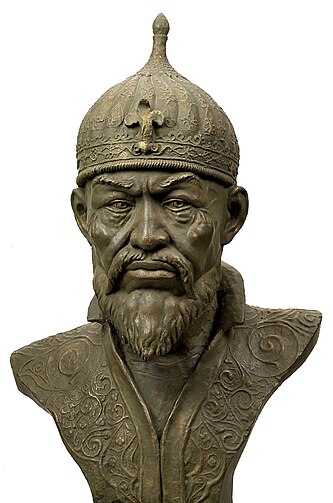
Timur (9 April 1336 – 18 February 1405), historically known as Amir Timur Gurkani and Tamerlane, was a Turco-Mongol conqueror. He founded Timurid Empire in Persia and Central Asia, and is widely regarded as one of the greatest military commanders in history. Referred to himself as the "Sword of Islam" and son-in-law of Genghis Khan, Timur patronized educational and Islamic institutions. He converted nearly all the Borjigin leaders to Islam during his lifetime. He was the ancestor of Sultan Ulugh Begh, an astronomer and mathematician, and Babur, the founder of the Mughal Empire.
Timur Quotes by Topic
Find exactly what you are looking for by browsing this categorized list of Timur quotes by topic.

What Timur Said About Others
Discover personal opinions Timur shared regarding contemporaries.
Timur on Jat people
“On the 8th of the month I marched from Ahruni, through the jungle to a village called Tohana. In answer to the inquiries I made about the inhabitants, I learned that they were a robust race, and were called Jats. They were Musulmans only in name and had not their equals in theft and highway robbery. They plundered caravans upon the road, and were a terror to Musulmans and travellers. They had now abandoned the village and had fled to the sugarcane fields, the valleys, and the jungles. When these facts reached my ears I prepared a force which I placed under the direction of Tokal Bahadur, son of the Hindu Karkarra, and sent it against the Jats. They accordingly marched into the sugarcanes and jungles. I also sent Maulana Nasirud din in pursuit of them. When these forces overtook the Jats they put 200 to the sword and made the rest prisoners. A large stock of cattle was captured, and my soldiers returned to camp. It was again brought to my knowledge that these turbulent Jats were as numerous as ants or locusts, and that no traveller or merchant passed unscathed from their hands. They had now taken flight, and had gone into jungles and deserts hard to penetrate. A few of them had been killed, but it was my fixed determination to clear from thieves and robbers every country that I subdued, so that the servants of God, and Musulmans and travellers might be secure from their violence. My great object in invading Hindustan had been to wage a religious war against the infidel Hindus, and it now appeared to me that it was necessary for me to put down these Jats and to deliver travellers from their hands. I consequently placed the care of the baggage and of all the plunder which had been gained in my victories in the charge of Amir Sulaiman Shah, to convey it with the heavy baggage to the town of Samana. On the 9th of the month I despatched the baggage from Tohana, and on the same day I marched into the jungles and wilds, and slew 2,000 demon-like Jats. I made their wives and children captives, and plundered their cattle and property. Thus I delivered the country from the terror it had long suffered at the hands of the marauding Jats.”
Quotes About Timur
Gain deeper perspective through quotes about Timur from others.
Kuvempu. Poem written on Timur
Tamerlane’s biographer Yazdi on Timur
“In the same manner, God, who was pleased to purge the world, made use of a medicine which was both sweet and bitter, to wit the clemency and the wrath of the incomparable Temur; and to that effect inspired in him an ambition to conquer all Asia and to expel the several tyrants thereof. He established peace and security in this part of the world so that a single man might carry a silver basin filled with gold from the east of Asia to the west. But yet he could not accomplish this great affair without bringing in some measure upon the places he conquered destruction, captivity and plunder, which are the concomitants of victory.119”
Will Durant on Timur
“Their first conqueror was Tamerlane himself—more properly Timur-i-lang—a Turk who had accepted Islam as an admirable weapon, and had given himself a pedigree going back to Genghis Khan, in order to win the support of his Mongol horde. Having attained the throne of Samarkand and feeling the need of more gold, it dawned upon him that India was still full of infidels. His generals, mindful of Moslem courage, demurred, pointing out that the infidels who could be reached from Samarkand were already under Mohammedan rule. Mullahs learned in the Koran decided the matter by quoting an inspiring verse: “Oh Prophet, make war upon infidels and unbelievers, and treat them with severity.”83 Thereupon Timur crossed the Indus (1398), massacred or enslaved such of the inhabitants as could not flee from him, defeated the forces of Sultan Mahmud Tughlak, occupied Delhi, slew a hundred thousand prisoners in cold blood, plundered the city of all the wealth that the Afghan dynasty had gathered there, and carried it off to Samarkand with a multitude of women and slaves, leaving anarchy, famine and pestilence in his wake.”

A.L. Srivastava quoted on Timur
“Srivastava describes what transpired after Timur's forces occupied Delhi on December 18, 1398: The citizens of the capital, headed by the ulema, waited on the conqueror and begged quarter. Timur agreed to spare the citizens; but, owing to the oppressive conduct of the soldiers of the invading force, the people of the city were obliged to offer resistance. Timur now ordered a general plunder and massacre which lasted for several days. Thousands of the citizens of Delhi were murdered and thousands were made prisoners. A historian writes: “High towers were built with the head of the Hindus, and their bodies became the food of ravenous beasts and birds…such of the inhabitants who escaped alive were made prisoners.”... He then proceeded along the Sivalik Hills to Kangara , plundering and sacking that town and Jammu - everywhere the inhabitants being slaughtered like cattle.”
Srivastava quoted on Timur
“Srivastava summarizes India's devastated condition following Timur's departure: Timur left [India] prostrate and bleeding. There was utter confusion and misery throughout northern India. [India's] northwestern provinces, including northern tracts of Rajasthan and Delhi, were so thoroughly ravaged, plundered and even burnt that it took these parts many years, indeed, to recover their prosperity. Lakhs [hundreds of thousands] of men, and in some cases, many women and children, too, were butchered in cold blood. The rabi crops [grown in October–November, harvested around March, including barley, mustard, and wheat] standing in the field were completely destroyed for many miles on both sides of the invader's long and double route from the Indus to Delhi and back. Stores of grain were looted or destroyed. Trade, commerce and other signs of material prosperity disappeared. The city of Delhi was depopulated and ruined. It was without a master or a caretaker. There was scarcity and virulent famine in the capital and its suburbs. This was followed by a pestilence caused by the pollution of the air and water by thousands of uncared-for dead bodies. In the words of the historian Badaoni, “those of the inhabitants who were left died (of famines and pestilence), while for two months not a bird moved wing in Delhi.””



About Timur
Timur (9 April 1336 – 18 February 1405), historically known as Amir Timur Gurkani and Tamerlane, was a Turco-Mongol conqueror. He founded Timurid Empire in Persia and Central Asia, and is widely regarded as one of the greatest military commanders in history. Referred to himself as the "Sword of Islam" and son-in-law of Genghis Khan, Timur patronized educational and Islamic institutions. He converted nearly all the Borjigin leaders to Islam during his lifetime. He was the ancestor of Sultan Ulugh Begh, an astronomer and mathematician, and Babur, the founder of the Mughal Empire.