Link Copied!
Peter Thiel Quotes (1967-)
Author, Activist, Revolutionary
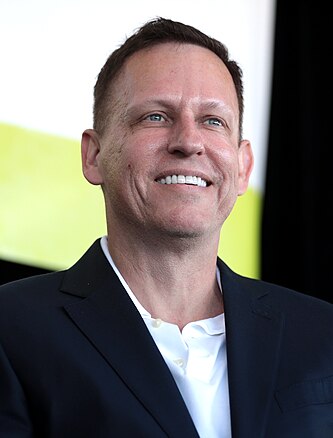



About Peter Thiel
Peter Andreas Thiel (born 11 October 1967) is a German-American billionaire entrepreneur, hedge fund manager, venture capitalist, philanthropist, political activist, and author. A co-founder of PayPal, Palantir Technologies, and Founders Fund, he was the first outside investor in Facebook.
Best Peter Thiel Quotes
Shortest
Earliest
Explore our curated collection of the most famous and impactful Peter Thiel quotes.
“We wanted flying cars, instead we got 140 characters.”
“... the phenomenon of serial entrepreneurship would seem to call into question our tendency to explain success as the product of chance.”
- Peter Thiel, Zero to One

“Confirm [the age of Apple is over]. We know what a smartphone looks like and does. It's not the fault of Tim Cook, but it's not an area where there will be any more innovation.”

“My own answer to the contrarian question is that most people think the future of the world will be defined by globalization, but the truth is that technology matters more. ... In a world of scarce resources, globalization without new technology is unsustainable.”
- Peter Thiel, Zero to One

“The university system in 2014, it's like the Catholic Church circa 1514... You have this priestly class of professors that doesn't do very much work; people are buying indulgences in the form of amassing enormous debt for the sort of the secular salvation that a diploma represents. And what I think is also similar to the 16th century is that the Reformation will come largely from the outside.”
“Whenever I interview someone for a job, I like to ask this question: "What important truth do very few people agree with you on?"
This question sounds easy because it's straightforward. Actually, it's very hard to answer. It's intellectually difficult because the knowledge that everyone is taught in school is by definition agreed upon. And it's psychologically difficulty because anyone trying to answer must say something she knows to be unpopular. Brilliant thinking is rare, but courage is in even shorter supply than genius.”
This question sounds easy because it's straightforward. Actually, it's very hard to answer. It's intellectually difficult because the knowledge that everyone is taught in school is by definition agreed upon. And it's psychologically difficulty because anyone trying to answer must say something she knows to be unpopular. Brilliant thinking is rare, but courage is in even shorter supply than genius.”
- Peter Thiel, Zero to One

“Just as the legal attack on Microsoft was ending Bill Gates's dominance, Steve Jobs's return to Apple demonstrated the irreplaceable value of a company's founder. In some ways, Steve Jobs and Bill Gates were opposites. Jobs was an artist, preferred closed systems, and spent his time thinking about great products above all else; Gates was a businessman, kept his products open, and wanted to run the world. But both were insider/outsiders, and both pushed the companies they started to achievements that nobody else would have been able to match.”
- Peter Thiel, Zero to One
“Every moment in business happens only once. The next Bill Gates will not build an operating system. The next Larry Page or Sergey Brin won't make a search engine. And the next Mark Zuckerberg won't create a social network. If you are copying these guys, you aren't learning from them.
....
Unless they invest in the difficult task of creating new things, American companies will fail in the future no matter how big their profits remain today. What happens when we've gained everything to be had from fine-tuning the old lines of businesses that we've inherited? Unlikely as it sounds, the answer threatens to be far worse than the crisis of 2008. Today's "best practices" lead to dead ends; the best paths are new and untried.”
- Peter Thiel, Zero to One
“I remain committed to the faith of my teenage years: to authentic human freedom as a precondition for the highest good. I stand against confiscatory taxes, totalitarian collectives, and the ideology of the inevitability of the death of every individual. For all these reasons, I still call myself "libertarian." ... But I must confess that over the last two decades, I have changed radically on the question of how to achieve these goals. Most importantly, I no longer believe that freedom and democracy are compatible... The 1920s were the last decade in American history during which one could be genuinely optimistic about politics. Since 1920, the vast increase in welfare beneficiaries and the extension of the franchise to women — two constituencies that are notoriously tough for libertarians — have rendered the notion of "capitalist democracy" into an oxymoron.”

“Zero to One is about how to build companies that create new things. It draws on everything I've learned directly as a co-founder of PayPal and Palantir and then an investor in hundreds of startups, including Facebook and SpaceX. But while I have noticed many patterns, and I relate them here, this book offers no formula for success. The paradox of teaching entrepreneurship is that such a formula necessarily cannot exist; because every innovation is new and unique, no authority can prescribe in concrete terms how be innovative. Indeed, the single most powerful pattern I have noticed is that successful people find value in unexpected places ...”
- Peter Thiel, Zero to One
“Most of our political leaders are not engineers or scientists and do not listen to engineers or scientists. Today a letter from Einstein would get lost in the White House mail room, and the Manhattan Project would not even get started; it certainly could never be completed in three years. I am not aware of a single political leader in the U.S., either Democrat or Republican, who would cut health-care spending in order to free up money for biotechnology research — or, more generally, who would make serious cuts to the welfare state in order to free up serious money for major engineering projects. ... Men reached the moon in July 1969, and Woodstock began three weeks later. With the benefit of hindsight, we can see that this was when the hippies took over the country, and when the true cultural war over Progress was lost. Today's aged hippies no longer understand that there is a difference between the election of a black president and the creation of cheap solar energy; in their minds, the movement towards greater civil rights parallels general progress everywhere. Because of these ideological conflations and commitments, the 1960s Progressive Left cannot ask whether things actually might be getting worse.”

“I think the future is something that always has to be thought of in relatively concrete terms — and it has to be different from the present ... Only something that's different from the present and very concrete can have any sort of charismatic force. Looking at Western Europe, I would say, there are ... basically three plausible futures on offer. Number one is Islamic sharia law, and if you're a woman you get to wear a burqa. Number two is totalitarian AI à la China, where the computers track you in everything you do — all the time — and that's kind of creepy. So the Eye of Sauron, to use the Lord of the Rings reference, is watching you at all times. And then the third one is hyper-environmentalism, where you drive an e-scooter and you recycle. And even though I'm not a radical environmentalist ... if those are the three choices, I think you can understand why the Green Movement is winning — because those are the three visions of the future we have. And the challenge on the conservative or libertarian side is to offer something that is a picture of the future that's different from these two dystopian and one somewhat stagnant one.”

“We're definitely onto something big. The need PayPal answers is monumental. Everyone in the world needs money – to get paid, to trade, to live. Paper money is an ancient technology and an inconvenient means of payment. You can run out of it. It wears out. It can get lost or stolen. In the twenty-first century, people need a form of money that's more convenient and secure, something that can be accessed from anywhere with a PDA or an Internet connection. Of course, what we're calling 'convenient' for American users will be revolutionary for the developing world. Many of these countries' governments play fast and loose with their currencies. They use inflation and sometimes wholesale currency devaluations, like we saw in Russia and several Southeast Asian countries last year [referring to the 1998 Russian and wikipedia:1997 Asian financial crisis, to take wealth away from their citizens. Most of the ordinary people there never have an opportunity to open an offshore account or to get their hands on more than a few bills of a stable currency like U.S. dollars. Eventually PayPal will be able to change this. In the future, when we make our service available outside the U.S. and as Internet penetration continues to expand to all economic tiers of people, PayPal will give citizens worldwide more direct control over their currencies than they ever had before. It will be nearly impossible for corrupt governments to steal wealth from their people through their old means because if they try the people will switch to dollars or Pounds or Yen, in effect dumping the worthless local currency for something more secure.”

Peter Thiel Quotes by Topic
Find exactly what you are looking for by browsing this categorized list of Peter Thiel quotes by topic.
Peter Thiel on Scientists 2 quotes
“The scientists never make any money. They are always deluded into thinking that they live in a just universe that will reward them for their work and for their inventions. And this is probably the fundamental delusion that scientists tend to suffer from in our society.”
Peter Thiel on Monopoly
“[...] the lies that people tell [...] the people who have monopolies pretend not to. [...] you don't want to get regulated by the government [...] So if the monopolists pretend not to have monopolies, the non-monopolists pretend to have monopolies. [...] If you are a non-monopolist, you will rhetorically describe your market as super-small [...] you are the only person in that market.”
- Peter Thiel, S-Z)

Peter Thiel on Universities
“The university system in 2014, it's like the Catholic Church circa 1514... You have this priestly class of professors that doesn't do very much work; people are buying indulgences in the form of amassing enormous debt for the sort of the secular salvation that a diploma represents. And what I think is also similar to the 16th century is that the Reformation will come largely from the outside.”

Peter Thiel on Competition
“I have an idée fixe that I am completely obsessed with on the business side — which is that if you are starting a company, if you are the founder entrepreneur starting a company, you always want to aim for monopoly. ... And you want to always avoid competition. ... Hence competition is for losers. ... What makes a business valuable? ... A business creates X dollars of value and captures Y% of X. X and Y are independent variables.”

Peter Thiel on Federal government of the United States
“Most of our political leaders are not engineers or scientists and do not listen to engineers or scientists. Today a letter from Einstein would get lost in the White House mail room, and the Manhattan Project would not even get started; it certainly could never be completed in three years. I am not aware of a single political leader in the U.S., either Democrat or Republican, who would cut health-care spending in order to free up money for biotechnology research — or, more generally, who would make serious cuts to the welfare state in order to free up serious money for major engineering projects.”

Peter Thiel on Woodstock Festival
“Men reached the moon in July 1969, and Woodstock began three weeks later. With the benefit of hindsight, we can see that this was when the hippies took over the country, and when the true cultural war over Progress was lost. Today's aged hippies no longer understand that there is a difference between the election of a black president and the creation of cheap solar energy; in their minds, the movement towards greater civil rights parallels general progress everywhere. Because of these ideological conflations and commitments, the 1960s Progressive Left cannot ask whether things actually might be getting worse.”
- Peter Thiel, Quotes about the festival)

Peter Thiel on Progress
“Men reached the moon in July 1969, and Woodstock began three weeks later. With the benefit of hindsight, we can see that this was when the hippies took over the country, and when the true cultural war over Progress was lost. Today's aged hippies no longer understand that there is a difference between the election of a black president and the creation of cheap solar energy; in their minds, the movement towards greater civil rights parallels general progress everywhere. Because of these ideological conflations and commitments, the 1960s Progressive Left cannot ask whether things actually might be getting worse.”

Peter Thiel on 1960s
“Men reached the moon in July 1969, and Woodstock began three weeks later. With the benefit of hindsight, we can see that this was when the hippies took over the country, and when the true cultural war over Progress was lost. Today's aged hippies no longer understand that there is a difference between the election of a black president and the creation of cheap solar energy; in their minds, the movement towards greater civil rights parallels general progress everywhere. Because of these ideological conflations and commitments, the 1960s Progressive Left cannot ask whether things actually might be getting worse.”

Peter Thiel on Hippie
“Men reached the moon in July 1969, and Woodstock began three weeks later. With the benefit of hindsight, we can see that this was when the hippies took over the country, and when the true cultural war over Progress was lost. Today's aged hippies no longer understand that there is a difference between the election of a black president and the creation of cheap solar energy; in their minds, the movement towards greater civil rights parallels general progress everywhere. Because of these ideological conflations and commitments, the 1960s Progressive Left cannot ask whether things actually might be getting worse.”
Peter Thiel on Progressivism
“Men reached the moon in July 1969, and Woodstock began three weeks later. With the benefit of hindsight, we can see that this was when the hippies took over the country, and when the true cultural war over Progress was lost. Today's aged hippies no longer understand that there is a difference between the election of a black president and the creation of cheap solar energy; in their minds, the movement towards greater civil rights parallels general progress everywhere. Because of these ideological conflations and commitments, the 1960s Progressive Left cannot ask whether things actually might be getting worse.”

Peter Thiel on Silicon Valley
“... I am always skeptical of copying things. ... Just like you shouldn't try to copy Microsoft or Facebook, copying Silicon Valley is probably also the wrong idea. ... One reason it's the wrong idea is that we don't even actually know what makes Silicon Valley work. Maybe it's the weather. Maybe it's non-compete agreements are not enforced in California. Maybe it is that there are these crazy network effects. ... All kinds of different explanations ... one can give. Even if we wanted to, I am not sure we know what makes it work. And then, I think, even more fundamentally when you are copying something, you are setting yourself up to be defined in a lesser way. If you are the Oxford of Iceland, that's not quite Oxford ... The something of somewhere is often the nothing of nowhere.”

Peter Thiel on Europe
“I think the future is something that always has to be thought of in relatively concrete terms — and it has to be different from the present ... Only something that's different from the present and very concrete can have any sort of charismatic force. Looking at Western Europe, I would say, there are ... basically three plausible futures on offer. Number one is Islamic sharia law, and if you're a woman you get to wear a burqa. Number two is totalitarian AI à la China, where the computers track you in everything you do — all the time — and that's kind of creepy. So the Eye of Sauron, to use the Lord of the Rings reference, is watching you at all times. And then the third one is hyper-environmentalism, where you drive an e-scooter and you recycle. And even though I'm not a radical environmentalist ... if those are the three choices, I think you can understand why the Green Movement is winning — because those are the three visions of the future we have. And the challenge on the conservative or libertarian side is to offer something that is a picture of the future that's different from these two dystopian and one somewhat stagnant one.”
- Peter Thiel, T)

What Peter Thiel Said About Others
Discover personal opinions Peter Thiel shared regarding contemporaries.
Peter Thiel on Donald Trump
Amidst debates over media coverage of Donald Trump during his presidency, this statement highlights a perceived disconnect between how media and voters interpret his words.
“[T]he media always is taking Trump literally. It never takes him seriously, but it always takes him literally. I think a lot of the voters who vote for Trump take Trump seriously, but not literally.”

About Peter Thiel
Peter Andreas Thiel (born 11 October 1967) is a German-American billionaire entrepreneur, hedge fund manager, venture capitalist, philanthropist, political activist, and author. A co-founder of PayPal, Palantir Technologies, and Founders Fund, he was the first outside investor in Facebook.