Link Copied!
Niccolò Machiavelli Quotes (1469-1527)
Philosopher, Poet, Musician
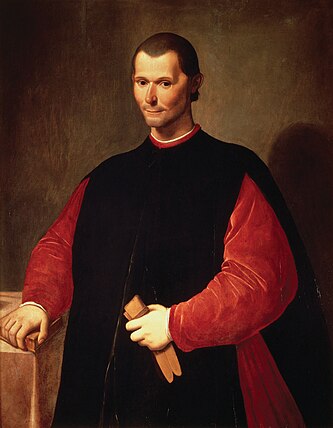






About Niccolò Machiavelli
Niccolò Machiavelli (3 May 1469 – 21 June 1527) was an Italian political philosopher, historian, musician, poet, and romantic comedic playwright. Machiavelli was also a key figure in realist political theory, crucial to European statecraft during the Renaissance.
Best Niccolò Machiavelli Quotes
Shortest
Earliest
Explore our curated collection of the most famous and impactful Niccolò Machiavelli quotes.
“El fine si ha a riguardare in tutte le cose.”
“It is not titles that make men illustrious, but men who make titles illustrious.”

“"The first method for estimating the intelligence of a ruler is to look at the men he has around him."”


“...debbe un uomo prudente entrare sempre per vie battute da uomini grandi, e quelli che sono stati eccellentissimi, imitare...”
“I believe that it is possible for one to praise, without concern, any man after he is dead since every reason and supervision for adulation is lacking.”
“So in all human affairs one notices, if one examines them closely, that it is impossible to remove one inconvenience without another emerging.”

“It is easier for the prince to make friends of those men who were contented under the former government, and are therefore his enemies, than of those who, being discontented with it, were favourable to him and encouraged him to seize it.”

“When Scipio became consul and was keen on getting the province of Africa, promising that Carthage should be completely destroyed, and the senate would not agree to this because Fabius Maximus was against it, he threatened to appeal to the people, for he knew full well how pleasing such projects are to the populace.”
“This return of Republics back to their principles also results from the simple virtue of one man, without depending on any law that excites him to any execution: none the less, they are of such influence and example that good men desire to imitate him, and the wicked are ashamed to lead a life contrary to those examples.”

“The people resemble a wild beast, which, naturally fierce and accustomed to live in the woods, has been brought up, as it were, in a prison and in servitude, and having by accident got its liberty, not being accustomed to search for its food, and not knowing where to conceal itself, easily becomes the prey of the first who seeks to incarcerate it again.”
“I assert once again as a truth to which history as a whole bears witness that men may second their fortune, but cannot oppose it; that they may weave its warp, but cannot break it. Yet they should never give up, because there is always hope, though they know not the end and more towards it along roads which cross one another and as yet are unexplored; and since there is hope, they should not despair, no matter what fortune brings or in what travail they find themselves.”

“The demands of a free populace, too, are very seldom harmful to liberty, for they are due either to the populace being oppressed or to the suspicious that it is going to be oppressed... and, should these impressions be false, a remedy is provided in the public platform on which some man of standing can get up, appeal to the crowd, and show that it is mistaken. And though, as Tully remarks, the populace may be ignorant, it is capable of grasping the truth and readily yields when a man, worthy of confidence, lays the truth before it.”
Niccolò Machiavelli Quotes by Topic
Find exactly what you are looking for by browsing this categorized list of Niccolò Machiavelli quotes by topic.
Niccolò Machiavelli on Medieval II: Total War 18 quotes
View all 18 quotes on Medieval II: Total War →Niccolò Machiavelli on Right to keep and bear arms
Niccolò Machiavelli on Diet
Niccolò Machiavelli on Generalization
“Men are more apt to be mistaken in their generalizations than in their particular observations.”

Niccolò Machiavelli on Law
Niccolò Machiavelli on War
“[T]hat one should never permit a disorder to persist in order to avoid war, for war is not avoided thereby but merely deferred to one's own disadvantage...”
Niccolò Machiavelli on Life
“Everything has contributed to your greatness; you ought to do the rest, God is not willing to do everything, and thus take away our free will and that share of glory which belongs to us.”

Niccolò Machiavelli on Foxes
Niccolò Machiavelli on Acquisition
“The wish to acquire more is admittedly a very natural and common thing; and when men succeed in this they are always praised rather than condemned. But when they lack the ability to do so and yet want to acquire more at all costs, they deserve condemnation for their mistakes.”
Niccolò Machiavelli on Neutrality
“And it will always happen that he who is not your friend will invite you to neutrality, while he who is your friend will call on you to declare yourself openly in arms. Irresolute Princes, to escape immediate danger, commonly follow the neutral path, in most instances to their destruction.”

Niccolò Machiavelli on Fear
“From this arises the question whether it is better to be loved rather than feared, or feared rather than loved. It might perhaps be answered that we should wish to be both: but since love and fear can hardly exist together, if we must choose between them, it is far safer to be feared than loved.”

Niccolò Machiavelli on Ambition
“Whenever men are not obliged to fight from necessity, they fight from ambition; which is so powerful in human breasts, that it never leaves them no matter to what rank they rise. The reason is that nature has so created men that they are able to desire everything but are not able to attain everything.”

What Niccolò Machiavelli Said About Others
Discover personal opinions Niccolò Machiavelli shared regarding contemporaries.
Niccolò Machiavelli on Moses
“Looking first to those who have become Princes by their merit, and not by their good fortune, I say that the most excellent among them were Moses, Cyrus, Romulus, Theseus, and the like … And if their actions and the particular institutions of which they were the authors be studied, they will be found not to differ from those of Moses, instructed though he was by so great a teacher.”

Quotes About Niccolò Machiavelli
Gain deeper perspective through quotes about Niccolò Machiavelli from others.
With such a name on Niccolò Machiavelli
Lord Acton on Niccolò Machiavelli
“He is the earliest conscious and articulate exponent of certain living forces in the present world. Religion, progressive enlightenment, the perpetual vigilance of public opinion, have not reduced his empire, or disproved the justice of his conception of mankind. He obtains a new lease of life from causes that are still prevailing, and from doctrines that are apparent in politics, philosophy, and science. Without sparing censure, or employing for comparison the grosser symptoms of the age, we find him near our common level, and perceive that he is not a vanishing type, but a constant and contemporary influence. Where it is impossible to praise, to defend, or to excuse, the burden of blame may yet be lightened by adjustment and distribution, and he is more rationally intelligible when illustrated by lights falling not only from the century he wrote in, but from our own, which has seen the course of its history twenty-five times diverted by actual or attempted crime.”
Francis Bacon on Niccolò Machiavelli
“We are much beholden to Machiavelli and others, that write what men do, and not what they ought to do. For it is not possible to join serpentine wisdom with the columbine innocency, except men know exactly all the conditions of the serpent; his baseness and going upon his belly, his volubility and lubricity, his envy and sting, and the rest; that is, all forms and natures of evil. For without this, virtue lieth open and unfenced. Nay, an honest man can do no good upon those that are wicked, to reclaim them, without the help of the knowledge of evil.”

Julien Benda on Niccolò Machiavelli
“When Machiavelli advises the Prince to carry out the Machiavellian scheme of action, he invests those actions with no sort of morality or beauty. For him morality remains what it is for everyone else, and does not cease to remain so because he observes (not without melancholy) that it is incompatible with politics. ... For him evil, even if it aids politics, still remains evil. The modern realists are the moralists of realism. For them, the act which makes the State strong is invested with a moral character by the fact that it does so, and this whatever the act may be. The evil which serves politics ceases to be evil and becomes good.”
Isaiah Berlin on Niccolò Machiavelli 2 quotes
“What has been shown by Machiavelli, who is often (like Nietzsche) congratulated for tearing off hypocritical masks, brutally revealing the truth, and so on, is not that men profess one thing and do another (although no doubt he shows this too) but that when they assume that the two ideals are compatible, or perhaps are even one and the same ideal, and do not allow this assumption to be questioned, they are guilty of bad faith (as the existentialists call it, or of “false consciousness,” to use a Marxist formula) which their actual behavior exhibits. Machiavelli calls the bluff not just of official morality—the hypocrisies of ordinary life—but of one of the foundations of the central Western philosophical tradition, the belief in the ultimate compatibility of all genuine values. His own withers are unwrung. He has made his choice. He seems wholly unworried by, indeed scarcely aware of, parting company with traditional Western morality.”

E. H. Carr on Niccolò Machiavelli
“Machiavelli is the first important political realist... The three essential tenets implicit in Machiavelli's doctrine are the foundation-stones of the realist philosophy. In the first place, history is a sequence of cause and effect, whose course can be analysed and understood by intellectual effort, but not (as the utopians believe) directed by "imagination". Secondly, theory does not (as the utopians assume) create practice, but practice theory. In Machiavelli's words, "good counsels, whencesoever they come, are born of the wisdom of the prince, and not the wisdom of the prince from good counsels". Thirdly, politics are not (as the utopians pretend) a function of ethics, but ethics of politics. Men "are kept honest by constraint". Machiavelli recognised the importance of morality, but thought that there could be no effective morality where there was no effective authority. Morality is the product of power. The extraordinary vigour and vitality of Machiavelli's challenge to orthodoxy may be attested by the fact that, more than four centuries after he wrote, the most conclusive way of discrediting a political opponent is still to describe him as a disciple of Machiavelli. Bacon was one of the first to praise him for "saying openly and without hypocrisy what men are in the habit of doing, not what they ought to do".”
John Casey on Niccolò Machiavelli 3 quotes
“For Machiavelli, courage is the highest expression of virtù, and virtù is the possession of whatever qualities are needed "to save the life and preserve the freedom of one's country."”
Robert A. Dahl on Niccolò Machiavelli
“Perhaps the most influential book ever written on the characteristics of men in politics is The Prince, by the great Renaissance Italian Nicolo Machiavelli (1469-1527). Despite its enduring popularity, fascination, and authority it is extremely one-sided and unsystematic.”

Albert O. Hirschman on Niccolò Machiavelli
“In attempting to teach the prince how to achieve, maintain, and expand power, Machiavelli made his fundamental and celebrated distinction between "the effective truth of things" and the "imaginary republics and monarchies that have never been seen nor have been known to exist." The implication was that moral and political philosophers had hitherto talked exclusively about the latter and had failed to provide guidance to the real world in which the prince must operate. This demand for a scientific, positive approach was extended only later from the prince to the individual, from the nature of the state to human nature. Machiavelli probably sensed that a realistic theory of the state required a knowledge of human nature, but his remarks on that subject, while invariably acute, are scattered and unsystematic.”

Victor Hugo on Niccolò Machiavelli
“If one desires to learn at one blow, to what degree of hideousness the fact can attain, viewed at the distance of centuries, let him look at Machiavelli. Machiavelli is not an evil genius, nor a demon, nor a miserable and cowardly writer; he is nothing but the fact. And he is not only the Italian fact; he is the European fact, the fact of the sixteenth century. He seems hideous, and so he is, in the presence of the moral idea of the nineteenth..”
Massimo Introvigne on Niccolò Machiavelli
“The jury is still out, but what Machiavelli described—either to recommend or subtly denounce it—was a diplomacy without conscience. It may look brilliant, but many who commented on Machiavelli noted that hidden in his works is the idea that a diplomacy totally separated from morality and conscience may achieve results occasionally but in most cases, and in the long run, would not work. …However we decide to read him, Machiavelli listed as the three features of effective diplomacy caution, art (meaning the mastery of a number of technical tools), and above all patience.”

Disputed Quotes
Quotes attributed to Niccolò Machiavelli that are questionable.
“When Machiavelli came to the end of his life, he had a vision shortly before giving up the ghost. He saw a small company of poor scoundrels, all in rags, ill-favoured, famished, and, in short, in as bad plight as possible. He was told that these were the inhabitants of paradise, of whom it is written, Beati pauperes, quoniam ipsorum est regnum caelorum.Blessed are the poor, for theirs is the kingdom of heaven After they withdrew, innumerable serious and majestic personages appeared, who seemed to be sitting in a senate-house and dealing with the most important affairs of state. Among them he saw Plato, Aristotle, Seneca, Plutarch, Tacitus, and others of similar character; but he was told at the same time that those venerable personages, notwithstanding their appearance, were the damned, and the souls rejected by heaven, for Sapientia huius saeculi, inimica est Dei.The wisdom of this world is the enemy of God. After this, he was asked to which of the groups he would choose to belong; he answered that he would much rather be in Hell with those great geniuses, to converse with them about affairs of state, than be condemned to the company of the verminous scoundrels that he had first been shown.”
Misattributed Quotes
Quotes mistakenly credited to Niccolò Machiavelli
“I am not interested in preserving the status quo; I want to overthrow it.”
About Niccolò Machiavelli
Niccolò Machiavelli (3 May 1469 – 21 June 1527) was an Italian political philosopher, historian, musician, poet, and romantic comedic playwright. Machiavelli was also a key figure in realist political theory, crucial to European statecraft during the Renaissance.