Link Copied!
Leonid Brezhnev Quotes (1906-1982)
Politician
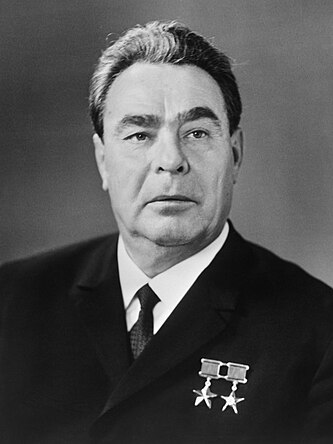
About Leonid Brezhnev
Leonid Ilyich Brezhnev (19 December 1906 – 10 November 1982) was a Soviet politician who led the Soviet Union as General Secretary of the governing Communist Party (1964–1982) and as Chairman of the Presidium of the Supreme Soviet (1960–1964, 1977–1982). His 18-year term as general secretary was second only to Joseph Stalin's in duration.
Best Leonid Brezhnev Quotes
Shortest
Earliest
Explore our curated collection of the most famous and impactful Leonid Brezhnev quotes.

“Soviet people are better off materially and richer spiritually.”


“The rout of fascism, in which the Soviet Union played the decisive role, generated a mighty tide of socio-political changes which swept across the globe.”
“Today progress is so swift in all fields that the education received by young people is only a foundation that requires the constant acquisition of knowledge.”

“We are entirely for the idea that Europe shall be free from nuclear weapons, from medium-range weapons as well as tactical weapons. That would be a real zero option.”
“Our militant union with peoples which still have to carry on an armed struggle against the colonialists constitutes an important element of our line in international affairs.”
“Of late, attempts have been made in the USA — at a high level and in a rather cynical form — to play the "Chinese card" against the USSR. This is a shortsighted and dangerous policy.”
“We stand for the dismantling of foreign military bases. We stand for a reduction of armed forces and armaments in areas where military confrontation is especially dangerous, above all in central Europe.”

“The substance of socialist democracy lies in efficient socialist organisation of all society for the sake of every individual, and in the socialist discipline of every individual for the sake of all society.”
“As you know, I am not a writer but a Party functionary. But like every Communist I consider myself to have been mobilized by Party propaganda and deem it my duty to participate actively in the work of our press.”

“Detente is a readiness to resolve differences and conflicts not by force, not by threats and sabre-rattling, but by peaceful means, at the conference table.”
“Every man must be made to realize that further retreat is impossible. He must realize with his mind and heart that this is a matter of life and death of the Soviet state, of the life and death of the people of our country...the Nazi troops must be stopped now, before it is too late.”

“Under the dictatorship of the proletariat, revisionists and opportunists reflect the pressure of nonproletarian, bourgeois and petty-bourgeois strata, the pressure that results from the force of habit, from the views and vestiges of the past, particularly those that are nationalistic.”
“Modern science and technology have reached a level where there is the grave danger that a weapon even more terrible than nuclear weapons may be developed. The reason and conscience of mankind dictate the need to erect an insuperable barrier barrier to the development of such a weapon.”
“I shall add that only he who has decided to commit suicide can start a nuclear war in the hope of emerging a victor from it. No matter what the attacker might possess, no matter what method of unleashing nuclear war he chooses, he will not attain his aims. Retribution will inevitably ensue.”

“Regarding the dreams of reaching military superiority over the U.S.S.R., one would do better to drop them. If it has to be, the Soviet people would find the possibility to undertake any additional efforts and to do everything that is necessary to guarantee a reliable defense of their country.”
“We Communists have got to string along with the capitalists for a while. We need their agriculture and their technology. But we are going to continue massive military programs. . . (soon) we will be in a position to return to a much more aggressive foreign policy designed to gain the upper-hand. . .”

“We want the world socialist system to be a well-knit family of nations, building and defending the new society together, and mutually enriching each other with experience and knowledge, a family, strong and united, which the people of the world would regard as the prototype of the future world community of free nations.”

“Our Party supports and will continue to support peoples fighting for their freedom. In so doing, the Soviet Union does not look for advantages, does not hunt for concessions, does not seek political domination and is not after military bases. We act as we are bid by our revolutionary conscience, our communist convictions.”
“It stands to the Party’s credit that millions upon millions of Soviet men of every nation and nationality have adopted internationalism—once the ideal of a handful of Communists—as their deep conviction and standard of behaviour. This was a true revolution in social thinking, and one which it is hard to overestimate.”
“One of our primary tasks is to foster in people a desire to attain lofty social goals, to foster in them ideological conviction and a truly creative attitude to work. This is a very important area of struggle for communism, and the economic as well as the socio-political development of the country will be increasingly dependent on our successes in this area.”
“Modern production sets rapidly rising demands not only on machines, on technology, but also and primarily on the workers, on those who create these machines and control this technology. For ever larger segments of workers specialised knowledge and a high degree of professional training, man’s general cultural standard, are becoming an obligatory condition of successful work.”

Leonid Brezhnev Quotes by Topic
Find exactly what you are looking for by browsing this categorized list of Leonid Brezhnev quotes by topic.
Leonid Brezhnev on Soviet Union 9 quotes
“Soviet people are better off materially and richer spiritually.”

Leonid Brezhnev on Fascism
“The rout of fascism, in which the Soviet Union played the decisive role, generated a mighty tide of socio-political changes which swept across the globe.”

Leonid Brezhnev on Marxism–Leninism
“The general line of our party worked out by its 20th, 21st and 22d congresses is a Leninist line. It was, is and will be the only immutable line in the entire domestic and foreign policy of the Communist party and the Soviet state. The party sees its supreme duty in serving the people, in strengthening the might of our Socialist country, adding to its glory and prestige, consistently and unswervingly implementing the great ideas of Marxism-Leninism.”
Leonid Brezhnev on Military history of Russia
“The Soviet people are perhaps second to none when it comes to knowing what war means. In World War II we won a victory of world historic significance. But in that war over 20 million Soviet citizens died, 70,000 of our towns and villages were devastated, and one third of our national wealth was destroyed. The war wounds have now been healed. Today the Soviet Union is a mightier and more prosperous country than ever before. But we remember the lessons of the war only too well, and that is why the peoples of the Soviet Union value peace so highly; that is why they strongly approve the peace policy of our Party and Government.”
Leonid Brezhnev on Cold War
“Some people in the West now express anxiety over the fact that the Soviet Union has still further outstripped the United States in the “space race.” Some people say that the United States is two years behind, others mention five years. Of course, it is pleasure for us that our country is ahead in the exploration of outer space. But we Soviet people do not regard our space research as an end in itself, as some kind of “race.” In the great and serious cause of the exploration and development of outer space, the spirit of frantic gamblers is alien to us. We see in this cause part and parcel of the tremendous constructive work the Soviet people are doing in conformity with the general line of our party in all spheres of the economy, science and culture, in the name of man, for the sake of man.”

Leonid Brezhnev on Russia–United States relations
“On the eve of the New Year 1964, we want to extend to the American people and you and your family personally on behalf of the people of the Soviet Union and ourselves New Year's greetings and very best wishes. The past year was marked by a significant improvement in the approach to the solutions of urgent international problems and in the development of Soviet-American relations. The conclusion of the Moscow treaty limiting nuclear testing was a good beginning, and demonstrable evidence of the fact that, given a realistic assessment of the actual world situation, cooperation of governments in resolving urgent international problems and achieving mutually satisfactory agreements is entirely possible. We would like to hope that the coming year will be marked by further significant successes, both in the resolution of important international problems and the improvement of relations between our countries, in the interest of the Soviet and American peoples and the interests of strengthening world peace.”

What Leonid Brezhnev Said About Others
Discover personal opinions Leonid Brezhnev shared regarding contemporaries.
Leonid Brezhnev on Jawaharlal Nehru
“It was with a feeling of great sorrow that we learned of the death of the outstanding statesman of our time, the great and sincere friend of the Soviet Union, Indian Prime Minister Jawaharlal Nehru. The name of Jawaharal Nehru enjoyed the tremendous respect and love of the Soviet people, who knew him as a tested and wise leader of the Indian people's struggle for national independence and the rebirth of their country, and as an active fighter against colonialism. Jawaharal Nehru is known as an outstanding statesman of modern times who devoted his entire life to the struggle for strengthening friendship and cooperation among peoples and for the progress of humanity. He was a passionate fighter for peace in the world and an ardent champion of principles of peaceful coexistence of states. He was the inspirer of the nonalignment policy promoted by the Indian Government. This reasonable policy won India respect and, due to it, India is now occupying a worthy place in the international arena. In our country Jawaharlal Nehru is well known as a sincere friend of the Soviet Union a statesman who has done much for strengthening and developing friendship and cooperation between the Soviet and Indian peoples. All those who happened to meet J. Nehru and speak to him were especially aware of his deep humaneness, combined with statesmanship and worldly wisdom . In these mournful days for the Indian people and all the friends of India, we express our deep-felt and sincere condolences to the Indian people and government. We ask to convey our sincere condolences to the family of the deceased.”
Quotes About Leonid Brezhnev
Gain deeper perspective through quotes about Leonid Brezhnev from others.
Sheila Fitzpatrick on Leonid Brezhnev
“Khrushchev had rashly promised that the country would achieve full communism by 1980. The more cautious Brezhnev shelved this in favour of ‘developed socialism’, an anodyne formulation that stood, in effect, for the economic and political system that already existed in the Soviet Union. But that was fine by the majority of Soviet citizens. They wanted more consumer goods for themselves, not communally shared goods, as would be delivered under the Communist model. It was a post-revolutionary moment, with the Revolution firmly consigned to history.”
Jacob Javits on Leonid Brezhnev
“We say there is a world of difference, a chasm, between carrying on the foreign policy and plunging the Nation into war. If Mr. Brezhnev has the authority do that, we disapprove of it. We disapprove of the system under which Mr. Brezhnev operates. Indeed, if that system can have anything said about it, that is exactly what is threatening the world and what is threatening the detente. We reject that. The House has rejected it and we should reject it.”
Richard Nixon “Richard Nixon’s on Leonid Brezhnev
Muhammad Reza Pahlavi on Leonid Brezhnev
“All ideological differences set apart, I cannot help having a sincere admiration for Mr Brezhnev. He is to all appearances an outstanding diplomat. He abides by the policy of peaceful co-existence as laid down by the Helsinki agreement. And he has succeeded in making his country as powerful as it is today: the first nuclear power in the world, soon to be he first maritime power; as for the land and air forces, their superiority is so great that it bears no comparison.”
Edward Pearce on Leonid Brezhnev
“When the Soviet Union came to be run by a valetudinarian mafioso like Brezhnev, the thing itself had fallen into self-contempt.”
Richard Pipes on Leonid Brezhnev
“In 1964, his colleagues deposed Khrushchev: the establishment had grown weary of his restless activity and yearned, in the words of his son, “for calm and stability.” His place was taken by Leonid Brezhnev, who would serve as first secretary for eighteen years, even though late in life he showed distinct signs of senility: the machine simply ground on. Year by year, the Soviet regime decayed. The economy stagnated, falling ever more behind those of the advanced industrial countries. With fear of draconian punishment gone, workers had little incentive to exert themselves: as they cynically explained, “They pretend to pay us and we pretend to work.” Workers who showed zeal risked being accused by their colleagues of “provocation” and roughed up. The central planning apparatus concentrated on doing what it knew best: turning out the same goods and in the process missing out on such innovations as plastics, synthetic fibers, and, above all, computers. Insistence on tight control of information meant that the USSR did not participate in advances in information technology, which revolutionized Western economies. The living standards of ordinary citizens, though better than in Stalin’s day, fell below even the low minimal norms set by the state: thus in the late 1980s, nearly one-half of the Soviet population earned less than ten dollars a month. Drunkenness was endemic: the Soviet Union could boast the highest rate of alcohol consumption in the world, as well as the highest rate of alcoholic deaths. Nothing illustrated better the ebbing vitality of its citizens than demographic statistics: the population, which under tsarism had grown at the most rapid rate in Europe, by the 1970s showed a deficit, as more Russians (and Ukrainians) died each year than were born.”
Ronald Powaski on Leonid Brezhnev
“The humiliation Krushchev suffered at the hands of Kennedy during the [Cuban] missile crisis contributed to his removal from power in October 1964. The new Soviet leadership, headed by Leonid Brezhnev, was determined to avoid a repetition of the humiliation Krushchev had experienced. Beginning in early 1965, the Kremlin embarked on a massive expansion of the Soviet nuclear arsenal that would enable the Soviet Union to achieve nuclear parity with the United States by the end of the decade.”
Ronald Reagan on Leonid Brezhnev 2 quotes
“You know, Michael, what I really wanted was to get the presidential nomination and then win the presidency in November because I was looking forward to negotiating the SALT treaty with Brezhnev. It has been a long time since an American president has stood up to the Soviet Union. It seems that every time we get into negotiations, the Soviets are telling us what we are going to have to give up in order for us to get along with them, and we forget who we are. I wanted to become president of the United States, so I could sit down with Brezhnev. And I was going to let him pick out the size of the table, and I was going to listen to him tell me, the American president, what we were going to have to give up. And I was going to listen to him for maybe twenty minutes, and then I was going to get up from my side of the table, walk around to the other side, and lean over and whisper in his ear "Nyet.' It has been a long time since they've heard 'nyet' from an American president.”

David Reynolds on Leonid Brezhnev
“The ultimate beneficiary of Nixon’s summitry was Leonid Brezhnev. The Soviet party leader had staked his bid for outright leadership on a policy of peaceful coexistence with the United States. That made sense for economic and defense reasons, not to mention the looming threat from China. In the spring of 1972 Brezhnev let nothing, not even the American mining of North Vietnam, get in the way of a summit. The arms control agreements signed in Moscow in May silenced his critics and apparently confirmed the Soviet Union’s equality with the United States. The statement of Basic Principles also suggested that the Americans were accepting détente on Soviet terms. Had Nixon remained potent in the second term he might have held the Kremlin to account, as he believed had not been done after Yalta. Instead his crumbling presidency gave the Soviets and their allies an increasingly free hand to act as they pleased. By the middle of 1975 communist forces controlled all of Indochina. Over the next few years the Soviets extended their influence in eastern and southern Africa, in ways that fitted their understanding of détente— a world made safe for class struggle—but also undermined support for the process in the United States. In 1976 Gerald Ford, Nixon’s successor, banned the word “détente” from the official diplomatic lexicon. Nixon’s failure, in other words, relegated not merely summitry but diplomacy to the back burner. Dialogue with Moscow atrophied. And after the Brezhnev Politburo sent troops into Afghanistan at the end of 1979, Soviet-American relations degenerated into what was dubbed a “new cold war.””
Robert Service on Leonid Brezhnev 2 quotes
“When he [Brezhnev] succeeded Khrushchev, he was still a vigorous politician who expected to make the Party and government work more effectively...But his General Secretaryship had turned into a ceremonial reign that had brought communism into its deepest contempt since 1917.”

Dmitry Peskov(2011) on Leonid Brezhnev
“Brezhnev wasn’t a minus for the history of our country, he was a huge plus, He laid a foundation for the country’s economics and agriculture.”

Misattributed Quotes
Quotes mistakenly credited to Leonid Brezhnev
About Leonid Brezhnev
Leonid Ilyich Brezhnev (19 December 1906 – 10 November 1982) was a Soviet politician who led the Soviet Union as General Secretary of the governing Communist Party (1964–1982) and as Chairman of the Presidium of the Supreme Soviet (1960–1964, 1977–1982). His 18-year term as general secretary was second only to Joseph Stalin's in duration.