Morris Kline, Mathematical Thought from Ancient to Modern Times (1972)
“
Paralleling what happened in France, an English group centered about John Wallis began in 1645 to hold meetings in Gresham College, London, These men emphasized mathematics and astronomy. The group was given a formal charter by Charles II in 1662 and adopted the name of the Royal Society of London for the Promotion of Natural Knowledge.
— Morris Kline
What It Means
This is a placeholder explanation generated by the low-overhead model. It interprets "Paralleling what happened in France, an English group centered about John Wallis began in 1645 to hold meetings in Gresham College, London, These men emphasized mathematics and astronomy. The group was given a formal charter by Charles II in 1662 and adopted the name of the Royal Society of London for the Promotion of Natural Knowledge." in the context of "Morris Kline, Mathematical Thought from Ancient to Modern Times (1972)" to mean that wisdom is timeless.
Source: Wikiquote: "John Wallis" (Quotes about Wallis)
The 'What it means' explanation text was generated by Google Gemini Flash (accessed January 18, 2026). https://gemini.google.com/app
Tags
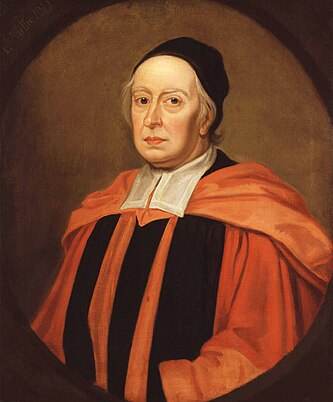
About John Wallis
John Wallis (November 23, 1616 – October 28, 1703) was an English clergyman and mathematician who is given partial credit for the development of infinitesimal calculus. Between 1643 and 1689 he served as chief cryptographer for Parliament and, later, the royal court. He is credited with introducing the symbol ∞ to represent the concept of infinity. He similarly used 1/∞ for an infinitesimal. He was a contemporary of Newton and one of the greatest intellectuals of the early renaissance of mathematics.
View all quotes →