Felix Bloch, in an interview with Thomas Kuhn, May 14, 1964https://archive.org/details/interviews_with_prof_felix_bloch_-_symmetry_seeker
“
Then, of course, there was Neumann, who always knew everything anyhow.
— Felix Bloch
What It Means
This is a placeholder explanation generated by the low-overhead model. It interprets "Then, of course, there was Neumann, who always knew everything anyhow." in the context of "Felix Bloch, in an interview with Thomas Kuhn, May 14, 1964https://archive.org/details/interviews_with_prof_felix_bloch_-_symmetry_seeker" to mean that wisdom is timeless.

Source: Wikiquote: "John von Neumann" (Quotes about von Neumann: Sorted alphabetically by author or source)
The 'What it means' explanation text was generated by Google Gemini Flash (accessed January 18, 2026). https://gemini.google.com/app
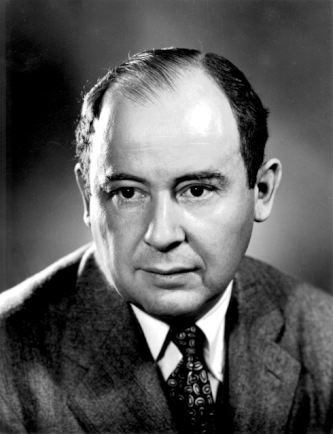
About John von Neumann
John von Neumann (28 December 1903 – 8 February 1957) was a Hungarian-American-Jewish mathematician, physicist, inventor, computer scientist, and polymath. He made major contributions to a number of fields, including mathematics (foundations of mathematics, functional analysis, ergodic theory, geometry, set theory, topology, and numerical analysis), physics (quantum mechanics, hydrodynamics and quantum statistical mechanics), economics (game theory), computing (Von Neumann architecture, linear programming, self-replicating machines, stochastic computing), and statistics.
View all quotes →