• ...Several versions of [computer] background wiring and their corresponding source [programming] languages were under discussion, each having a vocabulary between 50 and 100 [CPU] instruction types. Their implementation and testing began in 1948. They were still only on paper at the end of 1947, when the Association for Computing Machinery was founded and held its first national meeting at Aberdeen Proving Ground. The attendance at that meeting was 300; the program consisted of about a dozen papers. We had succeeded in obtaining John von Neumann as keynote speaker. He discussed the need for, and likely impact of, electronic computing. He mentioned the "new programming method" for ENIAC and explained that its seemingly small vocabulary was in fact ample: that future computers, then in the design stage, would get along on a dozen instruction types, and this was known to be adequate for expressing all of mathematics....Von Neumann went on to say that one need not be surprised at this small number, since about 1,000 words were known to be adequate for most situations of real life, and mathematics was only a small part of life, and a very simple part at that. This caused some hilarity in the audience, which provoked von Neumann to say: "If people do not believe that mathematics is simple, it is only because they do not realize how complicated life is."
If people do not believe that mathematics is simple, it is only because they do not realize how complicated life is.
What It Means
This is a placeholder explanation generated by the low-overhead model. It interprets "If people do not believe that mathematics is simple, it is only because they do not realize how complicated life is." in the context of "Remark made by von Neumann as keynote speaker at the first national meeting of the Association for Computing Machinery in 1947, as mentioned by Franz L. Alt at the end of "Archaeology of computers: Reminiscences, 1945--1947", Communications of the ACM, volume 15, issue 7, July 1972, special issue: Twenty-fifth anniversary of the Association for Computing Machinery, p. 694.
• ...Several versions of [computer] background wiring and their corresponding source [programming] languages were under discussion, each having a vocabulary between 50 and 100 [CPU] instruction types. Their implementation and testing began in 1948. They were still only on paper at the end of 1947, when the Association for Computing Machinery was founded and held its first national meeting at Aberdeen Proving Ground. The attendance at that meeting was 300; the program consisted of about a dozen papers. We had succeeded in obtaining John von Neumann as keynote speaker. He discussed the need for, and likely impact of, electronic computing. He mentioned the "new programming method" for ENIAC and explained that its seemingly small vocabulary was in fact ample: that future computers, then in the design stage, would get along on a dozen instruction types, and this was known to be adequate for expressing all of mathematics....Von Neumann went on to say that one need not be surprised at this small number, since about 1,000 words were known to be adequate for most situations of real life, and mathematics was only a small part of life, and a very simple part at that. This caused some hilarity in the audience, which provoked von Neumann to say: "If people do not believe that mathematics is simple, it is only because they do not realize how complicated life is."" to mean that wisdom is timeless.

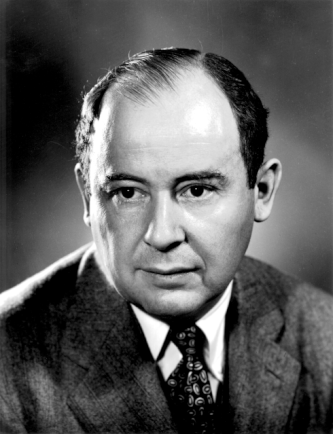
About John von Neumann