• quoted DeGroot, Morris H. "A conversation with David Blackwell." Statistical Science 1.1 (1986): 40–53.
I went in and started telling him about my thesis. He listened for about ten minutes and asked me a couple of questions, and then he started telling me about my thesis. What you have really done is this, and probably this is true, and you could have done it in a somewhat simpler way, and so on. He was a really remarkable man. He listened to me talk about this rather obscure subject and in ten minutes he knew more about it than I did. He was extremely quick. I think he may have wasted a certain amount of time, by the way, because he was so willing to listen to second- or third-rate people and think about their problems. I saw him do that on many occasions.
What It Means
This is a placeholder explanation generated by the low-overhead model. It interprets "I went in and started telling him about my thesis. He listened for about ten minutes and asked me a couple of questions, and then he started telling me about my thesis. What you have really done is this, and probably this is true, and you could have done it in a somewhat simpler way, and so on. He was a really remarkable man. He listened to me talk about this rather obscure subject and in ten minutes he knew more about it than I did. He was extremely quick. I think he may have wasted a certain amount of time, by the way, because he was so willing to listen to second- or third-rate people and think about their problems. I saw him do that on many occasions." in the context of "David Blackwell, as quoted in Out of the Mouths of Mathematicians: A Quotation Book for Philomaths (1993) by Rosemary Schmalz, p. 213
• quoted DeGroot, Morris H. "A conversation with David Blackwell." Statistical Science 1.1 (1986): 40–53." to mean that wisdom is timeless.
Tags
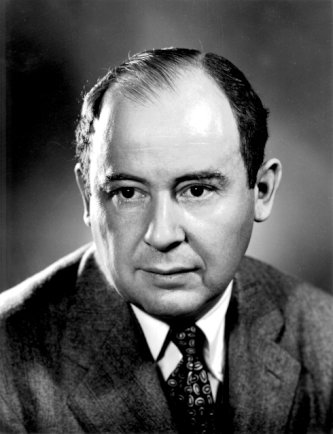
About John von Neumann