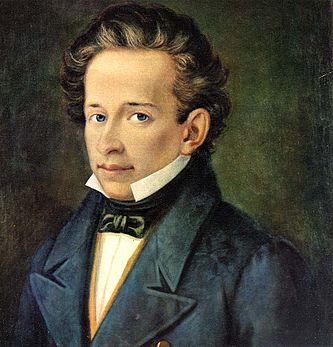
Leopardi is a poet who is very dark. It fascinates me that Mark Strand did that lovely, heartbreaking version of his poem. It's the way that Leopardi makes his incredibly courageous attempt, even though he knows he cannot excel Dante and Petrarch. He's a great literary critic, as his great notebook, Zibaldone, shows. He does it by going back to Lucretius (rather than Virgil), by treating all of Latin poetry as what changes into the Tuscan of Dante, Petrarch, and Boccaccio. He is a signal instance of the modern sublime, which is always a Lucretian-Epicurean sublime as it is in Walt Whitman. It's no surprise Whitman reads Lucretius in translation, and we know his father bought it. He comments on it. Leopardi, of all later Italian poets, is not only the greatest after Dante and Petrarch, but his sensibility is closest to that of high Romanticism in English, that is England and the United States. So far as I know, Hart Crane never mentions Leopardi, but I can't read Leopardi without thinking of Crane.
What It Means
This is a placeholder explanation generated by the low-overhead model. It interprets "Leopardi is a poet who is very dark. It fascinates me that Mark Strand did that lovely, heartbreaking version of his poem. It's the way that Leopardi makes his incredibly courageous attempt, even though he knows he cannot excel Dante and Petrarch. He's a great literary critic, as his great notebook, Zibaldone, shows. He does it by going back to Lucretius (rather than Virgil), by treating all of Latin poetry as what changes into the Tuscan of Dante, Petrarch, and Boccaccio. He is a signal instance of the modern sublime, which is always a Lucretian-Epicurean sublime as it is in Walt Whitman. It's no surprise Whitman reads Lucretius in translation, and we know his father bought it. He comments on it. Leopardi, of all later Italian poets, is not only the greatest after Dante and Petrarch, but his sensibility is closest to that of high Romanticism in English, that is England and the United States. So far as I know, Hart Crane never mentions Leopardi, but I can't read Leopardi without thinking of Crane." in the context of "Harold Bloom, quoted in Adam Fitzgerald, 'The Anatomy of Influence: An interview with Harold Bloom', Boston Review (1 April 2011)" to mean that wisdom is timeless.
Tags

About Harold Bloom