Link Copied!
George Orwell Quotes (1903-1950)
Novelist
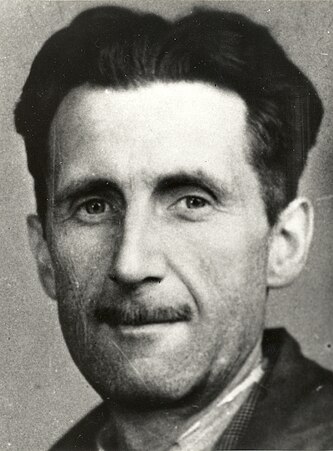


































































About George Orwell
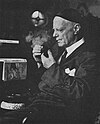
George Orwell (25 June 1903 – 21 January 1950) was the pen name of British novelist, essayist, and journalist Eric Arthur Blair, whose work is characterised by lucid prose, awareness of social injustice, opposition to totalitarianism, and strong support of democratic socialism.
Best George Orwell Quotes
Shortest
Earliest
Explore our curated collection of the most famous and impactful George Orwell quotes.

“An earthquake is such fun when it is over.”
- George Orwell, Burmese Days

“But it takes a war to make map-reading popular.”
- George Orwell, As I Please
“[E]ven stupidity is better than totalitarianism.”
- George Orwell, As I Please
“Beauty is meaningless until it is shared.”
- George Orwell, Burmese Days


“Men are only as good as their technical development allows them to be.”
- George Orwell, Charles Dickens

“Nationalism is power-hunger tempered by self-deception.”
- George Orwell, Notes on Nationalism

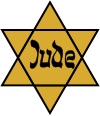
“Antisemitism, for instance, is simply not the doctrine of a grown-up person.”
- George Orwell, As I Please

“Fate seemed to be playing a series of extraordinarily unamusing jokes.”
- George Orwell, Down and Out in Paris and London
“[G]oodness knows how many times the Spanish standard of marksmanship has saved my life.”
- George Orwell, Homage to Catalonia
“Why is it that one can't borrow from a rich friend and can from a half-starved relative?”
- George Orwell, Keep the Aspidistra Flying

“The outstanding, unmistakable mark of Dickens's writing is the unnecessary detail.”
- George Orwell, Charles Dickens
George Orwell Quotes by Topic
Find exactly what you are looking for by browsing this categorized list of George Orwell quotes by topic.
George Orwell on Freedom of speech 6 quotes
“Take away freedom of speech, and the creative faculties dry up.”
- George Orwell, 1900s)
George Orwell on Socialism 6 quotes
“As with the Christian religion, the worst advertisement for Socialism is its adherents.”

George Orwell on Freedom 4 quotes
View all 4 quotes on Freedom →George Orwell on History 4 quotes
View all 4 quotes on History →George Orwell on Absurdism 4 quotes
View all 4 quotes on Absurdism →George Orwell on War 4 quotes
“A peace that was truly permanent would be the same as a permanent war. This—although the vast majority of Party members understand it only in a shallower sense—is the inner meaning of the Party slogan: War is Peace.”
George Orwell on Big Brother 4 quotes
“'Tell me, Winston - and remember, no lies: you know that I am always able to detect a lie - tell me, what are your true feelings towards Big Brother?' 'I hate him.' 'You hate him. Good. Then the time has come for you to take the last step. You must love Big Brother. It is not enough to obey him: you must love him.'”

George Orwell on Fascism's relationship with other political and economic ideologies 4 quotes
“The British ruling class were not altogether wrong in thinking that Fascism was on their side. It is a fact that any rich man, unless he is a Jew, has less to fear from Fascism than from either Communism or democratic Socialism. One ought never to forget this, for nearly the whole of German and Italian propaganda is designed to cover it up.”
George Orwell on Totalitarianism 4 quotes
“The Spanish war and other events in 1936-7 turned the scale and thereafter I knew where I stood. Every line of serious work that I have written since 1936 has been written, directly or indirectly, against totalitarianism and for democratic socialism, as I understand it. It seems to me nonsense, in a period like our own, to think that one can avoid writing of such subjects.”
George Orwell on Animals 3 quotes
View all 3 quotes on Animals →George Orwell on Patriotism 3 quotes
View all 3 quotes on Patriotism →George Orwell on Truth 3 quotes
View all 3 quotes on Truth →What George Orwell Said About Others
Discover personal opinions George Orwell shared regarding contemporaries.
George Orwell on Rudyard Kipling 3 quotes
“Kipling is the only English writer of our time who has added phrases to the language.”
George Orwell on Charles Dickens 3 quotes
“If Dickens were alive to-day he would make a trip to Soviet Russia and come back with a book rather like Gide's Retour de L'URSS.”

George Orwell on Joseph Stalin 3 quotes
“I believe that in the future we shall come to feel that Stalin's foreign policy, instead of being so diabolically clever as it is claimed to be, has been merely opportunistic and stupid.”

George Orwell on Gandhi 3 quotes
“Although no doubt he was shrewd enough in detecting dishonesty, he seems wherever possible to have believed that other people were acting in good faith and had a better nature through which they could be approached.”

George Orwell on Oswald Mosley 2 quotes
In a 1936 letter to Jack Common, George Orwell expressed disgust at witnessing Oswald Mosley's charismatic ability to manipulate a working-class crowd with his fascist rhetoric.
“I heard Mosley speak here on Sunday. It sickens one to see how easily a man of that type can win over and bamboozle a working class audience.”

George Orwell on A. E. Housman 2 quotes
“Housman is a "country" poet. His poems are full of the charm of buried villages, the nostalgia of place-names, Clunton and Clunbury, Knighton, Ludlow, "on Wenlock Edge", "in summer time on Bredon", thatched roofs and the jingle of smithies, the wild jonquils in the pastures, the "blue, remembered hills".”
George Orwell on Winston Churchill 2 quotes
Writing during wartime, Orwell acknowledges Churchill's effectiveness in galvanizing England through traditional patriotism, despite their political differences.
“The man who rallied the nation was Churchill, a gifted and courageous man, but a patriot of the limited, traditional kind. In effect Churchill said simply, "We are fighting for England," and the people flocked to follow him... I personally have always admired him as a man and as a writer, little as I like his politics.”

George Orwell on Leon Trotsky 2 quotes
“When one considers the elaborate forgeries that have been committed in order to show that Trotsky did not play a valuable part in the Russian civil war, it is difficult to feel that the people responsible are merely lying. More probably they feel that their own version was what happened in the sight of God, and that one is justified in rearranging the records accordingly.”
George Orwell on Robert Tressell 2 quotes
In a 1946 review, George Orwell praises *The Ragged Trousered Philanthropists* for its unsentimental depiction of working-class hardship and laments the societal loss of a promising novelist.
“Without sensationalism and almost without plot it sets to record the actual detail of manual work and the tiny things almost unimaginable to any comfortably situated person which make life a misery when one's income drops below a certain level... It is a book that everyone should read. Quite apart from its value as a piece of social history it leaves one with the feeling that a considerable novelist was lost in this young working-man whom society could not bother to keep alive”
George Orwell on B. H. Liddell Hart 2 quotes
In a 1942 review, Orwell praises military theorist Liddell Hart's tactical insight while critiquing his aversion to decisive battles stemming from disillusionment with WWI's senseless carnage.
“To some extent Captain Liddell Hart's tactical theories are separable from his strategic ones, and here his prophecies have been all too well justified by events. No military writer in our time has done more to enlighten public opinion. But his justified war with the Blimps has perhaps overcoloured his judgment... Disgusted by the spectacle of Passchendaele, Captain Liddell Hart seems to have ended by believing that wars can be won on the defensive or without fighting—and even, indeed, that a war is better half-won than won outright. That holds good only when your enemy thinks likewise, a state of affairs which disappeared when Europe ceased to be ruled by an aristocracy.”

George Orwell on Anthony Trollope
“A time-honoured abuse, he held, is frequently less bad than its remedy.”
George Orwell on Harold Laski
In his 1943 Observer article, Orwell reflects on the tension between ideological commitment and individual disposition when describing a "Socialist by allegiance and a Liberal by temperament."
“[S]omeone who is a Socialist by allegiance and a Liberal by temperament.”
Quotes About George Orwell
Gain deeper perspective through quotes about George Orwell from others.
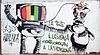
Anonymous graffiti on a monument on George Orwell
Kingsley Amis on George Orwell
“I often feel I will never pick up a book by Orwell again until I have read a frank discussion of the dishonesty and hysteria that mar some of his best work.”

Margaret Atwood on George Orwell
“Writing is also a profession, and, at its best, an honourable one. It has been made honourable by those who have already been members of it. Whether you like it or not, every time you set pen to paper you’re staring at the same blank space that confronted Milton, Melville, Emily Bronte, Dostoevsky and George Eliot, George Orwell and William Faulkner and Virginia Woolf and William Carlos Williams, not to mention the latest hero, Gabriel Garcia Marquez.”

Cyril Connolly on George Orwell
“He could not blow his nose without moralising on conditions in the handkerchief industry. This habit of mind informed everything he wrote. Animal Farm and 1984 are political novels, Homage to Catalonia, The Road to Wigan Pier and all his essays ask a cui bono and try to unseat the profit-makers, whoever they be. This ruling purpose is the secret of his best writing but far too evident in his worst. If we look dispassionately at his achievement, we notice the enormous preponderance of journalism in these four volumes.”

Isaac Deutscher on George Orwell
“What struck me in Orwell was his lack of historical sense and of psychological insight into political life, coupled with an acute, though narrow, penetration into some aspects of politics, and with an incorruptible firmness of opinion.”

Peter Edgerly Firchow on George Orwell
“Toward the end of his life he did ... become a kind of Tory anarchist — as he once described himself ... or even Tory socialist, someone, that is, who, though without exercising double-think, managed to fuse conservative ideas (about patriotism, for example) with radical ones (about the equitable distribution of wealth, for example).”
John Lewis Gaddis on George Orwell
“A second escape from determinism involved the discrediting of dictatorships. Tyrants had been around for thousands of years; but George Orwell's great fear, while writing 1984 on his lonely island in 1948, was that the progress made in restraining them in the 18th and 19th centuries had been reversed. Despite the defeats of Nazi Germany and Imperial Japan, it would have been hard to explain the first half of the 20th century without concluding that the currents of history had come to favor authoritarian politics and collectivist economics. Like Irish monks at the edge of their medieval world, Orwell at the edge of his was seeking to preserve what little was left of civilization by showing what a victory of the barbarians would mean. Big Brothers controlled the Soviet Union, China, and half of Europe by the time 1984 came out. It would have been Utopian to expect that they would stop there. But they did: the historical currents during the second half of the 20th century turned decisively against communism. Orwell himself had something to do with this: his anguished writings, together with the later and increasingly self-confident ones of Solzhenitsyn, Sakharov, Havel, and the future pope Karol Wojtyla, advanced a moral and spiritual critique of Marxism-Leninism for which it had no answer. It took time for these sails to catch wind and for these rudders to take hold, but by the late 1970s they had begun to do so. John Paul II and the other actor-leaders of the 1980s then set the course. The most inspirational alternatives the Soviet Union could muster were Leonid Brezhnev, Yuri Andropov, and Konstantin Chernenko, a clear sign that dictatorships were not what they once had been.”

David Goodway on George Orwell
“The Spanish Civil War shaped the political consciousness of a whole generation, which overwhelmingly saw it as representing heroic resistance to Fascism. Goldman and J. C. Powys did not belong to that generation – they belonged to the generation of its parents or, even, grandparents. And rather than resistance to Fascism, it was the social achievements of the Spanish Revolution that inspired them. In that they stand alone, among figures of the front rank, with Read and Orwell (and it will be seen how he and Homage to Catalonia fared, on the left at least, his reputation only taking off when Animal Farm and Nineteen Eighty-Four were taken up as being anti-Soviet at the onset of the Cold War).”
Eric Hobsbawm on George Orwell
“For most of us the image of Tony is dominated by the boundless admiration we feel for the way he confronted his death. There was a Roman grandeur about his refusal to concede to the inevitable that recalls memories of classical eulogies. It was not just the decision to carry on the chess game to mate, but the decision to provoke death by demonstrating his full abilities as a grandmaster, doomed but never defeated. It is a moving image, but we must abandon it: encouraging mythopoeia is not for historians. Tony has been presented as another George Orwell. This is wrong, because while both were enormously gifted and profoundly polemical, they were very different. Tony lacked Orwell's combination of prejudices, forward and backward-looking Old Testament prophecy and imaginative denunciation – he could never have written 1984 or Animal Farm. And Orwell, the more powerful writer, had neither Tony's remarkable range of knowledge, nor his wit, intellectual speed and manoeuvrability: there is no way he could have doubled as an academic. But the comparison with Orwell is also dangerous because essentially it is not about two writers but about a political era that should now be over for good, the Cold War. Orwell's reputation was constructed as an intellectual anti-Soviet missile site and even today, when the rest of Orwell has emerged or re-emerged, it still remains frozen in the 1950s. Tony was, of course, as anti-Stalinist as anyone, and bitterly critical of those who did not abjure the CP even when they were demonstrably not Stalinists and were, like myself, slowly edging clear of the original world hope of October 1917. Like those opposed to the performing of Wagner in Israel, he could let political dislike get in the way of aesthetic enjoyment, dismissing Brecht's poem about the Comintern cadres, ‘An die Nachgeborenen’, ‘admired by so many’, as ‘obnoxious’ not on literary grounds, but because it inspired believers in an evil cause. Yet it is evident from Thinking the 20th Century that his basic concern during the acute phase of the Cold War was not the Russian threat to the ‘free world’ but the arguments within the left. Marx – not Stalin and the Gulag – was his subject. True, after 1968 he became much more of a militant oppositionist liberal over Eastern Europe, an admirer of the mixed but more usually right-wing academic tourists who provided much of our commentary on the end of the East European Communist regimes. This also led him and others who should have known better into creating the fairy tale of the Velvet and multicoloured revolutions of 1989 and after. There were no such revolutions, only different reactions to the Soviet decision to pull out. The real heroes of the period were Gorbachev, who destroyed the USSR, and men within the old system like Suárez in Franco’s Spain and Jaruzelski in Poland, who effectively ensured a peaceful transition and were execrated by both sides. Indeed, in the 1980s Tony’s essentially social-democratic liberalism was briefly infected by François Furet’s Hayekian economic libertarianism. I don’t think this late Cold War afterglow was central to Tony’s development, but it helped to give more body and depth to his very impressive Postwar.”
Clive James on George Orwell 2 quotes
“The word ‘Orwellian’ is a daunting example of the fate that a distinguished writer can suffer at the hands of journalists. When, as almost invariably happens, a totalitarian set-up, whether in fact or in fantasy – in Brazil or in Brazil – is called Orwellian, it is as if George Orwell had conceived the nightmare instead of analysed it, helped to create it instead of helping to dispel its euphemistic thrall. (Similarly Kafka, through the word Kafkaesque, gets the dubious credit for having somehow wished into existence the same sort of bureaucratic labyrinth that convulsed him to the heart.) Such distortions would be enough to make us give up on journalism altogether if we happened to forget that Orwell himself was a journalist.”

Tony Judt on George Orwell
“Orwell served in a low-level but locally senior administrative capacity for the Burma imperial police from 1924 to 1927. Reading him, one never feels that he developed much of an interest in the Empire per se; his writings from those years suggest the emergence of a set of moral and political considerations—deriving to be sure from his criticisms of Imperial rule—which will in the fullness of time permeate his observations on England itself. Orwell's awareness that the Burmese (or Indian) question transcended issues of local injustice and concerned above all the impropriety and impossibility of imperial domination, would certainly color his political stance back home. It seems fair to add that Orwell was one of the first commentators to grasp that issues of justice and subordination, no less than the traditional themes of class and politics, must be taken up by the Left—indeed, they were henceforth part of what it meant to be Left. We forget that well into the interwar decades it had been perfectly possible to combine social reformism and even political radicalism at home with liberal imperialism. Until quite recently it had been possible to believe that the key to social improvement in Britain lay in retaining, defending and even expanding the empire. By the 1930s, this position had begun to sound ethically as well as politically incoherent, and Orwell can take some credit for this shift in sensibilities.”

Simon Leys on George Orwell
“Blair's personal life and Orwell's public activity both reflected one powerfully single-minded personality. Blair-Orwell was made of one piece: a recurrent theme in the testimonies of all those who knew him at close range was his "terrible simplicity." He had the "innocence of a savage." ... Orwell once defined himself half in jest — but only half — as a "Tory Anarchist." Indeed, after his first youthful experience in the colonial police in Burma, he only knew that he hated imperialism and all forms of political oppression; all authority appeared suspect to him, even "mere success seemed to me a form of bullying." Then after his inquiry into workers' conditions in northern industrial England during the Depression he developed a broad nonpartisan commitment to “socialism”: “socialism does mean justice and liberty when the nonsense is stripped off it.” The decisive turning point in his political evolution took place in Spain, where he volunteered to fight fascism. First he was nearly killed by a fascist bullet and then narrowly escaped being murdered by the Stalinist secret police:
What I saw in Spain, and what I have seen since of the inner workings of left-wing political parties, have given me a horror of politics…. I am definitely “left,” but I believe that a writer can only remain honest if he keeps free of party labels.
From then on he considered that the first duty of a socialist is to fight totalitarianism, which means in practice “to denounce the Soviet myth, for there is not much difference between Fascism and Stalinism.””
Disputed Quotes
Quotes attributed to George Orwell that are questionable.
“In a time of universal deceit, telling the truth is a revolutionary act.”
Misattributed Quotes
Quotes mistakenly credited to George Orwell
“It's not a matter of whether the war is not real, or if it is, Victory is not possible. The war is not meant to be won, it is meant to be continuous. Hierarchical society is only possible on the basis of poverty and ignorance. This new version is the past and no different past can ever have existed. In principle the war effort is always planned to keep society on the brink of starvation. The war is waged by the ruling group against its own subjects and its object is not the victory over either Eurasia or East Asia but to keep the very structure of society intact.”
“We have a hunger for something like authenticity, but are easily satisfied by an ersatz facsimile.”
“There are some ideas so absurd that only an intellectual could believe them.”
About George Orwell
George Orwell (25 June 1903 – 21 January 1950) was the pen name of British novelist, essayist, and journalist Eric Arthur Blair, whose work is characterised by lucid prose, awareness of social injustice, opposition to totalitarianism, and strong support of democratic socialism.