Link Copied!
Galileo Galilei Quotes (1564-1642)
Physicist, Philosopher, Mathematician


About Galileo Galilei
Galileo di Vincenzo Bonaiuti de' Galilei (15 February 1564 – 8 January 1642) was an Italian astronomer, physicist, engineer, philosopher, and mathematician who played a major role in the scientific revolution during the Renaissance.
Best Galileo Galilei Quotes
Shortest
Earliest
Explore our curated collection of the most famous and impactful Galileo Galilei quotes.


“All truths are easy to understand once they are discovered; the point is to discover them.”
“What has philosophy got to do with measuring anything? It's the mathematicians you have to trust, and they measure the skies like we measure a field.”


“My dear Kepler, what would you say of the learned here, who, replete with the pertinacity of the asp, have steadfastly refused to cast a glance through the telescope? What shall we make of this? Shall we laugh, or shall we cry?”
“Surely it is a great thing to increase the numerous host of fixed stars previously visible to the unaided vision, adding countless more which have never before been seen, exposing these plainly to the eye in numbers ten times exceeding the old and familiar stars.”

“Quòd tertio loca à nobis fuit obſeruatum, eſt ipſiuſmet LACTEI Circuli eſſentia, ſeu materies, quam Perſpicilli beneficio adeò ad ſenſum licet intueri, vt & altercationes omnes, quæ per tot ſæcula Philoſophos excrucia runt ab oculata certitudine dirimantur, nosque à verboſis dſputationibus liberemur.”
“Copernicus never discusses matters of religion or faith, nor does he use argument that depend in any way upon the authority of sacred writings which he might have interpreted erroneously. ... He did not ignore the Bible, but he knew very well that if his doctrine were proved, then it could not contradict the Scriptures when they were rightly understood.”
“Names and attributes must be accommodated to the essence of things, and not the essence to the names, since things come first and names afterwards.
• Variant translation: Names and attributes must be accommodated to the essence of things, and not the essence to the names, because things came first, and their names subsequently.”
• Variant translation: Names and attributes must be accommodated to the essence of things, and not the essence to the names, because things came first, and their names subsequently.”

“We seek not what God could have done but what He has done.… God could have caused birds to fly with bones of solid gold, with veins full of quicksilver, with flesh heavier than lead and very small and heavy wings, so as to better show His power … but He wanted to make their bones, flesh and feathers very light … to teach us that He likes simplicity and ease.”

“Alas! Your dear friend and servant Galileo has been for the last month hopelessly blind; so that this heaven, this earth, this universe, which I by my marvelous discoveries and clear demonstrations had enlarged a hundred thousand times beyond the belief of the wise men of bygone ages, henceforward for me is shrunk into such a small space as is filled by my own bodily sensations.”
“I am certainly interested in a tribunal in which, for having used my reason, I was deemed little less than a heretic. Who knows but men will reduce me from the profession of a philosopher to that of historian of the Inquisition! But they behave to me in order that I may become the ignoramus and the fool of Italy...”
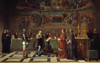
“I have been in my bed for five weeks, oppressed with weakness and other infirmities from which my age, seventy four years, permits me not to hope release. Added to this (proh dolor! [O misery!]) the sight of my right eye — that eye whose labors (dare I say it) have had such glorious results — is for ever lost. That of the left, which was and is imperfect, is rendered null by continual weeping.”
“If I shall have sufficient strength to improve and amplify what was written and published by me up to now about motion by adding some little speculations, and in particular those relating to the force of percussion, in the investigation of which I have consumed hundreds and thousands of hours, and finally reduced this to very easy explanation, so that people can understand it in less than half an hour of time.”
“sì perché l'autorità dell'opinione di mille nelle scienze non val per una scintilla di ragione di un solo, sì perché le presenti osservazioni spogliano d'autorità i decreti de' passati scrittori, i quali se vedute l'avessero, avrebbono diversamente determinato.
• Variant translation: In questions of science the authority of a thousand is not worth the humble reasoning of a single individual.”
• Variant translation: In questions of science the authority of a thousand is not worth the humble reasoning of a single individual.”
“Philosophy is written in this grand book, which stands continually open before our eyes (I say the 'Universe'), but can not be understood without first learning to comprehend the language and know the characters as it is written. It is written in mathematical language, and its characters are triangles, circles and other geometric figures, without which it is impossible to humanly understand a word; without these one is wandering in a dark labyrinth.”
“After the publication of my dialogues, I was summoned to Rome by the Congregation of the holy Office, where, being arrived on the 10th of February 1633, I was subjected to the infinite clemency of that tribunal, and of the Sovereign Pontiff, Urban the Eighth; who, notwithstanding, thought me deserving of his esteem.”
“I would say here something that was heard from an ecclesiastic of the most eminent degree [probably Caesar Baronius]: "The intention of the Holy Ghost is to teach us how one goes to heaven, not how heaven goes."
• Variant translation: I would say here something that was heard from an ecclesiastic of the most eminent degree: "That the intention of the Holy Spirit is to teach us how one goes to heaven, not how the heavens go."”
• Variant translation: I would say here something that was heard from an ecclesiastic of the most eminent degree: "That the intention of the Holy Spirit is to teach us how one goes to heaven, not how the heavens go."”
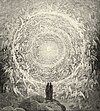
“To this end they make a shield of their hypocritical zeal for religion. They go about invoking the Bible, which they would have minister to their deceitful purposes. Contrary to the sense of the Bible and the intention of the holy Fathers, if I am not mistaken, they would extend such authorities until even in purely physical matters — where faith is not involved — they would have us altogether abandon reason and the evidence of our senses in favor of some biblical passage, though under the surface meaning of its words this passage may contain a different sense.”
“Whence do you have it that the terrestrial globe is so heavy? For my part, either I do not know what heaviness is, or the terrestrial globe is neither heavy nor light, as likewise all other globes of the universe. Heaviness to me (and I believe to Nature) is that innate tendency by which a body resists being moved from its natural place and by which, when forcibly removed therefrom, it spontaneously returns there. Thus a bucketful of water raised on high and set free, returns to the sea; but who will say that the same water remains heavy in the sea, when being set free there, does not move?”
“I esteem myself happy to have as great an ally as you in my search for truth. I will read your work … all the more willingly because I have for many years been a partisan of the Copernican view because it reveals to me the causes of many natural phenomena that are entirely incomprehensible in the light of the generally accepted hypothesis. To refute the latter I have collected many proofs, but I do not publish them, because I am deterred by the fate of our teacher Copernicus who, although he had won immortal fame with a few, was ridiculed and condemned by countless people (for very great is the number of the stupid).”
“Some years ago, as Your Serene Highness well knows, I discovered in the heavens many things that had not been seen before our own age. The novelty of these things, as well as some consequences which followed from them in contradiction to the physical notions commonly held among academic philosophers, stirred up against me no small number of professors — as if I had placed these things in the sky with my own hands in order to upset nature and overturn the sciences. They seemed to forget that the increase of known truths stimulates the investigation, establishment, and growth of the arts; not their diminution or destruction.”

“Nature … is inexorable and immutable; she never transgresses the laws imposed upon her, or cares a whit whether her abstruse reasons and methods of operation are understandable to men. For that reason it appears that nothing physical which sense-experience sets before our eyes, or which necessary demonstrations prove to us, ought to be called in question (much less condemned) upon the testimony of biblical passages which may have some different meaning beneath their words. For the Bible is not chained in every expression to conditions as strict as those which govern all physical effects; nor is God any less excellently revealed in Nature's actions than in the sacred statements of the Bible.”
“Revealing great, unusual, and remarkable spectacles, opening these to the consideration of every man, and especially of philosophers and astronomers; as observed by Galileo Galilei, Gentleman of Florence, Professor of Mathematics in the University of Padua, with the aid of a spyglass lately invented by him, in the surface of the Moon, in innumerable fixed stars, in nebulae, and above all in four planets swiftly revolving about Jupiter at differing distances and periods, and known to no one before the author recently perceived them and decided they should be named the Medicean Stars”
Galileo Galilei Quotes by Topic
Find exactly what you are looking for by browsing this categorized list of Galileo Galilei quotes by topic.
Galileo Galilei on Infinity 7 quotes
“Nature doth, and in it alone is discovered an infinite wisdom, so that Divine Wisdom may be concluded to be infinitely infinite.”

Galileo Galilei on Mathematics 3 quotes
“What has philosophy got to do with measuring anything? It's the mathematicians you have to trust, and they measure the skies like we measure a field.”

Galileo Galilei on Inertia 3 quotes
“I mentally conceive of some moveable [sphere] projected on a horizontal plane, all impediments being put aside. Now it is evident... that equable motion on this plane would be perpetual if the plane were of infinite extent, but if we assume it to be ended, and [situated] on high, the movable, driven to the end of this plane and going on further, adds on to its previous equable and indelible motion, that downward tendency which it has from its heaviness. Thus, there emerges a certain motion, compounded...”
Galileo Galilei on Planet 2 quotes
“The sun, with all those planets revolving around it and dependent on it, can still ripen a bunch of grapes as if it had nothing else in the universe to do.”

Galileo Galilei on Jupiter 2 quotes
“I therefore concluded, and decided unhesitatingly, that there are three stars in the heavens moving about Jupiter, as Venus and Mercury about the Sun; which at length was established as clear as daylight by numerous other observations. These observations also established that there are not only three, but four, erratic sidereal bodies performing their revolutions round Jupiter.”

Galileo Galilei on Mercury (planet) 2 quotes
“I therefore concluded, and decided unhesitatingly, that there are three stars in the heavens moving about Jupiter, as Venus and Mercury about the Sun; which at length was established as clear as daylight by numerous other observations. These observations also established that there are not only three, but four, erratic sidereal bodies performing their revolutions round Jupiter.”

Galileo Galilei on Solar System 2 quotes
“I therefore concluded, and decided unhesitatingly, that there are three stars in the heavens moving about Jupiter, as Venus and Mercury about the Sun; which at length was established as clear as daylight by numerous other observations. These observations also established that there are not only three, but four, erratic sidereal bodies performing their revolutions round Jupiter.”

Galileo Galilei on Scientific revolution 2 quotes
“I mentally conceive of some moveable [sphere] projected on a horizontal plane, all impediments being put aside. Now it is evident... that equable motion on this plane would be perpetual if the plane were of infinite extent, but if we assume it to be ended, and [situated] on high, the movable, driven to the end of this plane and going on further, adds on to its previous equable and indelible motion, that downward tendency which it has from its heaviness. Thus, there emerges a certain motion, compounded...”

Galileo Galilei on Number 2 quotes
“I esteem myself happy to have as great an ally as you in my search for truth. I will read your work … all the more willingly because I have for many years been a partisan of the Copernican view because it reveals to me the causes of many natural phenomena that are entirely incomprehensible in the light of the generally accepted hypothesis. To refute the latter I have collected many proofs, but I do not publish them, because I am deterred by the fate of our teacher Copernicus who, although he had won immortal fame with a few, was ridiculed and condemned by countless people (for very great is the number of the stupid).”
Galileo Galilei on Art 2 quotes
“Do we not say that the judicious discovering of a most lovely Statua in a piece of Marble, hath sublimated the wit of Buonarruotti far above the vulgar wits of other men? And yet this work is onely the imitation of a meer aptitude and disposition of exteriour and superficial members of an immoveable man; but what is it in comparison of a man made by nature, composed of as many exteriour and interiour members, of so many muscles, tendons, nerves, bones, which serve to so many and sundry motions? but what shall we say of the senses, and of the powers of the soul, and lastly, of the understanding? May we not say, and that with reason, that the structure of a Statue falls far short of the formation of a living man, yea more of a contemptible worm?”

Galileo Galilei on Religion
What Galileo Galilei Said About Others
Discover personal opinions Galileo Galilei shared regarding contemporaries.
Galileo Galilei on Johannes Kepler 4 quotes
“I thank you because you are the first one, and practically the only one, to have complete faith in my assertions.”

Galileo Galilei on Aristotle 2 quotes
“I do believe for certain, that he [Aristotle] first procured, by the help of the senses, such experiments and observations as he could, to assure him as much as was possible of the conclusion, and that he afterwards sought out the means how to demonstrate it; for this is the usual course in demonstrative sciences. And the reason thereof is, because when the conclusion is true, by the help of the resolutive method, one may hit upon some proposition before demonstrated, or come to some principle known per se; but if the conclusion be false, a man may proceed in infinitum, and never meet with any truth already known.”

Galileo Galilei on Nicolaus Copernicus
“[Copernicus] did not ignore the Bible, but he knew very well that if his doctrine were proved, then it could not contradict the Scriptures when they were rightly understood.”

Galileo Galilei on Pythagoras
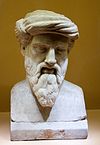
“Nor need you question but that Pythagoras a long time before he found the demonstration for which he offered the Hecatomb, had been certain, that the square of the side subtending the right angle in a rectangle triangle, was equal to the square of the other two sides: and the certainty of the conclusion conduced not a little to the investigating of the demonstration, understanding me alwayes to mean in demonstrative Sciences.”
Galileo Galilei on Plato
“I would not do so much wrong to Plato, but yet I may truly say with Aristotle, that he too much lost himself in, and too much doted upon that, his Geometry: for that in conclusion these Mathematical subtilties, Salviatus, are true in abstract, but applied to sensible and Physical matter, they hold not good. For the Mathematicians will very well demonstrate for example, that Sphæra tangit planum in puncto [the sphere touches the plane at the point]; a position like to that in dispute, but when one cometh to the matter, things succeed quite another way. And so I may say of these angles of contact, and these proportions; which all evaporate into Air, when they are applied to things material and sensible.”

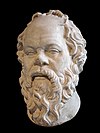
Galileo Galilei on Socrates
“Neither one nor the other doth follow, for that both the assertions may be true. The Oracle adjudged Socrates the wisest of all men, whose knowledg is limited; Socrates acknowledgeth that he knew nothing in relation to absolute wisdome, which is infinite; and because of infinite, much is the same part as is little, and as is nothing (for to arrive... to the infinite number, it is all one to accumulate thousands, tens, or ciphers,) therefore Socrates well perceived his wisdom to be nothing, in comparison of the infinite knowledg which he wanted. But yet, because there is some knowledg found amongst men, and this not equally shared to all, Socrates might have a greater share thereof than others, and therefore verified the answer of the Oracle.”
Galileo Galilei on Michelangelo
“Do we not say that the judicious discovering of a most lovely Statua in a piece of Marble, hath sublimated the wit of Buonarruotti far above the vulgar wits of other men? And yet this work is onely the imitation of a meer aptitude and disposition of exteriour and superficial members of an immoveable man; but what is it in comparison of a man made by nature, composed of as many exteriour and interiour members, of so many muscles, tendons, nerves, bones, which serve to so many and sundry motions? but what shall we say of the senses, and of the powers of the soul, and lastly, of the understanding? May we not say, and that with reason, that the structure of a Statue falls far short of the formation of a living man, yea more of a contemptible worm?”

Quotes About Galileo Galilei
Gain deeper perspective through quotes about Galileo Galilei from others.
Francis Bacon on Galileo Galilei
“[I]t was upon... inequality of motions in point of velocity that Galileo built his theory of flux and reflux of the sea; supposing that the earth revolved faster than the water could follow; and that the water was therefore first gathered in a heap and then fell down, as we see in a basin of water moved quickly. But this he devised upon an assumption which cannot be allowed, viz. that the earth moves; and also without being well informed as to the sexhorary motion of the tide.”

Eric Temple Bell on Galileo Galilei
“Galileo observed as early as 1638 that there are precisely as many squares 1, 4, 9, 16, 25,... as are positive integers all together. This is evident from the sequences1, 2, 3, 4, 5, 6, ... , n, ... 12, 22, 32, 42, 52, 62, ..., n, ... He thus recognized the fundamental distinction between finite and infinite classes that became current in the late nineteenth century. An infinite class is one in which there is a one-to-one correspondence between the whole class and a subclass of the whole. Or, what is equivalent, there are as many things in one part of an infinite class as there are in the whole class. ...A class whose elements can be put in a one-to-one correspondence with the integers 1, 2, 3, ... is said to be denumerable. All the points in any line segment, finite or infinite in length, form a non-denumerable set. A basic course in calculus starts from the theory of point sets. The distinction between denumerable and non-denumerable classes was not started by Galileo; it was observed about 1840 by Bolzano and in 1878 by Cantor. But Galileo's recognition of the cardinal property of all infinite classes makes him one of the genuine anticipators in the history of calculus. The other was Archimedes.”

Arthur Berry on Galileo Galilei
“The credit of first using the telescope for astronomical purposes is almost invariably attributed to Galilei, though his first observations were in all probability slightly later in date than those of Harriot and Marius, is to a great extent justified by the persistent way in which he examined object after object, whenever there seemed any reasonable prospect of results following, by the energy and acuteness with which he followed up each clue, by the independence of mind with which he interpreted his observations, and above all by the insight with which he realised their astronomical importance.”
David Brewster on Galileo Galilei 2 quotes
“His brilliant discoveries the man of science regards as his peculiar property; the means by which they were made, and the development of his intellectual character, belong to the logician and to the philosopher; but the triumphs and the reverses of his eventful life must be claimed for our common nature, as a source of more than ordinary instruction.”

Edwin Arthur Burtt on Galileo Galilei
“Others before him had asked why heavy bodies fall; now, the homogeneity of the earth with the heavenly bodies having suggested that terrestrial motion is a proper subject for exact mathematical study, we have the further question raised: how do they fall? with the expectation that the answer will be given in mathematical terms.”
Herbert Butterfield on Galileo Galilei
“Copernicus had taken one course in treating the earth as virtually a celestial body in the Aristotelian sense—a perfect sphere governed by the laws which operated in the higher reaches of the skies. Galileo complemented this by taking now the opposite course—rather treating the heavenly bodies as terrestrial ones, regarding the planets as subject to the very laws which applied to balls sliding down inclined planes. There was something in all this which tended to the reduction of the whole universe to uniform physical laws, and it is clear that the world was coming to be more ready to admit such a view.”

Lord Byron on Galileo Galilei
“In Santa Croce's holy precincts lie Ashes which make it holier, dust which is Even in itself an immortality, Though there were nothing save the past, and this, The particle of those sublimities Which have relapsed to chaos: here repose Angelo's, Alfieri's bones, and his, The starry Galileo, with his woes; Here Machiavelli's earth returned to whence it rose. These are four minds, which, like the elements, Might furnish forth creation:—Italy! Time, which hath wronged thee with ten thousand rents Of thine imperial garment, shall deny, And hath denied, to every other sky, Spirits which soar from ruin: thy decay Is still impregnate with divinity, Which gilds it with revivifying ray; Such as the great of yore Canova is to-day.”

Florian Cajori on Galileo Galilei 2 quotes
“While Stevin investigated statics, Galileo pursued principally dynamics. Galileo was the first to abandon the Aristotelian idea that bodies descend more quickly in proportion as they are heavier; he established the first law of motion; determined the laws of falling bodies; and, having obtained a clear notion of acceleration and of the independence of different motions, was able to prove that projectiles move in parabolic curves. Up to his time it was believed that a cannon-ball moved forward at first in a straight line and then suddenly fell vertically to the ground. Galileo had an understanding of centrifugal forces, and gave a correct definition of momentum. Though he formulated the fundamental principles of statics, known as the parallelogram of forces, yet he did not fully recognise its scope. The principle of virtual velocities was partly conceived by Guido Ubaldo (died 1607), and afterwards more fully by Galileo.”

I. Bernard Cohen on Galileo Galilei 5 quotes
“It is impossible to exaggerate the effects of his telescopic discoveries on Galileo's life, so profound were they. Not only is it true of Galileo's personal life and thought, but it equally true of their influence on the history of scientific thought. Galileo had the experience of beholding the heavens as they actually are for perhaps the first time, and wherever he looked he found evidence to support the Copernican system against the Ptolemaic, or at least weaken the authority of the ancients. This shattering experience—of observing the depths of the universe, of being the first mortal to know what the heavens are actually like—made so deep an impression... that it is only by considering the events of 1609... that one can understand the subsequent direction of his life.”
Clifford D. Conner on Galileo Galilei
“Koyré's exaltation of the "Platonic and Pythagorean" elements of the Scientific Revolution... was based on a demonstrably false understanding of how Galileo reached his conclusions. Koyré asserted that Galileo merely used experiments as a check on the theories he devised by mathematical reasoning. But later research has definitively established that Galileo's experiments preceded his attempts to give a mathematical account of their results.”
William H. Cropper on Galileo Galilei
“For measurements of time he collected and weighed water flowing from a container at a constant rate of about three fluid ounces per second, He recorded weights of water in grains and, and defined his time unit, called a tempo, to be the time for 16 grains of water to flow, which was equivalent to 1/92 second. These units were small enough so Galileo's measurements of distance and time always resulted in large numbers. That was a necessity because decimal numbers were not part of his mathematical equipment; the only way he could add significant digits in his calculations was to make the numbers larger.”
A. D'Abro on Galileo Galilei
“Galileo was the first scientist to recognise clearly that the only way to further our understanding of the physical world was to resort to experiment. ...the Greeks, in spite of their proficiency in geometry, never seem to have realised the importance of experiment (Democritus and Archimedes excepted). ...an excuse ...can scarcely be put forward when the elementary nature of Galileo's experiments and observations is recalled. Watching a lamp oscillate in the cathedral of Pisa, dropping bodies from the leaning tower of Pisa, rolling balls down inclined planes, noticing the magnifying effect of water in a spherical glass vase... might just as well have been performed by the Greeks.”
Misattributed Quotes
Quotes mistakenly credited to Galileo Galilei
“Mathematics is the key and door to the sciences.”
“Measure what is measurable, and make measurable what is not so.”
About Galileo Galilei
Galileo di Vincenzo Bonaiuti de' Galilei (15 February 1564 – 8 January 1642) was an Italian astronomer, physicist, engineer, philosopher, and mathematician who played a major role in the scientific revolution during the Renaissance.