Link Copied!
François-René de Chateaubriand Quotes (1768-1848)
Writer, Politician
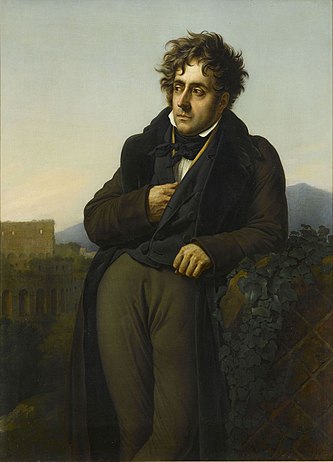
About François-René de Chateaubriand
François-René, vicomte de Chateaubriand (4 September 1768 – 4 July 1848) was a French writer, politician and diplomat, considered the founder of Romanticism in French literature.
Best François-René de Chateaubriand Quotes
Shortest
Earliest
Explore our curated collection of the most famous and impactful François-René de Chateaubriand quotes.
“Every institution goes through three stages — utility, privilege, and abuse.”
“My downfall made a great noise: those who appeared most satisfied criticized the manner of it.”
“Aussitôt qu'une pensée vraie est entrée dans notre esprit, elle jette une lumière qui nous fait voir une foule d'autres objets que nous n'apercevions pas auparavant.”
“I am Bourbon as a matter of honour, royalist according to reason and conviction, and republican by taste and character.”
“Aristocracy has three successive ages, — the age of superiorities, the age of privileges, and the age of vanities; having passed out of the first, it degenerates in the second, and dies away in the third.”

“Perfect works are rare, because they must be produced at the happy moment when taste and genius unite; and this rare conjuncture, like that of certain planets, appears to occur only after the revolution of several cycles, and only lasts for an instant.”
“In living literature no person is a competent judge but of works written in his own language. I have expressed my opinion concerning a number of English writers; it is very possible that I may be mistaken, that my admiration and my censure may be equally misplaced, and that my conclusions may appear impertinent and ridiculous on the other side of the Channel.”

“Though we have not employed the arguments usually advanced by the apologists of Christianity, we have arrived by a different chain of reasoning at the same conclusion: Christianity is perfect; men are imperfect. Now, a perfect consequence cannot spring from an imperfect principle. Christianity, therefore, is not the work of men. If Christianity is not the work of man, it can have come from none but God. If it came from God, men cannot have acquired a knowledge of it except by revelation. Therefore, Christianity is a revealed religion.”

“How small man is on this little atom where he dies! But how great his intelligence! He knows when the face of the stars must be masked in darkness, when the comets will return after thousands of years, he who lasts only an instant! A microscopic insect lost in a fold of the heavenly robe, the orbs cannot hide from him a single one of their movements in the depth of space. What destinies will those stars, new to us, light? Is their revelation bound up with some new phase of humanity? You will know, race to be born; I know not, and I am departing.”

“I have explored the seas of the Old World and the New, and trodden the soil of the four quarters of the Earth. Having camped in the cabins of Iroquois, and beneath the tents of Arabs, in the wigwams of Hurons, in the remains of Athens, Jerusalem, Memphis, Carthage, Granada, among Greeks, Turks and Moors, among forests and ruins; after wearing the bearskin cloak of the savage, and the silk caftan of the Mameluke, after suffering poverty, hunger, thirst, and exile, I have sat, a minister and ambassador, covered with gold lace, gaudy with ribbons and decorations, at the table of kings, the feasts of princes and princesses, only to fall once more into indigence and know imprisonment.”
“I halt at the beginning of my travels, in Pennsylvania, in order to compare Washington and Bonaparte. I would rather not have concerned myself with them until the point where I had met Napoleon; but if I came to the edge of my grave without having reached the year 1814 in my tale, no one would then know anything of what I would have written concerning these two representatives of Providence. I remember Castelnau: like me Ambassador to England, who wrote like me a narrative of his life in London. On the last page of Book VII, he says to his son: ‘I will deal with this event in Book VIII,’ and Book VIII of Castelnau’s Memoirs does not exist: that warns me to take advantage of being alive.”
“I have borne the musket of a soldier, the traveller’s cane, and the pilgrim’s staff: as a sailor my fate has been as inconstant as the wind: a kingfisher, I have made my nest among the waves.
I have been party to peace and war: I have signed treaties, protocols, and along the way published numerous works. I have been made privy to party secrets, of court and state: I have viewed closely the rarest disasters, the greatest good fortune, the highest reputations. I have been present at sieges, congresses, conclaves, at the restoration and demolition of thrones. I have made history, and been able to write it. ... Within and alongside my age, perhaps without wishing or seeking to, I have exerted upon it a triple influence, religious, political and literary.”
I have been party to peace and war: I have signed treaties, protocols, and along the way published numerous works. I have been made privy to party secrets, of court and state: I have viewed closely the rarest disasters, the greatest good fortune, the highest reputations. I have been present at sieges, congresses, conclaves, at the restoration and demolition of thrones. I have made history, and been able to write it. ... Within and alongside my age, perhaps without wishing or seeking to, I have exerted upon it a triple influence, religious, political and literary.”

“New storms will arise; one can believe in calamities to come which will surpass the afflictions we have been overwhelmed by in the past; already, men are thinking of bandaging their old wounds to return to the battlefield. However, I do not expect an imminent outbreak of war: nations and kings are equally weary; unforeseen catastrophe will not yet fall on France: what follows me will only be the effect of general transformation. No doubt there will be painful moments: the face of the world cannot change without suffering. But, once again, there will be no separate revolutions; simply the great revolution approaching its end. The scenes of tomorrow no longer concern me; they call for other artists: your turn, gentlemen!
As I write these last words, my window, which looks west over the gardens of the Foreign Mission, is open: it is six in the morning; I can see the pale and swollen moon; it is sinking over the spire of the Invalides, scarcely touched by the first golden glow from the East; one might say that the old world was ending, and the new beginning. I behold the light of a dawn whose sunrise I shall never see. It only remains for me to sit down at the edge of my grave; then I shall descend boldly, crucifix in hand, into eternity.”
As I write these last words, my window, which looks west over the gardens of the Foreign Mission, is open: it is six in the morning; I can see the pale and swollen moon; it is sinking over the spire of the Invalides, scarcely touched by the first golden glow from the East; one might say that the old world was ending, and the new beginning. I behold the light of a dawn whose sunrise I shall never see. It only remains for me to sit down at the edge of my grave; then I shall descend boldly, crucifix in hand, into eternity.”

“A degree of silence envelops Washington’s actions; he moved slowly; one might say that he felt charged with future liberty, and that he feared to compromise it. It was not his own destiny that inspired this new species of hero: it was that of his country; he did not allow himself to enjoy what did not belong to him; but from that profound humility what glory emerged! Search the woods where Washington’s sword gleamed: what do you find? Tombs? No; a world! Washington has left the United States behind for a monument on the field of battle.
Bonaparte shared no trait with that serious American: he fought amidst thunder in an old world; he thought about nothing but creating his own fame; he was inspired only by his own fate. He seemed to know that his project would be short, that the torrent which falls from such heights flows swiftly; he hastened to enjoy and abuse his glory, like fleeting youth. Following the example of Homer’s gods, in four paces he reached the ends of the world. He appeared on every shore; he wrote his name hurriedly in the annals of every people; he threw royal crowns to his family and his generals; he hurried through his monuments, his laws, his victories. Leaning over the world, with one hand he deposed kings, with the other he pulled down the giant, Revolution; but, in eliminating anarchy, he stifled liberty, and ended by losing his own on his last field of battle.
Each was rewarded according to his efforts: Washington brings a nation to independence; a justice at peace, he falls asleep beneath his own roof in the midst of his compatriots’ grief and the veneration of nations.
Bonaparte robs a nation of its independence: deposed as emperor, he is sent into exile, where the world’s anxiety still does not think him safely enough imprisoned, guarded by the Ocean. He dies: the news proclaimed on the door of the palace in front of which the conqueror had announced so many funerals, neither detains nor astonishes the passer-by: what have the citizens to mourn?
Washington’s Republic lives on; Bonaparte’s empire is destroyed. Washington and Bonaparte emerged from the womb of democracy: both of them born to liberty, the former remained faithful to her, the latter betrayed her.
Washington acted as the representative of the needs, the ideas, the enlightened men, the opinions of his age; he supported, not thwarted, the stirrings of intellect; he desired only what he had to desire, the very thing to which he had been called: from which derives the coherence and longevity of his work. That man who struck few blows because he kept things in proportion has merged his existence with that of his country: his glory is the heritage of civilisation; his fame has risen like one of those public sanctuaries where a fecund and inexhaustible spring flows.”
François-René de Chateaubriand Quotes by Topic
Find exactly what you are looking for by browsing this categorized list of François-René de Chateaubriand quotes by topic.
François-René de Chateaubriand on Atheism 2 quotes
“Religion assures us that our afflictions shall have an end; she comforts us, she dries our tears, she promises us another life. On the contrary, in the abominable worship of atheism, human woes are the incense, death is the priest, a coffin the altar, and annihilation the Deity.”

François-René de Chateaubriand on Antinatalism
“After the misfortune of being born, I do not know any greater than giving birth.”

François-René de Chateaubriand on Mystery
François-René de Chateaubriand on House of Bourbon
“I am Bourbon as a matter of honour, royalist according to reason and conviction, and republican by taste and character.”

François-René de Chateaubriand on Decoration
“I have sat, a minister and ambassador, covered with gold lace, gaudy with ribbons and decorations, at the table of kings, the feasts of princes and princesses, only to fall once more into indigence and know imprisonment.”
François-René de Chateaubriand on Genius
“Perfect works are rare, because they must be produced at the happy moment when taste and genius unite; and this rare conjuncture, like that of certain planets, appears to occur only after the revolution of several cycles, and only lasts for an instant.”

François-René de Chateaubriand on Religion
“Religion assures us that our afflictions shall have an end; she comforts us, she dries our tears, she promises us another life. On the contrary, in the abominable worship of atheism, human woes are the incense, death is the priest, a coffin the altar, and annihilation the Deity.”

François-René de Chateaubriand on Immortality
“Whence comes the powerful impression that is made upon us by the tomb? Are a few grains of dust deserving of our veneration? Certainly not; we respect the ashes of our ancestors for this reason only — because a secret voice whispers to us that all is not extinguished in them. It is this that confers a sacred character on the funeral ceremony among all the nations of the globe; all are alike persuaded that the sleep, even of the tomb, is not everlasting, and that death is but a glorious transfiguration.”
François-René de Chateaubriand on Papal conclave
“I have borne the musket of a soldier, the traveller’s cane, and the pilgrim’s staff: as a sailor my fate has been as inconstant as the wind: a kingfisher, I have made my nest among the waves. I have been party to peace and war: I have signed treaties, protocols, and along the way published numerous works. I have been made privy to party secrets, of court and state: I have viewed closely the rarest disasters, the greatest good fortune, the highest reputations. I have been present at sieges, congresses, conclaves, at the restoration and demolition of thrones. I have made history, and been able to write it. ... Within and alongside my age, perhaps without wishing or seeking to, I have exerted upon it a triple influence, religious, political and literary.”
What François-René de Chateaubriand Said About Others
Discover personal opinions François-René de Chateaubriand shared regarding contemporaries.
François-René de Chateaubriand on Napoleon 2 quotes
“Bonaparte robs a nation of its independence: deposed as emperor, he is sent into exile, where the world's anxiety still does not think him safely enough imprisoned, guarded by the Ocean. He dies: the news proclaimed on the door of the palace in front of which the conqueror had announced so many funerals, neither detains nor astonishes the passer-by: what have the citizens to mourn? Washington's Republic lives on; Bonaparte's empire is destroyed. Washington and Bonaparte emerged from the womb of democracy: both of them born to liberty, the former remained faithful to her, the latter betrayed her.”

François-René de Chateaubriand on Torquato Tasso
“Whoever has a relish for the beauty, the art, the interest of a poetic composition, for richness of detail, for truth of character, for generosity of sentiment, should make the Jerusalem Delivered his favourite study. It is in a particular manner the poem of the soldier: it breathes valour and glory, and, as I have elsewhere observed, it seems to have been written upon a buckler in the midst of camps.”

François-René de Chateaubriand on George Washington
“A degree of silence envelops Washington's actions; he moved slowly; one might say that he felt charged with future liberty, and that he feared to compromise it. It was not his own destiny that inspired this new species of hero: it was that of his country; he did not allow himself to enjoy what did not belong to him; but from that profound humility what glory emerged! Search the woods where Washington's sword gleamed: what do you find? Tombs? No; a world! Washington has left the United States behind for a monument on the field of battle. … Washington's Republic lives on; Bonaparte's empire is destroyed. Washington and Bonaparte emerged from the womb of democracy: both of them born to liberty, the former remained faithful to her, the latter betrayed her. Washington acted as the representative of the needs, the ideas, the enlightened men, the opinions of his age; he supported, not thwarted, the stirrings of intellect; he desired only what he had to desire, the very thing to which he had been called: from which derives the coherence and longevity of his work. That man who struck few blows because he kept things in proportion has merged his existence with that of his country: his glory is the heritage of civilisation; his fame has risen like one of those public sanctuaries where a fecund and inexhaustible spring flows.”

Quotes About François-René de Chateaubriand
Gain deeper perspective through quotes about François-René de Chateaubriand from others.
Georges Bertrin in on François-René de Chateaubriand
“He has abundant views on the future, particularly on the subject of religion and the social rôle which he believed it called upon to play. His influence on literature is unanimously acknowledged. Romanticism may be traced back to him, and it may even be said that the whole literary movement characteristic of the nineteenth century begins with him.”
Marie-Hélène Huet on François-René de Chateaubriand
“In the twenty-sixth book of his Mémoires d'outre-tombe, Chateaubriand recounts his 1821 arrival at the French embassy in Berlin. He cites a flattering portrait of him written by the Baroness of Hohenhausen and published in the morning press on March 22: "M. de Chateaubriand is of a somewhat short, yet slender, stature. His oval face has an expression of reverence and melancholy. He has black hair and black eyes that glow with the fire of his mind." At this point, Chateaubriand flatly adds: "Mais j'ai les cheveux blancs; j'ai plus d'un siècle, en outre, je suis mort" ("But I have white hair; I am more than a century old, besides, I am dead") ... Of course, those startling words, "en outre, je suis mort" do not refer to the year 1821, nor to the time Chateaubriand is writing this account. Rather, they refer to the time we, readers, turn to this specific page of the Mémoires: as you are reading this, Chateaubriand reminds us, I am dead. The words wrest us away from the event he is relating, his arrival in Berlin, to remind us in the most direct terms that our reading of these words necessarily entails the death of their author. Moreover, the French en outre brings us back to the very title of the Mémoires d'outre-tombe: outre-tombe, from beyond the grave. In 1836, Chateaubriand signed a contract with a society of shareholders: in exchange for an immediate payment of 156,000 francs and a life annuity, he sold "the literary ownership of his Mémoires as they existed and as they would exist at his death." Commenting on this transaction, Maurice Levaillant notes: "With this agreement, Chateaubriand bought material security at the price of a concession that he never got over: instead of appearing after a period he had first prescribed as fifty years after his death, his Mémoires would suddenly appear, so to speak, live from his grave."”
Victor Hugo at the age of on François-René de Chateaubriand
“I will be Chateaubriand or nothing.”
Misattributed Quotes
Quotes mistakenly credited to François-René de Chateaubriand
“A master in the art of living draws no sharp distinction between his work and his play; his labor and his leisure; his mind and his body; his education and his recreation. He hardly knows which is which. He simply pursues his vision of excellence through whatever he is doing, and leaves others to determine whether he is working or playing. To himself, he always appears to be doing both.”
About François-René de Chateaubriand
François-René, vicomte de Chateaubriand (4 September 1768 – 4 July 1848) was a French writer, politician and diplomat, considered the founder of Romanticism in French literature.