Link Copied!
Erich Fromm Quotes (1900-1980)
Philosopher























About Erich Fromm
Erich Seligmann Fromm (23 March 1900 – 18 March 1980) was a German social psychologist, psychoanalyst, sociologist, humanistic philosopher, and democratic socialist. He was associated with the Frankfurt School of critical theory.
Best Erich Fromm Quotes
Shortest
Earliest
Explore our curated collection of the most famous and impactful Erich Fromm quotes.
“Man’s biological weakness is the condition of human culture.”
“The successful revolutionary is a statesman, the unsuccessful one a criminal.”
“One cannot be deeply responsive to the world without being saddened very often.”
“Human history began with an act of disobedience, and it is not unlikely that it will be terminated by an act of obedience.”
“Fairness means not to use fraud and trickery in the exchange of commodities and services and the exchange of feelings.”
“The quest for certainty blocks the search for meaning. Uncertainty is the very condition to impel man to unfold his powers.”

“What most people in our culture mean by being lovable is essentially a mixture between being popular and having sex appeal.”
“Greed is a bottomless pit which exhausts the person in an endless effort to satisfy the need without ever reaching satisfaction.”
“All men are in need of help and depend on one another. Human solidarity is the necessary condition for the unfolding of any one individual.”

“If a person loves only one other person and is indifferent to all others, his love is not love but a symbiotic attachment, or an enlarged egotism.”

“The existential split in man would be unbearable could he not establish a sense of unity within himself and with the natural and human world outside.”
“Man’s main task in life is to give birth to himself, to become what he potentially is. The most important product of his effort is his own personality.”

“The kind of relatedness to the world may be noble or trivial, but even being related to the basest kind of pattern is immensely preferable to being alone.”
“Just as modern mass production requires the standardization of commodities, so the social process requires standardization of man, and this standardization is called equality.”
“Psychoanalysis is essentially a theory of unconscious strivings, of resistance, of falsification of reality according to one's subjective needs and expectations.”

“Neurosis can be understood best as the battle between tendencies within an individual; deep character analysis leads, if successful, to the progressive solution.”
“People have committed suicide because of their failure to realize the passions for love, power, fame, revenge. Cases of suicide because of a lack of sexual satisfaction are virtually nonexistent.”

“Chronic boredom — compensated or uncompensated — constitutes one of the major psychopathological phenomena in contemporary technotronic society, although it is only recently that it has found some recognition.”
“His concept of the anal character as one that has not reached maturity is in fact a sharp criticism of bourgeois society of the nineteenth century, in which the qualities of the anal character constituted the norm for moral behavior.”
“I believe that the fundamental alternative for man is the choice between "life" and "death"; between creativity and destructive violence; between reality and illusions; between objectivity and intolerance; between brotherhood-independence and dominance-submission.”
Erich Fromm Quotes by Topic
Find exactly what you are looking for by browsing this categorized list of Erich Fromm quotes by topic.
Erich Fromm on Love 16 quotes
“Love is an act of faith, and whoever is of little faith is also of little love.”
Erich Fromm on Art 7 quotes
“There is undoubtedly a difference between people who manipulate other people and people who create things.”

Erich Fromm on Boredom 2 quotes
View all 2 quotes on Boredom →Erich Fromm on Religious views on love 2 quotes
“Love is an act of faith, and whoever is of little faith is also of little love.”

Erich Fromm on Idolatry 2 quotes
“It is time to cease to argue about God, and instead to unite in the unmasking of contemporary forms of idolatry.”

Erich Fromm on Basic income 2 quotes
“A guaranteed income ... could for the first time free man from the threat of starvation, and thus make him truly free and independent economically and psychologically. ... People would no longer learn to be afraid, if they did not have to fear for their bread.”

Erich Fromm on Adjustment (psychology) 2 quotes
“Many psychiatrists and psychologists refuse to entertain the idea that society as a whole may be lacking in sanity. They hold that the problem of mental health in a society is only that of the number of ‘unadjusted’ individuals, and not of a possible unadjustment of the culture itself.”

Erich Fromm on Psychoanalysis 2 quotes
“Psychoanalysis, which interprets the human being as a socialized being, and the psychic apparatus as essentially developed and determined through the relationship of the individual to society, must consider it a duty to participate in the investigation of sociological problems to the extent the human being or his/her psyche plays any part at all.”
Erich Fromm on Obedience 2 quotes
“From the fight against the authority of the Church, State and family which characterize the last centuries, we have come back full circle to a new obedience; but this obedience is not one to autocratic persons, but to the organization. The ‘organization man’ is not aware that he obeys; he believes that he only conforms with what is rational and practical.”

Erich Fromm on Sanity
Erich Fromm on Revolution
“The successful revolutionary is a statesman, the unsuccessful one a criminal.”

What Erich Fromm Said About Others
Discover personal opinions Erich Fromm shared regarding contemporaries.
Erich Fromm on Sigmund Freud 2 quotes
“Freud was one of the last representatives of Enlightenment philosophy. He genuinely believed in reason as the one strength man has and which alone could save him from confusion and decay.”

Erich Fromm on Émile Durkheim 2 quotes
“Durkheim points out that only the political state survived the French Revolution as a solitary factor of collectivization. As a result, a genuine social order has disappeared, the state emerging as the only collective organizing activity of the social character. The individual, free from all genuine social bonds, finds himself abandoned, isolated, and demoralized. Society becomes "a disorganized dust of individuals."”

Erich Fromm on Politicians
“Our society is run by a managerial bureaucracy, by professional politicians; people are motivated by mass suggestion, their aim is producing more and consuming more, as purposes in themselves.”
Erich Fromm on D. T. Suzuki
“In the literature on Zen Buddhism, there are writers such as Suzuki, whose authenticity is beyond doubt--he speaks of what he has experienced. The very fact of this authenticity makes his books often difficult to read, because it is of the essence of Zen not to give answers that are rationally satisfying. There are some other books which seem to portray the thoughts of Zen properly, but whose authors are mere intellectuals whose experience is shallow. Their books are easier to understand, but they do not convey the essential quality of Zen.”

Erich Fromm on Lewis Mumford
“Lewis Mumford, with whose writings my own ideas have many points in common, says this about our contemporary civilization: "The most deadly criticism one could make of modern civilization is that apart from its man-made crises and catastraphes, it is not humanly interesting...In the end, such a civilization can produce only a mass man: incapable of choice, incapable of spontaneous, self-directed activities: at best patient, docile, disciplined to monotonous work to an almost pathetic degree, but increasingly irresponsible as his choices become fewer and fewer..."”

Erich Fromm on Baruch Spinoza
“Spinoza formulated the problem of the socially patterned defect very clearly. He says: "Many people are seized by one and the same affect with great consistency. All his senses are so strongly affected by one object that he believes this object to be present even if it is not. If this happens while the person is awake, the person is believed to be insane. … But if the greedy person thinks only of money and possessions, the ambitious one only of fame, one does not think of them as being insane, but only as annoying ; generally one has contempt for them. But factually greediness, ambition, and so forth are forms of insanity, although usually one does not think of them as 'illness.'" These words were written a few hundred years ago ; they still hold true, although the defects have been culturally patterned to such an extent now that they are not even generally thought any more to be annoying or contemptible.”

Quotes About Erich Fromm
Gain deeper perspective through quotes about Erich Fromm from others.
Herbert Marcuse on Erich Fromm
“Fromm revives all the time-honored values of idealistic ethics as if nobody had ever demonstrated their conformist and repressive features. He speaks of the productive realization of the personality, of care, responsibility, and respect for one’s fellow men, of productive love and happiness – as if man could actually practice all this and still remain sane and full of “well-being” in a society which Fromm himself describes as one of total alienation, dominated by the commodity relations of the “market.” In such a society, the self-realization of the “personality” can proceed only on the basis of a double repression: first, the “purification” of the pleasure principle and the internalization of happiness and freedom; second, their reasonable restriction until they become compatible with the prevailing unfreedom and unhappiness. As a result, productiveness, love, responsibility become “values” only in so far as they contain manageable resignation and are practiced within the framework of socially useful activities (in other words, after repressive sublimation); and then they involve the effective denial of free productiveness and responsibility.”
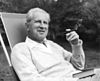
About Erich Fromm
Erich Seligmann Fromm (23 March 1900 – 18 March 1980) was a German social psychologist, psychoanalyst, sociologist, humanistic philosopher, and democratic socialist. He was associated with the Frankfurt School of critical theory.