Link Copied!
David Gregory (mathematician) Quotes (1659-1708)
Mathematician

About David Gregory (mathematician)
David Gregory (originally spelt Gregorie) FRS (3 June 1659 – 10 October 1708) was a Scottish mathematician and astronomer. He was professor of mathematics at the University of Edinburgh, and later Savilian Professor of Astronomy at the University of Oxford, and a proponent of Isaac Newton's Philosophiæ Naturalis Principia Mathematica.
Best David Gregory (mathematician) Quotes
Shortest
Earliest
Explore our curated collection of the most famous and impactful David Gregory (mathematician) quotes.
“Descartes's cosmic system, which he jokingly called his fable of the world, is shown to be a fable indeed.”
“[T]hose who are less vers'd in the more abstruse parts of Geometry, or less concerned about the Physical parts, may pass over, and only read the Astronomy separately and distict...”
“[U]niversally, the Weights which generate all Tones in Strings, are reciprocally as the Squares of the lengths of Strings of equal Tension, producing the same sound in any Musical Instrument.”
“[I]t is by the help of geometry that all the arts necessary for improving life,.. as geography,.. rules of navigation,.. determining of times... [etc.], have been carried to such an incredible pinnacle of distinction.”

“[I]f we look back to the first Rise of Astronomy... we shall find nothing better approv'd of, nothing more universally entertained among the several Sects of Philosophers, than this notion of the Gravity of the Celestial Bodies.”
“[T]he Physics delivered in the following Work... was both known and diligently cultivated by the most ancient Philosophers. ...[T]he true System of the World, approv'd of Pythagoras, and others among the Ancients...”
“Lucretius and those whom he followed, believ'd that all Bodies did Gravitate towards the Matter placed around them, and that every single Body was carried by the more prevailing Gravity, towards that region where there was most Matter.”

“The Celestial Physics, or Physical Astronomy, is not only the first in dignity of all inquiries into Nature... but the first in order, because it is the easiest.”

“[T]he Physics, it is all taken out of the above mention'd Authors; but is here intermix'd with Astronomy, in such places as seem'd proper and convenient; the Geometry to be met with in it, I have either borrowed elsewhere, and quoted... or delivered it Lemmatrically.”
“[W]ith this one problem... three years ago, after the above was published, Gottfried Leibniz... produced a construction... in terms of his system—not without the blemish of paralogism.”
“[T]he easier, simpler and less composite these theories are, the more they will be consonant not only with what has already been observed... but with what is yet to be observed, and with the very machine of the world which was constructed by the supreme creator with the greatest simplicity.”
“[T]hose persons seem to apply their thoughts but to a very indifferent purpose in the study of Nature, that overlook this part of Astronomy, from whence the principal and most simple Laws of Nature are to be learn'd.”
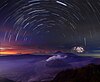
“The phenomena prove that the tail of a comet is vapour from its head which, when the comet is greatly heated in the neighbourhood of the sun in perihelion, continually rises up and moves away into the regions opposite the sun.”

“It is... most gratifying to my soul that, after spending a large part of my life in other universities, I can be linked in the University of Oxford with the prince of geometers Dr John Wallis as colleague and the most scholarly Dr Edward Bernard as successor.”

“These notions Anaximenes received from Anaximander, Anaximander from Thales himself, who was the Head and Founder of the Ionic Philosophy; and spread this opinion of the Gravity of the Fix'd Stars among his Sect.”
“But... Kepler’s problem was to be resolved, to find the position of a body moved in an elliptical orbit at a given time. As concerns an algebraic resolution... adapted to the construction of tables, we... also have produced a work not... to be ashamed of.”
“[W]e do still tread in the steps of the Ancients in this Physical Astronomy; inasmuch as they knew that the Celestial Bodies gravitated towards each other, and were retain'd in their Orbits by the force of Gravity; and were also apprized of the Law of this Gravity.”

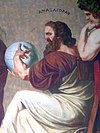
“[A]s we are told by Democritus these notions about the Sun and Moon are not to be ascrib'd to Anaxagoras as their original... He had them from his Master Anaximenes whose Opinion... was, that the Stars were of a fiery nature and substance, that there were also mingled with them certain Earthly Bodies... [H]e plainly means, Planets of a terrestrial nature, performing their revolutions in the System of every Fix'd Star.”
“[W]ithin the memory of ourselves and... our fathers, philosophers began to extend the limits of geometry in order to found the kingdom of astronomy. This they have carried out... with such success that now no one can be received into astronomical citizenship who is not a visiting citizen in the most abstruse geometry and has not arisen from the patrician, that is the geometrical, family of philosophers.”

“[F]or the further improvement of natural philosophy a more advanced geometry must be found. ...[T]he reason why physical science has here been brought to a level that is the envy of foreigners is the knowledge... of some more universal geometry. Of what part of this the learned owe to this renowned university and in it to the prince of geometers I shall not speak lest I appear to be fawning, which in a mathematician would be unseemly.”
“Since two or more mutually gravitating bodies describe orbits around a common immobile centre of gravity, and since by common consent there is an immense difference between the quantity of matter in the sun and that in the Earth, it is clear that neither the sun nor, much less, the sun in the company of five planets can revolve around an immobile Earth. Thus is shown not only the falsity but the impossibility of the Tychonic system.”

“That saying is well known, so often used by Anaxagoras, and his Scholars, Achelaus and Euripides, Namely, "That the Sun and Stars were fiery or red-hot Stones and Golden Clods." Of the same mind also were Democritus, Metrodorus, and Diogenes...”
“My design in publishing this Book, was, that the Celestial Physics, which the most sagacious Kepler had got the scent of, but the Prince of Geometers Sir Isaac Newton, brought to such a pitch as surprises all the World, might, by my... illustrating, become easier to such as are desirous of being acquainted with Philosophy and Astronomy.”

“Although in every age there have been those who cultivated astronomy, either by... observations... or by theories and systems made up according to the state of understanding of any period, or by a talent for exposition, yet the lucubrations of all these astronomers do not reveal the ways of the heaven any more than they reveal the skill and experience of their progenitors in geometrical matters.”

“[A]fterwards it diffused it self thro' the Italic Philosophy, the followers of which taught, that each Star was a World in the infinite Æthereal Space, containing Earth, Air and Æther; and that the Moon, not only was like our Earth, but inhabited by Animals of a larger size, and furnish'd with Plants of a more beautiful appearance.”
Quotes About David Gregory (mathematician)
Gain deeper perspective through quotes about David Gregory (mathematician) from others.
George Crabb on David Gregory (mathematician)
“Gregory, David, nephew of preceeding [James Gregory (1638-1675)], was born at Aberdeen in 1661, and died 1708, Savilian professor of Astronomy at Oxford. He published, 1. 'Exercitatio Geometrica de Dimensione Figurarum,' 4to. Edinb. 1684. 2. 'Catoptricæ et Diopticræ Sphericæ Elementa,' 8vo. Oxon. 1695. 3. 'Astronomæ Physicæ et Geometriæ Elementa,' fol. Oxon. 1702, and 4to. Genev. 1726. 4. 'Treatise of Practical Geometry,' originally written in Latin, and of which a translation by Mr. MacLaurin, was published in 8vo. 1745, and again in 1751. 5. 'A Short Treatise of the Nature of Arithmetic and Logarithms,' printed at the end of Keill's translation of Commandine's Euclid, besides several papers in the 'Philosophical Transactions.'”
Niccolò Guicciardini on David Gregory (mathematician)
“David Gregory’s manuscript ‘Isaaci Neutoni methodus fluxionum’ is the first systematic presentation of the method of fluxions written by somebody other than Newton. It was penned in 1694, when Gregory was the Savilian Professor of Astronomy at Oxford. ...[I]t sheds light upon Gregory’s views on how Newton’s mathematical innovations related to... other mathematicians, both British and Continental. This paper... proves that Newton, far from being—as often stated—wholly isolated and reluctant to publish the method of fluxions, belonged to a network of mathematicians who were made aware of his discoveries. Second, it shows that Gregory—very much as other Scottish mathematicians such as George Cheyne and John Craig—received Newton’s fluxional method within a tradition that was independent from England and that, before getting in touch with Newton, had assimilated elements of the calculi developed on the Continent.”
J. Nicholson on David Gregory (mathematician)
“The Science of Astronomy which is as much esteem'd and admir'd for its great and manifold uses for the Service of Mankind, as it is delightful and entertaining to the more curious and contemplative, has in all ages been cultivated and improv'd, by Men the most eminent for their parts and learnings; and is now brought... to the utmost degree of perfection, and that chiefly by the Superior Genius and Industry of those of our own Nation. But since nothing considerable therein, has been as yet writ in our own Language... I could not oblige my Country-Men more than in publishing an English Edition of the most valuable and finish'd piece of Astronomy now extant. It is generally reckoned to be a Book that contains not only all the Discoveries and Philosophical Sentiments of the great Kepler, and the various Hypotheses of the most noted Astronomers before and since his Time; but is chiefly valued by the best Judges, for the large and instructive Comments... on the Writings of the illustrious Sir Isaac Newton, as well as on the Several Astronomical Dissertations of the Sagacious Dr. Halley, which the Reader will find here every where interspers'd. ...I shall, in a very little time, present... another Volume, containing correct Astronomical Tables, for the ready computing of the Planets Places, Eclipses, &c. all done by a Person of known ability, from the true Theory of Gravity, deliver'd in this Book: For it was by no means judged proper that I should annex to so intire a piece as this, any imperfect Tables, drawn from a different Principle from what is here established, such it seems all those as yet published are.”
Source on David Gregory (mathematician) 3 quotes
“After I had taken holy orders, I returned to the college, and went on with my own studies there, particularly the mathematicks, and the Cartesian philosophy; which was alone in vogue with us at that time. But it was not long before I, with immense Pains, but no assistance, set myself, with the utmost zeal, to the Study of Sir Isaac Newtons wonderful discoveries in his Philosophiæ Naturalis Principia Mathematica, one or two of which Lectures I had heard... read in the publick Schools, though I understood them not at all... Being indeed greatly excited thereto by a Paper of Dr. Gregory’s when he was Professor in Scotland; wherein he had given the most prodigious Commendations to that work, as not only right in all things, but in a manner the Effect of a plainly divine genius''''', and had already caused several of his Scholars to keep Acts, as we call them, upon several branches of the Newtonian Philosophy; while we at Cambridge, poor Wretches, were ignominiously studying the fictitious Hypotheses of the Cartesian, which Sir Isaac Newton had also himself done formerly, as I have heard him say.”
About David Gregory (mathematician)
David Gregory (originally spelt Gregorie) FRS (3 June 1659 – 10 October 1708) was a Scottish mathematician and astronomer. He was professor of mathematics at the University of Edinburgh, and later Savilian Professor of Astronomy at the University of Oxford, and a proponent of Isaac Newton's Philosophiæ Naturalis Principia Mathematica.