Link Copied!
D. V. Gundappa Quotes (1887-1975)
Writer, Novelist

About D. V. Gundappa
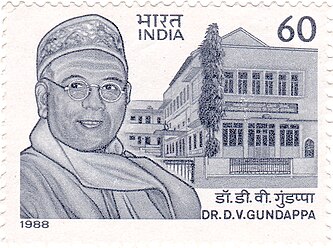
Devanahalli Venkataramanaiah Gundappa (March 17, 1887 – 1975), popularly known by his pen name DVG, was an Indian writer, biographer, journalist, and novelist in the Kannada language with philosophical approach to life. His magnum opus, the Manku Thimmana Kagga, meaning "Dull Thimma's Rigmarole", is a set of philosophical muse, which is a collection of 945 poems, each of four lines in length. It is one of the best known of the major literary works in Kannada. He also started Kannada newspapers such as Bharat and Karnataka and also founded the Gokhale Institute and promoted fine arts. He was the recipient of Padmabhushan by the Government of India. A commemorative postage stamp was also issued by the Indian Postal Department.
Best D. V. Gundappa Quotes
Shortest
Earliest
Explore our curated collection of the most famous and impactful D. V. Gundappa quotes.
“Reading biographies of great men would shape the life of the youth.”

“Any journalist worth his salt, should have to study literature to some extent.”

“Journalism is meant to educate the people. To do this effectively, journalists will have to equip themselves adequately.”

“But a nationalist shall not merely have control over these weakness but would cultivate the qualities of politeness and cordiality.”

“Linguistic equivalence and cultural communication are thus complimentary to each other as language is culture generative and culture bound.”

“Once in garden then in friends’ company,
Once in music and then in philosophy,
Once with family and then in silence,
Experience Brahman- Mankuthimma”
Once in music and then in philosophy,
Once with family and then in silence,
Experience Brahman- Mankuthimma”
“I have written this book to enunciate some principles, ends and means in which I have full faith, implementation of which would do good to the people and society”

“The craze for power among elected representatives is the deathtrap of democracy. Once they get in to the positions of power, they become gluttons, like the hungry at the dining table.”

“For some people belligerency and divisiveness are inbuilt qualities and if they come to power, unity becomes a far cry. Belligerent and divisive attitude are but natural in power politics.”
“The probity in a public life is a must for improvement of country’s economy vis-à-vis the living conditions of common man. To mould the perceptions of students he wrote biographies of three great men.”

“New shoots, old roots make a tree look beautiful
New approaches and old principles give us true Dharma
Sayings of sages and findings of scientists come together
Human life is then truly splendid –Mankuthimma.”
New approaches and old principles give us true Dharma
Sayings of sages and findings of scientists come together
Human life is then truly splendid –Mankuthimma.”
“Best of feasts is the essence of the Supreme
Brahman, Nothing to beg when you have tasted it.
Vanishes the distinction of renouncer, renunciation and renounced.
And you become the monarch of the universe - Mankuthimma.”
Brahman, Nothing to beg when you have tasted it.
Vanishes the distinction of renouncer, renunciation and renounced.
And you become the monarch of the universe - Mankuthimma.”

“The higher we go, the ups and downs at the lower level would gradually fade. If what we do is to be worth while and if we are to get job satisfaction, we have to study more and work hard. The more we work, the stronger the profession would become and grow.”

“Be like that grass on the foot of the hill,
Or like that jasmine plant behind the house,
Be like hard rock when the fate rains difficulties upon you;
Be like jaggery & sugar bringing happiness to the poor & needy,
Be one among all mingling and mixing –Mankuthimma”
Or like that jasmine plant behind the house,
Be like hard rock when the fate rains difficulties upon you;
Be like jaggery & sugar bringing happiness to the poor & needy,
Be one among all mingling and mixing –Mankuthimma”

“In the…varṇāśrama polity of ancient India, the State did not occupy so prominent a place in the non-kshatriya man’s life as it does now. Family was the hub of the universe…Family life was for every man. State life or civic duty was only for the kshatriya ordinarily. It was Greece that first developed the notion of the State as a moral annexe to…the family.”

“Never think of attempting a Utopia. Utopias are built either with self-perfected men and women or with brainless robots of obedience; but not with such mixture of good and bad as we are. Attempt at Utopia is therefore a delusion. It causes diversion of attention and energy which should go to little improvements that are achievable. The Utopia is thus the enemy of the practicable good.”

“History, if it should serve its purpose of stirring emotion, instigating inquiry and directing thought, must first of all be exciting. Is it impossible to be both truthful and warm-hearted, both factual and moving? Are imagination and conscience necessarily enemies to each other? In reconciling them is the art of the true historian. The flow of the story must be swift, vivid, vibrant.”
“When the mind was disgusted with the ways of the world, when obstructions were feared in the path of duty, when people became excited and lost their reason, when friends lost their spirit and suffered inner disquiet on any account, [Sastry used to recollect these Slokas. Tulya nindastuti] – equal and unmoved by praise or insult - is an injunction which ought to guide our public men...”
“This [Journalism] is not a profession of my choice. Nor is it family traditional occupation. God must have created this profession as a fit theater for all my struggles...Whatever I have written so far is about politics or philosophy, literature, music, poetry or even speeches I made either in the floor of assembly or from public-platforms-all these in a way touch one aspect of journalism or the other”
“We must endeavour to bring about a correlationship and complementarity between the spiritual and secular. Let there be whatever changes in our style of living or in the conditions of society. The recognition of the soul and conscience, the acknowledgement of the supremacy of Divine, faith and devotion to Dharma, and the limitation of selfishness and greed - if these four are kept alive, we can boldly assert that the teaching of the Gita will remain alive.”
“As the author describes it, it is the conversation of a “common man” with other common men. Intricate, distant and sacred questions of Religion, Reality, Dharma and Divinity are not for me. .... such has been my belief from the outset. It was not my good fortune to have had transcendental experiences, concentration on religious austerities, or the philosophical knowledge to qualify me for the exposition of abstruse problems.”
“What is the character and nature of the people of India? What are their life-ideals? These are primary and basic questions that need to be asked in our politics... [in the ideals of our people], the world is just an instrument; the other world is a possibility, that is, it’s something that needs to be attained. A thirsty man needs water. What is required for water is a utensil. Thus, the utensil acquires a value because of water. In the same manner, worldly life acquires a value because it enables the attainment of the goal of reaching a higher world. And politics acquires a value because of worldly life. This is the chief tenet.”

D. V. Gundappa Quotes by Topic
Find exactly what you are looking for by browsing this categorized list of D. V. Gundappa quotes by topic.
D. V. Gundappa on Job satisfaction
“The higher we go, the ups and downs at the lower level would gradually fade. If what we do is to be worth while and if we are to get job satisfaction, we have to study more and work hard. The more we work, the stronger the profession would become and grow.”

Quotes About D. V. Gundappa
Gain deeper perspective through quotes about D. V. Gundappa from others.
By Prof. G. N. Sarma on D. V. Gundappa 3 quotes
“D.V.G.’s exposition of the Bhagavad Gita is unique in the vast literature on the “Song Celestial”. It is the record of talks before an audience seeking guidance in the real concerns of living. It is not a deliberate work of philosophical discussion or dry, intellectual analysis. Even where philosophical problems are taken up, academic interest is subordinated to practical concern. Material for explanation and illustration is taken up from everyday life. It is an easy, informal and clear stream of discourse without the ponderousness of a formal composition.”
About D. V. Gundappa
Devanahalli Venkataramanaiah Gundappa (March 17, 1887 – 1975), popularly known by his pen name DVG, was an Indian writer, biographer, journalist, and novelist in the Kannada language with philosophical approach to life. His magnum opus, the Manku Thimmana Kagga, meaning "Dull Thimma's Rigmarole", is a set of philosophical muse, which is a collection of 945 poems, each of four lines in length. It is one of the best known of the major literary works in Kannada. He also started Kannada newspapers such as Bharat and Karnataka and also founded the Gokhale Institute and promoted fine arts. He was the recipient of Padmabhushan by the Government of India. A commemorative postage stamp was also issued by the Indian Postal Department.