Link Copied!
Adolphe Quetelet Quotes (1796-1874)
Mathematician
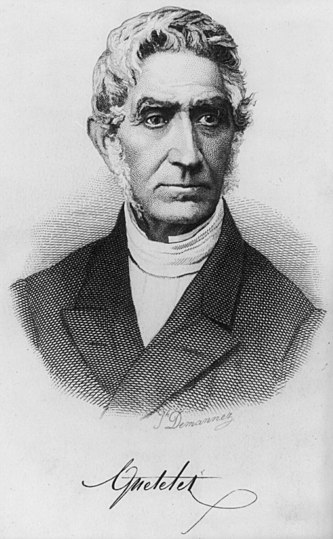


About Adolphe Quetelet
Lambert Adolphe Jacques Quetelet (or Quételet) (22 February 1796 – 17 February 1874) was a Belgian astronomer, mathematician, statistician and sociologist. He founded and directed the Brussels Observatory and was perpetual secretary of the Royal Academy of Brussels. Quetelet was influential in introducing statistical methods to the social sciences.
Best Adolphe Quetelet Quotes
Shortest
Earliest
Explore our curated collection of the most famous and impactful Adolphe Quetelet quotes.

“Society prepares the crime, and the guilty are only the instruments by which it is executed.”

“To him... who had examined the laws of light merely in a drop of water, the brilliant phenomenon of the rainbow would be totally unintelligible.”

“Expect not... that efforts for the moral regeneration of man can be immediately crowned with success; operations upon masses are ever slow in progress, and their effects distant.”
“As laws and the principles of religion and morality are influencing causes, I have then not only the hope, but, what you have not, the positive conviction, that society may be ameliorated and reformed.”

“Having for their object the Science of Man, present difficulties exceedingly great, and, to merit confidence, must be collected upon a scale far too extended to be attempted by an individual philosopher.”
“It has seemed to me that the theory (calcul) of probabilities ought to serve as the basis for the study of all the sciences, and particularly of the sciences of observation.”
“The Supreme has then not only spread life and movement throughout, and willed that its impress should be preserved, but has done more; for he has permitted man to associate in some degree with his work, and to modify it.”
“We then better understand the weakness of man, and the power of the Supreme: we are struck with the inflexible constancy of the laws which regulate the march of worlds, and which preside over the succession of human generations.”
“The progressive development of moral and intellectual man has scarcely occupied their [scientists] attention; nor have they noted how the faculties of his mind are at every age influenced by those of the body, nor how his faculties mutually react.”

“We might even predict annually how many individuals will stain their hands with the blood of their fellow-men, how many will be forgers, how many will deal in poison, pretty nearly in the same way as we may foretell annual births and deaths.”
“The analysis of the moral man through his actions, and of the intellectual man through his productions, seems to me calculated to form one of the most interesting parts of the sciences of observation, applied to anthropology.”

“Hitherto, the science of Man has been limited to researches... respecting some of its laws, to results deduced from single or insulated observations, and to theories often based on mere glimpses; and these constitute pretty nearly all the materials it possesses.”
“It may be seen, in my work, that the course which I have adopted is that followed by the natural philosopher, in order to grasp the laws that regulate the material world. By the seizure of facts, I seek to rise to an appreciation of the causes whence they spring.”
“I have sought to determine... the different relations of bulk, subsisting between the various parts of his frame; and to ascertain how far these relations become modified during his development, what they are in the flower of his age, and in what position they remain up to the instant of decay.”
“The more advanced the sciences have become, the more they have tended to enter the domain of mathematics, which is a sort of center towards which they converge. We can judge of the perfection to which a science has come by the facility, more or less great, with which it may be approached by calculation.”

“It is only by long and laborious study, and by the comparison of a number of individuals, that it will be possible to succeed in establishing correct average proportions each age, and in settling the limits betwixt they can be made to vary, without ceasing to be accurate and faithful to nature—our first and guide in this difficult study.”
“"There are few works on political economy," said Malthus to me, "which have been more spoken and less read than mine." All the absurdities which have been spoken and written respecting the illustrious English author, are well known. Certainly, by an appeal against such decisions, he would have all to gain, and nothing to lose, before a less prejudiced tribunal.”
“Judgments upon books are formed with even more haste and levity than judgments upon men. Writings are talked of without being known; and people take up an opinion for or against, in consequence of decisions which it would cost them some trouble to determine the source. These are evils which must be borne with patience, and the more so because they are common.”
“Social physics never can pretend to discover laws which will verify themselves in every particular, in the case of isolated individuals. The science will have rendered a service sufficiently vast, in giving more precise views upon a host of points, of which vague glimpses only were before possessed.”
“The words cited from my work, when viewed isolatedly, are far from expressing the idea which I wished to attach to them. The works of genius upon which our judgments bear are in general complex; for there is no work, constructed by genius, which does not suppose the exercise of various of its faculties. A skilful analysis could alone make out the part of each of them...”

“Moral phenomena, when observed on a great scale, are found to resemble physical phenomena; and we thus arrive... at the fundamental principle, that the greater the number of individuals observed, the more do individual peculiarities, whether physical or moral, become effaced, and leave in a prominent point of view the general facts, by virtue of which society exists and is preserved.”
“This observation is merely the extension of a law well known to all who have studied the condition of society in a philosophic manner: it is, that so long as the same causes exist, we must expect a repetition of the same effects. What has induced some to believe that moral phenomena did not obey this law, has been the too great influence ascribed all times to man himself over his actions.”

Adolphe Quetelet Quotes by Topic
Find exactly what you are looking for by browsing this categorized list of Adolphe Quetelet quotes by topic.
Adolphe Quetelet on History of science 2 quotes
“The more advanced the sciences have become, the more they have tended to enter the domain of mathematics, which is a sort of center towards which they converge. We can judge of the perfection to which a science has come by the facility, more or less great, with which it may be approached by calculation.”

Adolphe Quetelet on Mathematics
“The more advanced the sciences have become, the more they have tended to enter the domain of mathematics, which is a sort of center towards which they converge. We can judge of the perfection to which a science has come by the facility, more or less great, with which it may be approached by calculation.”
Quotes About Adolphe Quetelet
Gain deeper perspective through quotes about Adolphe Quetelet from others.
I. Bernard Cohen on Adolphe Quetelet
“The influence of Quetelet's ideas spread throughout the sciences, even to the physical sciences. The two primary founders of the modern kinetic theory of gases, based on considerations of probability, were James Clerk Maxwell and Ludwig Boltzmann. Both acknowledged their debt to Quetelet. ...historians generally consider the influence of the natural sciences on the social sciences, whereas in the case of Maxwell and Boltzmann, there is an influence of the social sciences on the natural sciences, as Theodore Porter has shown.”
Patricia Fara on Adolphe Quetelet
“God had been forcefully excluded from astronomy during the French Revolution, when Pierre-Simon Laplace rewrote Newton's ideas to create his [Laplace's] deterministic cosmos, in which scientific laws govern every movement of every planet with no need for divine intervention. Inspired by his success, a Belgian astronomer called Alphonse Quetelet decided that human societies are also controlled by laws. ...and so Quetelet suggested that an 'average man' can consistently encapsulate a nation's characteristics. ...Quetelet's successors took his ideas in many different directions. ...Data collection projects proliferated, and statisticians searched for laws governing every aspect of life. ...In physics, the most important application of statistics was to gases.”
Frank Hamilton Hankins on Adolphe Quetelet
“The most important of Quetelet's statistical principles... include the conception of the Average Man as a type, the significance for social science of the regularities found in the moral actions of man, and the theoretical basis of the distribution of group phenomena about their type.”
Hankins on Adolphe Quetelet 4 quotes
“Quetelet published quite a number of poems, and until the age of thirty he continued to exercise his poetical talents as pastime and relief from his scientific studies. His poems were of a serious tone, but were well received by both public and critics. We may mention here an Essai sur la romance, which Quetelet brought out in 1823. ...This essay, together with translations, in prose and in verse, of German, English, Italian, and Spanish romances, shows Quetelet's wide acquaintance at that early age with the various European literatures.”
F. J. Mouat on Adolphe Quetelet
“The mere enumeration of his contributions to pure and mixed mathematics would occupy a very large space, and from their intrinsic merit, patient and conscientious research and earnest regard for truth, would alone have secured him a foremost place among the distinguished and scientific men of the present century.”
Theodore M. Porter on Adolphe Quetelet
“In principle, wrote Quetelet, the courage or criminality of a real person could be established... but it was wholly unnecessary for social physics. Instead, the physicist need only arrange that courageous and criminal acts be recorded throughout society, as the latter already were, and then the average man could be assigned a "penchant for crime" equal to the number of criminal acts committed divided by the population. In this way, a set of discrete acts by distinct individuals was transformed into a continuous magnitude... an attribute of the average man.”
Tom Siegfried on Adolphe Quetelet 2 quotes
“Maxwell... mastered electricity and magnetism, light and heat, pretty much mopping up all the major areas of physics beyond those that Newton had... taken care of—gravitation and the laws of motion. ...Maxwell detected an essential shortcoming in Newton's laws of motion, too. They worked... for macroscopic objects, like cannonballs and rocks. But what about the submicroscopic molecules from which such objects were made? ...Newton's laws ...did you no good because you could not possibly trace the motion of an individual molecule ...Maxwell applied the sort of statistical thinking that Quetelet had promoted.”
About Adolphe Quetelet
Lambert Adolphe Jacques Quetelet (or Quételet) (22 February 1796 – 17 February 1874) was a Belgian astronomer, mathematician, statistician and sociologist. He founded and directed the Brussels Observatory and was perpetual secretary of the Royal Academy of Brussels. Quetelet was influential in introducing statistical methods to the social sciences.