Link Copied!
Henry Cavendish Quotes (1731-1810)
Scientist
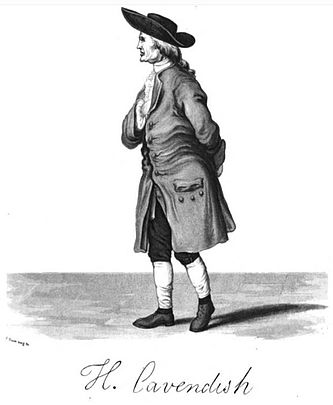
About Henry Cavendish
Henry Cavendish FRS (10 October 1731 – 24 February 1810) was a British scientist noted for his discovery of hydrogen or what he called "inflammable air". Cavendish is also known for the Cavendish experiment, his measurement of the Earth's density, and early research into electricity.
Best Henry Cavendish Quotes
Shortest
Earliest
Explore our curated collection of the most famous and impactful Henry Cavendish quotes.
“By factitious air, I mean in general any kind of air which is contained any in other bodies in an unelastic state, and is produced from thence by art.”
“By fixed air, I mean that particular species of factitious air, which is separated from alcaline substances by solution in acids or by calcination and to which Dr. Black has given that name in his treatise on quicklime.”
“I think we must allow that dephlogisticated air is in reality nothing but dephlogisticated water, or water deprived of its phlogiston; or, in other words, that water consists of dephlogisticated air united to phlogiston; and that inflammable air is either pure phlogiston, as Dr. Priestley and Mr. Kirwan suppose [and as Cavendish formerly supposed], or else water united to phlogiston; since, according to this supposition, these two substances united together form pure water. On the other hand, if the first explanation be true, we must suppose that dephlogisticated air consists of water united to a little nitrous acid and deprived of its phlogiston; but still the nitrous acid in it must make only a very small part of the whole, as it is found, that the phlogisticated air, which it is converted into, is very small in comparison of the dephlogisticated air.”

Henry Cavendish Quotes by Topic
Find exactly what you are looking for by browsing this categorized list of Henry Cavendish quotes by topic.
Henry Cavendish on Phlogiston theory
“From inflammable air and dephlogisticated air water is produced.”

Quotes About Henry Cavendish
Gain deeper perspective through quotes about Henry Cavendish from others.
Jean-Baptiste Biot on Henry Cavendish
“He was the wealthiest of all scholars (savants) and probably also the most scholarly of all the wealthy.”

Henry Brougham "Note on Henry Cavendish
“I never charged or thought of charging Mr. Cavendish with having obtained from Mr. Watt's paper his knowledge of the composition of water, and having knowingly borrowed it, however suspicious a case Mr. Harcourt's publication may seem to make. Both those great men, in my opinion, made the discovery apart from each other, and ignorant each of the other's doctrine. Mr. Cavendish was a man of the strictest integrity, and the most perfect sense of justice. His feelings were very far inferior to his principles. He was singularly callous to the ordinary calls of humanity, as there exist positive proofs sufficient to satisfy the polemical writer upon whose paper ['Eloge de M. Cavendish'] I have been commenting if he has any mind to see them. Nor do they rest on my assertion, for I never had any intercourse with him except in society. But the pursuits of a philosopher and the life of a recluse, which had so entirely hardened his heart, had not in the least degree impaired his sense of justice; and my own belief is, that he as entirely supposed himself to have alone made the discovery in question, as Sir Isaac Newton believed himself to be the sole discoverer of the nature of light, and the theory of the solar system.”
Benjamin Franklin on Henry Cavendish
“It were to be wished, that this noble philosopher would communicate more of his experiments to the world, as he makes many, and with great accuracy.”
Source on Henry Cavendish 18 quotes
“It only remains that I offer very briefly my own estimate of the character of the Philosopher. Morally it was a blank, and can be described only by a series of negations. He did not love; he did not hate; he did not hope; he did not fear; he did not worship as others do. He separated himself from his fellow men, and apparently from God. There was nothing earnest, enthusiastic, heroic, or chivalrous in his nature, and as little was there anything mean, grovelling, or ignoble. He was almost passionless.”
Footnote: on Henry Cavendish
“At the time Cavendish made his study of arsenic compounds, chemists still had not been able to "determine what it /arsenic/ really is, or to what class of bodies it belongs." ...[A]rsenic behaves as a metal in some states, and like a salt in other states. ...[L]ike every metallic calx, arsenic [could be] changed into a metallic form... "regulus of arsenic"... [by combining] with "phlogiston." ...[L]ike salts, arsenic is soluble in water. ...[N]either acidic nor alkaline, yet Macquer claimed, behaving as if it were an acid. ...In other ways ...arsenic differs from other... calces: it is volatile with a strong smell, it is fusible, it unites with metals and semimetals—the difference that Macquer and Cavendish picked up on—it decomposes nitre when distilled with it. From the standpoint of affinities... arsenic is exceptional too.”
About Henry Cavendish
Henry Cavendish FRS (10 October 1731 – 24 February 1810) was a British scientist noted for his discovery of hydrogen or what he called "inflammable air". Cavendish is also known for the Cavendish experiment, his measurement of the Earth's density, and early research into electricity.