Link Copied!
Francisco Franco Quotes (1892-1975)
Leader, King
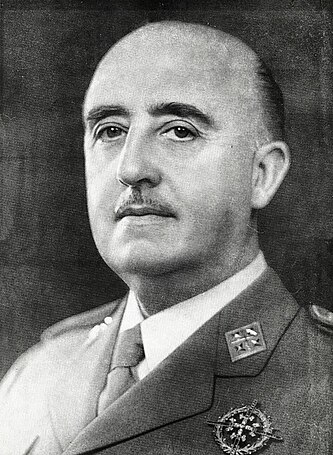
About Francisco Franco
Francisco Franco Bahamonde (4 December 1892 – 20 November 1975), commonly referred to as Francisco Franco, was a military generalísimo, leader of Spain (Caudillo de España) from October 1936 (whole country from April 1, 1939 on), and de-facto regent of the nominally restored Kingdom of Spain from 1947 until his death in 1975.
Best Francisco Franco Quotes
Shortest
Earliest
Explore our curated collection of the most famous and impactful Francisco Franco quotes.
“"It's true. They have everything. Everything except reason."”

“The defence of internal peace and order constitutes the sacred mission of a nation's armed forces and that is what we have carried out.”
“All is well, thank God... but victory will not be complete, definitive or stable, as long as Masonry is in our Spain. And how will it disappear? What to do? Ask Mussolini.”
“One thing that I am sure of, and which I can answer truthfully, is that whatever the contingencies that may arise here, wherever I am there will be no communism.”

“We do not believe in government through the voting booth. The Spanish national will was never freely expressed through the ballot box. Spain has no foolish dreams.”


“Let us be under no illusion. The Jewish spirit which was responsible for the alliance of large-scale capital with Marxism and was the driving force behind so many anti-Spanish revolutionary agreements, will not be got rid of in a day.”
“Un estado totalitario armonizará en España el funcionamiento de todas las capacidades y energías del país, que dentro de la Unidad Nacional, el trabajo estimado como el más ineludible de los deberes será el único exponente de la voluntad popular.”
“I say this to you because we Spaniards are a forgetful people, because we are used to living for the moment, because we do not look back, because we do not know how to see the chain of heroes, because we do not contemplate the sum of sacrifices.”
“We have torn up Marxist materialism and we have disorientated Masonry. We have thwarted the Satanic machinations of the clandestine Masonic superstate. Despite its control of the world’s press and numerous international politicians. Spain’s struggle is a Crusade; as soldiers of God we carry with us the evangelism of the world!”
“The Spanish Republic did not find itself free of obligations. For the most part the leaders were Freemasons. Before their duty to their country came their obligations to the Grand Orient. In my opinion, Freemasonry, with all its international influence, is the organization principally responsible for the political ruin of Spain, as well as the murder of Calvo Sotelo, who was executed in accordance with orders from the Grand Secretary of Freemasonry in Geneva.”
“Fascism, since that is the word that is used, fascism presents, wherever it manifests itself, characteristics which are varied to the extent that countries and national temperaments vary. It is essentially a defensive reaction of the organism, a manifestation of the desire to live, of the desire not to die, which at certain times seizes a whole people. So each people reacts in its own way, according to its conception of life. Our rising, here, has a Spanish meaning! What can it have in common with Hitlerism, which was, above all, a reaction against the state of things created by the defeat, and by the abdication and the despair that followed it?”

“Spaniards!
To all of you who feel holy love for Spain, to all of you who in the ranks of the army and the navy have sworn to serve the fatherland, to those of you who swore to defend it from its enemies with your lives, the nation calls you to defend it. The situation in Spain has been growing worse every day: anarchy reigns in most of the countryside and the towns; authorities named by the government preside over revolts, when they do not directly promote them. Pistols and machine guns are used to settle differences between groups of citizens, who murder each other treacherously and treasonously while the public powers do nothing to impose peace and justice.
Revolutionary strikes of all kinds paralyze the nation, ruining and destroying its sources of wealth and creating a situation of hunger that will throw working men into a state of desperation.
Artistic monuments and treasures are the object of the most frenzied attacks by revolutionary hordes obeying the commands they receive from foreign directors, who count on the complicity or negligence of governors and officials.
The most serious crimes are committed in the countryside while the forces of public order remain in their barracks, restrained by blind obedience to governors who intend to dishonor them. The army, the navy, and other military forces are the target of the lowest and most slanderous attacks by the very ones who should safeguard their prestige.”
“States of emergency and alarm only serve to muzzle the people and to keep Spain from knowing what is happening outside the gates of their towns and cities, as well as to jail supposed political adversaries. The constitution, constantly suspended and violated, has been completely eclipsed; there is neither equality before the law nor liberty, enchained by tyranny, nor fraternity, threatened by the tearing apart of the national territory... that the governing powers themselves are promoting, nor solidarity and defense of our borders, when in the heart of Spain people listen to foreign broadcasts preaching the destruction and division of our soil.
The judiciary, whose independence the constitution guarantees, also suffers persecutions that exhaust or neutralize it, and it is the target of withering attacks on its independence.
Electoral pacts made at the cost of the integrity of the very fatherland, together with assaults on civil governments and vaults [intended] to falsify their acts, created the mask of legality that rules over us. Nothing restrains the appetite for power...
In addition to the revolutionary and ignorant spirit of the masses deceived and exploited by Soviet agents, who hide the bloody reality of that regime that has sacrificed 25 million people for its existence, there is the maliciousness and negligence of authorities of all kinds, who, protected by an incompetent government, lack the authority and prestige to impose order and the rule of liberty and justice.”

“Can we consent to the shameful spectacle we are presenting to the world for one more day? Can we abandon Spain to the fatherland's enemies by cowardly and treasonous actions, surrendering it without a struggle and without resistance? No! The traitors may do so, but those of us who have sworn to defend it will not. We offer you justice and equality before the law. Peace and love among Spaniards. Liberty and fraternity free from libertinage and tyranny. Work for all. Social justice, carried out without rancor or violence, and an equitable and progressive distribution of wealth without destroying or endangering the Spanish economy. But first, a war without quarter against the exploiters of politics, against the deceivers of the honorable worker, and against the foreigners and would-be foreigners who, directly or indirectly, seek to destroy Spain. At this moment, it is Spain as a whole that is rising up and demanding peace, fraternity, and justice; in all of the regions, the army, the navy, and the forces of public order are rushing to defend the fatherland. The energy devoted to upholding order will match the magnitude of the resistance offered to it.
Our motives do not derive from the defense of a few illegitimate interests, nor from the desire to go backward along the path of history... Because the purity of our intentions prevents us from stifling those advances that represent an improvement in the political and social realm, and because the spirit of hatred and vengeance has no place in our hearts, we shall be able to salvage those legislative efforts which are compatible with the internal peace of Spain and its much-desired greatness, bringing about, for the first time in our country, the three-part order, Fraternity, liberty, and equality. Spaniards: Long live Spain! Long live the honorable Spanish people!”
Our motives do not derive from the defense of a few illegitimate interests, nor from the desire to go backward along the path of history... Because the purity of our intentions prevents us from stifling those advances that represent an improvement in the political and social realm, and because the spirit of hatred and vengeance has no place in our hearts, we shall be able to salvage those legislative efforts which are compatible with the internal peace of Spain and its much-desired greatness, bringing about, for the first time in our country, the three-part order, Fraternity, liberty, and equality. Spaniards: Long live Spain! Long live the honorable Spanish people!”
Francisco Franco Quotes by Topic
Find exactly what you are looking for by browsing this categorized list of Francisco Franco quotes by topic.
Francisco Franco on Spanish Civil War 3 quotes
“Spaniards! To all of you who feel holy love for Spain, to all of you who in the ranks of the army and the navy have sworn to serve the fatherland, to those of you who swore to defend it from its enemies with your lives, the nation calls you to defend it. The situation in Spain has been growing worse every day: anarchy reigns in most of the countryside and the towns; authorities named by the government preside over revolts, when they do not directly promote them. Pistols and machine guns are used to settle differences between groups of citizens, who murder each other treacherously and treasonously while the public powers do nothing to impose peace and justice. Revolutionary strikes of all kinds paralyze the nation, ruining and destroying its sources of wealth and creating a situation of hunger that will throw working men into a state of desperation. Artistic monuments and treasures are the object of the most frenzied attacks by revolutionary hordes obeying the commands they receive from foreign directors, who count on the complicity or negligence of governors and officials. The most serious crimes are committed in the countryside while the forces of public order remain in their barracks, restrained by blind obedience to governors who intend to dishonor them. The army, the navy, and other military forces are the target of the lowest and most slanderous attacks by the very ones who should safeguard their prestige.”

Francisco Franco on Spain 2 quotes
“I say this to you because we Spaniards are a forgetful people, because we are used to living for the moment, because we do not look back, because we do not know how to see the chain of heroes, because we do not contemplate the sum of sacrifices.”
Francisco Franco on Fascism
“Fascism, since that is the word that is used, fascism presents, wherever it manifests itself, characteristics which are varied to the extent that countries and national temperaments vary. It is essentially a defensive reaction of the organism, a manifestation of the desire to live, of the desire not to die, which at certain times seizes a whole people. So each people reacts in its own way, according to its conception of life. Our rising, here, has a Spanish meaning! What can it have in common with Hitlerism, which was, above all, a reaction against the state of things created by the defeat, and by the abdication and the despair that followed it?”
What Francisco Franco Said About Others
Discover personal opinions Francisco Franco shared regarding contemporaries.
Francisco Franco on António de Oliveira Salazar
“The most complete statesman, the one most worthy of respect, that I have known is Salazar. I regard him as an extraordinary personality for his intelligence, his political sense and his humility. His only defect is probably his modesty.”

Francisco Franco on Grand Orient of Italy
“The Spanish Republic did not find itself free of obligations. For the most part the leaders were Freemasons. Before their duty to their country came their obligations to the Grand Orient. In my opinion, Freemasonry, with all its international influence, is the organization principally responsible for the political ruin of Spain, as well as the murder of Calvo Sotelo, who was executed in accordance with orders from the Grand Secretary of Freemasonry in Geneva.”
Quotes About Francisco Franco
Gain deeper perspective through quotes about Francisco Franco from others.
Ofer Aderet on Francisco Franco 2 quotes
“Francisco Franco, the former fascist dictator of Spain, gave the Nazis a list of every Jew in his country in order to facilitate efforts to locate, deport and destroy them, according to a document found recently in a Spanish archive and reported on Sunday by the Spanish daily El Pais. The paper said that in 1941, Spain prepared a list of all 6,000 Jews in its territory and gave it to the architect of the Nazis' Final Solution, Heinrich Himmler...”
Madeline Albright on Francisco Franco 4 quotes
“The Spanish general had neither the look nor the commanding voice of a dashing military leader. He was short, pudgy, and balding, had a droopy countenance, was prone to crying, and- when issuing orders- he tended to squeak. Colleagues tended to refer to him behind his back as "Miss Canary Islands," a comment on both his demeanor and the remote site where he was stationed when the first shots were fired; but Franco was the sort of leader who could find his way through a minefield without putting a foot wrong. Unlike many, he expected the Civil War to be long, dirty, and closely fought. In preparation, he solicited and received aid from Hitler and Mussolini. To the irritation of both dictators, Franco resisted pressure for bold actions that, in his judgment, would have entailed taking excessive risks. Instead he waged war like a safecracker, turning the dial one click at a time. He used aerial bombardments to soften up any opposition before attacking on the ground. He paid careful attention to logistics and didn't squander his ammunition, equipment or men. He moved his headquarters close to the fighting and insisted that a field commander lead in retaking any territory on the global stage, for the Spanish Civil War (1936-1939) was of interest not solely to Spain.”
Sebastian Balfour on Francisco Franco
“Franco's own ideology was deeply conservative but it was subordinated to the perputation of his own power. He maintained control by repeatedly shifting the balance of influence within the regime according to internal and external pressures, and he continued to command loyalty by allowing the self-enrichment of his elites through the institutions of the state.”
Alvah Bessie on Francisco Franco 5 quotes
“"Bring us Franco's balls!" the men shouted. "'e ain't got no bloody balls," a voice replied.”
Martin Blinkhorn on Francisco Franco
“In April 1937 Franco, as effective head of state of Nationalist Spain, fused the Falange with the Carlists, monarchists and the rest of the right to form the single party of his regime: a process, though differently conducted, somewhat similar to Italian fascism's fusion with Nationalism and Clerico-Fascism after 1922. The product, like the Italian Fascist regime, was a compromise between radical fascism and conservative authoritarianism, in this case with unambiguous military and Church support.”
William F. Buckley on Francisco Franco
“General Franco is an authentic national hero. It is generally conceded that he above others had the combination of talents, the perseverance, and the sense of righteousness of his cause, that were required to wrest Spain from the hands of the visionaries, ideologues, Marxists and nihlistis that were imposing on her, in the thirties, a regime so grotesque as to do violence to the Spanish soul, to deny, even Spain's historical identity.”
Admiral Wilhelm Canaris. Quoted on Francisco Franco
Brian Crozier on Francisco Franco
“He was inevitably dubbed a fascist for accepting aid from the German and Italian dictators during the Civil War and for making Spain's version of a fascist party – the Falange – the core of his "Movement". But he was never particularly fascist, just as he had never been particularly monarchist or republican. Although he accepted help from Hitler, he gave refuge to thousands of Hitler's Jewish victims during the Second World War and revived citizenship rights for the Sephardic Jewish community of Salonika, to save it from Nazi persecution. Above all, Franco was a professional soldier, dedicated to the maintenance of discipline and order, with a minimal interest in constitutional forms and a paternalistic conception of his patriotic duty. Supporters of the "monster" myth would call him an opportunist; to upholders of the "hero" myth in its mildest form, he is simply a pragmatist.”
Niall Ferguson on Francisco Franco
“In Spain there was a constitutional monarchy from 1917 until 1923, then a military dictatorship under Primo de Rivera until 1930, then a republic that drifted steadily to the Left, culminating in the formation of the Popular Front coalition, which included both Communists and Socialists. After a bitter three-year civil war initiated in 1936 by a group of army officers and supported by the parties of the National Front, General Francisco Franco established himself as dictator, the beneficiary not only of German and Italian intervention but also of the debilitating 'civil war within the civil war' between the various factions of the Left.”

William Faulkner on Francisco Franco
“I most sincerely wish to go on record as being unalterably opposed to Franco and fascism, to all violations of the legal government and outrages against the people of Republican Spain.”

Clive Foss on Francisco Franco 2 quotes
“Franco ruled Spain, but not as a Republic. The Succession Law of 1947 defined the country as a monarchy, although it recognized Franco's power for his lifetime. He intended to name Juan Carlos, grandson of the late King Alfonso XIII as his successor, although he waited another 22 years before naming him. Franco called a plebiscite that approved his succession plans by a huge margin. He termed this (and similar votes) his 'democratic mandate': no other forms of democracy were needed. Franco was always cautious and considered all options before making up his mind. Reserved and spacious, but courteous and proud, he rarely revealed his feelings. But a particular book he published in 1952 exposed his thinking. Freemasonry blamed the problems of the world on Spain's enemies, Freemasons and Communists. For him, Roosevelt, Truman, and Churchill were all Masons, part of a destructive tide only temporarily held back by Hitler and Mussolini. When the western leaders met Stalin at Yalta and Potsdam, they confirmed Franco's worst fears. These erratic views were not widely publicized abroad.”
John Gunther on Francisco Franco
“It would be naïve in the extreme to dismiss General Francisco Franco as a villain or a butcher. He is a creature of his caste, a product of his moral environment, and a fairly typical example of it. He has been commended for intelligence and courage, and he possesses social grace and charm. Beyond doubt, as he sees patriotism, he is a patriot. He is an idealist too. But let it be remembered that he started the war, and if he loses it, he will be a man like such tragic figures as Wrangel and Deniken, who helped create what they sought to destroy. It is Franco- and what he represents- who knit Leftist Spain into a competent unity; if communism comes to Spain, General Franco will have been its accoucheur.”

Stanton Griffis on Francisco Franco
“Franco is hardworking, has a thorough knowledge of the Spanish political and economic situations, and is more astute politically than any of his opposition.”
Ernest Hemingway on Francisco Franco

Harold B. Hinton on Francisco Franco 2 quotes
“Just as the [1936 United States] presidential campaign neared its climax the Spanish Civil War broke out, lending point to the fears of the isolationists that the United States might get dragged into a general war against its wishes. We have tended to forget, under the influence of the great war to follow, for which the Spanish struggle was only a rehearsal, the intense bitterness it generated. That bitterness spread far and quickly beyond national frontiers and begat class struggle in foreign lands to an extent the Communist revolution in Russia never approached. For the Spanish war was nourished by religious fanaticism. In Spain the rich and conservative classes were devoted supporters of the Roman Catholic Church. It was their wealth that made the Church in Spain so rich as to be the main support of the Vatican in Rome. When the Spanish Republic, established after many vicissitudes following the departure of King Alfonso XIII, continued to gain strength at the subsequent elections and to attempt reforms, the rich Catholics decided things had gone far enough and that the good old days must be restored by force of arms. They made General Franco their champion and Mother Church their battle cry.”
Manuel Fraga Iribarne on Francisco Franco
“A great man...and the greatest and most representative of the Spanish people of the 20th century... one of the great leaders we have had in our history.”

Lyndon B. Johnson on Francisco Franco
“He is a champion of anti-communism.”

Ian Kershaw on Francisco Franco 4 quotes
“Franco, it is tempting to think, is too peripheral a figure to be ranked as a 'maker of twentieth-century Europe'- central to Spanish history of the era, naturally, but not necessarily of wider importance. It is, of course, obvious that Franco's wider impact scarcely compares with that of Hitler and Mussolini, or Lenin and Stalin. He presents a case-study in the role and impact of the individual in history at the lower end of the scale. And it is fair to say that for much of the twentieth century Spain was on the periphery of the key developments in Europe. It has been judged that Franco 'at best influenced world history during the 1930s. But the twentieth century would not have been much different without him.' Such an assessment is too dismissive. European as well as Spanish history would certainly, in indefinable ways, have been different had the republic survived after 1936. That it did not survive owed much to Franco's leadership in the Civil War. Moreover, the importance of that war was such that it drew in- in different measure- Europe's major powers and attracted the participation of volunteer fighters from across the continent. Franco's dealings with the Axis powers during the Second World War and then with the West during the Cold War also gave his long dictatorship a significance not confined to Spain. Moreover, the character of the subsequent transition to pluralist democracy, and the impact of Franco's era on Spanish memory and political culture and on the divisive question of regional separatism in one of Europe's biggest countries, additionally make Franco a figure of relevance to European, not just Spanish, history. Not least, '''Franco demonstrates how an individual with recognized qualities as a military commander but no experience of political leadership could benefit from the historical conditions that made his assumption of power possible in the first place and enabled him to go on to 'make his own history.''''”
Erik von Kuehnelt-Leddihn on Francisco Franco 2 quotes
“A democracy can be highly illiberal, while on the other hand an absolute ruler could be a thorough liberal—without being for this reason the least bit democratic. Even a dictator, theoretically, could be a liberal. [...] A purely military dictatorship based on the bayonets and sabres of a handful of professional soldiers has greater liberal potentialities (one has only to compare Franco, Oliveira Salazar and Pétain with Hitler, Mussolini and Stalin).”

José Larios on Francisco Franco 2 quotes
“The Madrid victory parade took place on May 19. This time we formed the letters "F-R-A-N-C-O," a still more difficult flying maneuver. We flew straight up the Castellana, high in the clear sky, while thousands of troops, tanks, and guns moved through the city. The enthusiasm was unsurpassed. A few months later I retired from the air force, but I remain in the reserve to this day. On October 19, 1939, Paz and I were married in Seville's magnificent cathedral. We now have six children, two girls and four boys, age eight to twenty-four. We had won the war, yet our troubles were not over by any means. A major work of reconstruction lay ahead for a ruined but vigorous and proud country. But a new World War was looming up menacingly and was to delay and hinder the steep uphill climb; also ahead lay the years of isolation by a hostile world. The years have flown and hate's sharp and bitter edge has been dulled and blunted by the healing balm of time. New generations have sprung up to fill the ranks where once stood veterans, united, shoulder to shoulder, to save Spain, our beloved country, from national death. Reconstruction has, in truth, flourished under the warm sun of social justice and twenty-five years of peace, our hard-won peace. The firm and steady hand of a great captain and patriot, in my view one of the greatest in Spain's long history, has held the tiller of the ship of state through fierce gales and in and out of sharp reefs, to steer it to a calm and prosperous anchorage. If the spirit, courage, and overwhelming national enthusiasm born on July 18, 1936, can be kept alive by present generations and kindled in succeeding ones Spain need have no fear from any internal foes nor from inveterate enemies beyond her frontiers.”
About Francisco Franco
Francisco Franco Bahamonde (4 December 1892 – 20 November 1975), commonly referred to as Francisco Franco, was a military generalísimo, leader of Spain (Caudillo de España) from October 1936 (whole country from April 1, 1939 on), and de-facto regent of the nominally restored Kingdom of Spain from 1947 until his death in 1975.