James Howard Kunstler on Population decline
← Back to James Howard Kunstler Profile
“The attrition of global populations by disease may be unavoidable. Some readers may regard it as the inevitable revenge of nature against the hubris of a human species arrogantly exceeding the carrying capacity of its habitat. Some may regard it as a moral victory against wickedness. Some may view it in the therapeutic mode as a positive development for the health of the planet. Many self-conscious "humanists" have militated for the goal of reducing population growth—though most of them would have probably preferred widespread birth control to a die-off. But that kind of thinking might have been just another product of the narcotic comfort of cheap oil, as merely stabilizing the earth's population at current levels (or even 1968 levels) would arguably still have left humanity beyond the earth's carrying capacity. Apart from these issues of attitude and ethics, however, a major decline in world population, or [a] change in demographic profiles, is apt to have profound and strange repercussions on everyday life.”
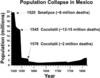
“Peak [living] human population will… lag… peak [extraction of] oil and peak [extraction of other] mineral resources until these conditions express themselves as food shortages. This means that the human population will continue to rise for a while, even as we begin to encounter these… limits. It’s not possible to estimate how much the [living] population will increase because the relationship between energy and mineral resources and food production is a very fragile equation, subject to any number of discontinuities. To these, add the complications of weather disasters arising from climate change, including drought, the spread of plant diseases, and so forth. This lagging further rise in [the living] human population will only make the inevitable contraction more acute once food shortages begin. […] We're putting a strain on everything the earth has to offer us. While the combination of peak stuff and… billion[s of] [living] humans is forcing the issue, ...the truth is that circumstances will now determine what happens, not policies or personalities. […] Population overshoot is therefore unlikely to yield to management. Rather, the usual suspects will enter the scene and do their thing: starvation, disease, […] violence […] [and] death […].”