Link Copied!
B. H. Liddell Hart Quotes (1895-1970)
King
About B. H. Liddell Hart
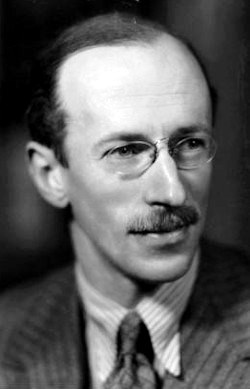
Sir Basil Henry Liddell Hart (31 October 1895 – 29 January 1970), commonly known throughout most of his career as Captain B. H. Liddell Hart, was a British soldier, military historian and military theorist. He wrote a series of military histories that proved influential among strategists. He argued that frontal assault was a strategy that was bound to fail at great cost in lives as happened in the First World War. He instead recommended the "indirect approach" and reliance on fast-moving armoured formations.
Best B. H. Liddell Hart Quotes
Shortest
Earliest
Explore our curated collection of the most famous and impactful B. H. Liddell Hart quotes.
“Clausewitz's principle of force without limit and without calculation of cost fits, and is only fit for, a hate-maddened mob. It is the negation of statesmanship—and of intelligent strategy, which seeks to serve the ends of policy.”
“Unless our field force could arrive on the scene during this opening phase—and it is difficult to see how it could, since it has to cross the sea—our assistance might be more profitably given in the form of a proportionately larger contribution in air strength.”
“If one weighs his [ Carl von Clausewitz] influence and his emphasis, one might describe him historically as the Mahdi of mass and mutual massacre. For he was the source of the doctrine of "absolute war", the fight to a finish theory which, beginning with the argument that "war is only a continuation of state policy by other means", ended by making policy the slave of strategy.”

“At present one clear factor in the problem is that the offensive is as much at an advantage in the air as it is at a disadvantage on land. This comparison, in conjunction with our present deficiencies, has suggested that the offensive role of an expeditionary force might be entrusted to the Air Force. Apart from its greater promise of effect, it could be conducted from our own shores or from bases more easy to secure and more remote from the enemy than the zone an army requires; and it would avoid many of the complications involved, and evolving, when we land an army on the Continent. The Army could then be left to fulfil its Imperial garrison and police duties, with the possible addition of covering the oversea bases of our Expeditionary Air Force.”

“The new risks to such a force under modern military conditions have also to be weighed. The risks that were incurred in 1914, in landing a field force of 100,000 men in a foreign land, were much less than would be run to-day—when it may have greater distances to cover, and when both railways and roads will lie under the menace of air attack. Broken communications are bad enough when an army is in its own territory, or one where it has complete control. In face of air attack it is impossible to ignore the risk of a field force being stranded with no prospect either of reaching the front or of maintaining itself. In such a plight it could do little for the defence of British interests and it would be more nuisance than a help to any ally... Before the idea of intervention by land is accepted as politically indispensable, there should be full acknowledgement of its unstable military foundations. It should also be made clear to any nation looking to British aid, whether under the old Locarno Treaty or under its possible successor, first, that they may get more value from increased air assistance, which would naturally become effective sooner, in place of a field force; secondly, that the dispatch of a field force cannot imply a willingness to reinforce it without limit, and to expend the massed man-power of this nation, fully engaged as it must be by sea and and in the air, and in factory and farm, in another four years' process of exploring by trial and error a problem which can be, and could have been, examined scientifically.”
B. H. Liddell Hart Quotes by Topic
Find exactly what you are looking for by browsing this categorized list of B. H. Liddell Hart quotes by topic.
B. H. Liddell Hart on British Army 2 quotes
“At present one clear factor in the problem is that the offensive is as much at an advantage in the air as it is at a disadvantage on land. This comparison, in conjunction with our present deficiencies, has suggested that the offensive role of an expeditionary force might be entrusted to the Air Force. Apart from its greater promise of effect, it could be conducted from our own shores or from bases more easy to secure and more remote from the enemy than the zone an army requires; and it would avoid many of the complications involved, and evolving, when we land an army on the Continent. The Army could then be left to fulfil its Imperial garrison and police duties, with the possible addition of covering the oversea bases of our Expeditionary Air Force.”

What B. H. Liddell Hart Said About Others
Discover personal opinions B. H. Liddell Hart shared regarding contemporaries.
B. H. Liddell Hart on Carl von Clausewitz 2 quotes
“Clausewitz's principle of force without limit and without calculation of cost fits, and is only fit for, a hate-maddened mob. It is the negation of statesmanship—and of intelligent strategy, which seeks to serve the ends of policy.”

B. H. Liddell Hart on Samuel Hoare, 1st Viscount Templewood
“He had a very sharp mind, along with a sharpness of facial outline that reflected his primly precise manner—which prompted "F. E.", Lord Birkenhead, with devastating aptness to describe him as "the last of a long line of maiden aunts". He also had an irritating mannerism of interjecting "Yes, yes" at short intervals in any conversation.”
B. H. Liddell Hart on Günther Blumentritt
“He felt that the ‘halt’ had been called for more than military reasons, and that it was part of a political scheme to make peace easier to reach. If the British Army had been captured at Dunkirk, the British people might have felt that their honour had suffered a stain which they must wipe out. By letting it escape Hitler hoped to conciliate them.”
Quotes About B. H. Liddell Hart
Gain deeper perspective through quotes about B. H. Liddell Hart from others.
Neville Chamberlain on B. H. Liddell Hart
“I have been reading Europe in Arms by Liddell Hart. If you have not already done so, you might find it interesting to glance at this, especially the chapter on the "Role of the British Army."”
Niall Ferguson on B. H. Liddell Hart 2 quotes
“Blitzkrieg is, of course, a German word meaning 'lightning war'. The ironic thing is that it was in many ways a British invention, derived from the lessons of the Western Front in the First World War. Captain Basil Liddell Hart had drawn his own conclusions from the excessively high casualties suffered by both sides. As an infantry subaltern, he himself had been gassed, the long-term effects of which forced him to retire from the army in 1927, after which he turned to journalism, working as defence correspondent for the Daily Telegraph and then The Times and publishing numerous works of military history. In Liddell Hart's view, the fatal mistake of most offensives on the Western Front had been their ponderous and predictable directness. A more 'indirect approach', he argued, would aim at surprising the enemy, throwing his commanders off balance, and then exploiting the ensuing confusion. The essence was to concentrate armour and air power in a lethal lightning strike.”

Heinz Guderian on B. H. Liddell Hart
“It was principally the books and articles of the Englishmen, Fuller, Liddell Hart and Martel, that excited my interest and gave me food for thought. These far-sighted soldiers were even then trying to make of the tank something more than just an infantry support weapon. They envisaged it in relationship to the growing motorization of our age, and thus they became the pioneers of a new type of warfare on the largest scale. I learned from them the concentration of armour, as employed in the battle of Cambrai. Further, it was Liddell Hart who emphasized the use of armoured forces for long-range strokes, operations against the opposing army's communications, and also proposed a type of armoured division combining panzer and panzer-infantry units. Deeply impressed by these ideas I tried to develop them in a sense practicable for our own army. So I owe many suggestions of our further development to Captain Liddell Hart.”
Leslie Hore-Belisha on B. H. Liddell Hart
“I immediately read the "Role of the British Army" in Liddell Hart's book. I am impressed by his general theories.”
Michael Howard on B. H. Liddell Hart
“It would be doing Liddell Hart an injustice, both as a historian and as a controversialist, to suggest that this analysis of British strategy was anything more than a piece of brilliant political pamphleteering, sharply argued, selectively illustrated, and concerned rather to influence British public opinion and government policy than to illuminate the complexities of the past in any serious or scholarly way.”


About B. H. Liddell Hart
Sir Basil Henry Liddell Hart (31 October 1895 – 29 January 1970), commonly known throughout most of his career as Captain B. H. Liddell Hart, was a British soldier, military historian and military theorist. He wrote a series of military histories that proved influential among strategists. He argued that frontal assault was a strategy that was bound to fail at great cost in lives as happened in the First World War. He instead recommended the "indirect approach" and reliance on fast-moving armoured formations.