Link Copied!
Benedict Arnold Quotes (1741-1801)
King, Revolutionary
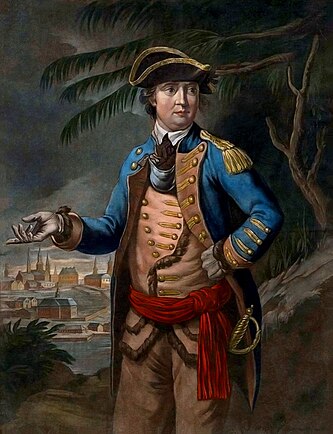
About Benedict Arnold
Benedict Arnold V (January 14 1741 – June 14 1801) was an American military officer who served during the Revolutionary War. He fought with distinction for the American Continental Army, rising to the rank of major general, before defecting to the British side of the conflict in 1780. General George Washington had given him his fullest trust and placed him in command of West Point, New York. Arnold planned to surrender the fort to British forces, but the plot was discovered in September 1780 and he fled to the British lines. Arnold received a commission as a brigadier general in the British Army, commanding the American Legion in the later part of the conflict. Arnold's name quickly became a byword in the United States for treason and betrayal because he led the British army in battle against the very men whom he had once commanded.
Best Benedict Arnold Quotes
Shortest
Earliest
Explore our curated collection of the most famous and impactful Benedict Arnold quotes.
“What do you think would be my fate if my misguided countrymen were to take me prisoner?”

“We have but very indifferent men in general. Great part of those who ship for seamen know very little of the matter.”
“The drafts from the regiments at Ticonderoga are a miserable set; indeed the men on board the fleet, in general, are not equal to half their number of good men.”
“Neglected by Congress below; pinched with every want here; distressed with the small-pox; want of Generals and discipline in our Army — which may rather be called a great rabble — our late unhappy retreat from Quebec, and loss of the Cedars; our credit and reputation lost, and great part of the country; and a powerful foreign enemy advancing upon us; are so many difficulties we cannot surmount them. My whole thoughts are now bent on making a safe retreat out of this country; however, I hope we shall not be obliged to leave it until we have had one bout more for the honour of America. I think we can make a stand at Isle-aux-Noix, and keep the Lake this summer from an invasion that way. We have little to fear; but I am heartily chagrined to think we have lost in one month all the immortal Montgomery was a whole campaign in gaining, together with our credit, and many men and an amazing sum of money. The commissioners this day leave us, as our good fortune has long since; but as Miss, like most other Misses, is fickle, and often changes, I still hope for her favors again; and that we shall have the pleasure of dying or living happy together.”

Quotes About Benedict Arnold
Gain deeper perspective through quotes about Benedict Arnold from others.
Allan R. Millett on Benedict Arnold
“Compounding the agony was the treason of Benedict Arnold, who conspired to sell the plans of West Point- the crucial fortress in Washington's Hudson Highlands defense system- to the British. While some believed the conspiracy's failure afforded, as Greene said, "the most convincing proofs that the liberties of America are the object of divine protection," others wondered whether the cause would survive. If Arnold, who served so nobly at Quebec, at Valcour Island, and during the Saratoga campaign, had lost all sense of honor and patriotism, how many others might follow his treasonous path?”
About Benedict Arnold
Benedict Arnold V (January 14 1741 – June 14 1801) was an American military officer who served during the Revolutionary War. He fought with distinction for the American Continental Army, rising to the rank of major general, before defecting to the British side of the conflict in 1780. General George Washington had given him his fullest trust and placed him in command of West Point, New York. Arnold planned to surrender the fort to British forces, but the plot was discovered in September 1780 and he fled to the British lines. Arnold received a commission as a brigadier general in the British Army, commanding the American Legion in the later part of the conflict. Arnold's name quickly became a byword in the United States for treason and betrayal because he led the British army in battle against the very men whom he had once commanded.