Link Copied!
World War I Quotes (1914-1918)
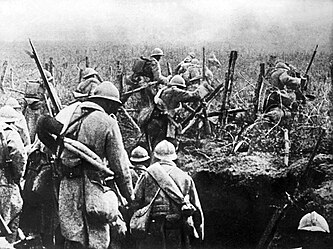
About World War I
World War I (WWI or WW1), also known as the First World War or the Great War, was a global war centred in Europe that began on 28 July 1914 and lasted until 11 November 1918. More than 9 million combatants and 7 million civilians died as a result of the war, a casualty rate exacerbated by the belligerents' technological and industrial sophistication, and tactical stalemate. It was one of the deadliest conflicts in history, paving the way for major political changes, including revolutions in many of the nations involved.
Best World War I Quotes
Shortest
Earliest
Explore our curated collection of the most famous and impactful World War I quotes.
“In war-time the word patriotism means suppression of truth.”

“What passing-bells for these who die as cattle?
Only the monstrous anger of the guns.”
Only the monstrous anger of the guns.”


An unidentified actress found unexpected fulfillment in wartime factory work during World War I, expressing pride in supporting soldiers "on the other side."
“It have been one of the richest experiences of my life...feeling that I was being really useful to the boys on the other side.”
Speaking amidst WWI calls for negotiated peace, Winston Churchill's defiant 1918 rally cry solidified Allied resolve to pursue total victory over Germany.
“No compromise on the main purpose; no peace till victory; no pact with unrepentant wrong -- that is the Declaration of July 4th, 1918.”

“The First World War had begun – imposed on the statesmen of Europe by railway timetables. It was an unexpected climax to the railway age.”
“The protagonists of 1914 were sleepwalkers, watchful but unseeing, haunted by dreams, yet blind to the reality of the horror they were about to bring into the world.”
“For all the astounding growth in man’s power, there had been no parallel increase in responsibility. The caveman with the club was now a caveman with a machine gun.”
“I think a curse should rest on me — because I love this war. I know it's smashing and shattering the lives of thousands every moment — and yet — I can't help it — I enjoy every second of it.”
“the big war of 1914-1918 was not my war. It was plainly not a war for democracy but for plutocracy; not for peace but for plunder, and to make our country military-minded. It was capitalism's war-not mine.”
Facing defeat in WWI, Kaiser Wilhelm II framed the conflict as a battle between virtuous "Germanic ideals" and the corrupting influence of "Anglo-Saxon" materialism.
“Either Germanic ideals or Anglo-Saxon ones must prevail. Justice, freedom, honor, and virtue will triumph, or the worship of money. There can be only one victor in this struggle. German ideals are at stake!”

“To me the war was an abomination, a madness, a crime, and from the first moment onwards–more out of impulse than reflection–I inwardly rejected it and could never reconcile myself with it up to this very moment.”

“In retrospect, Jean Jaurès and Rosa Luxemburg seem to me the only delegates who, like Adler, realized fully the inevitability of the World War and the horrors it entailed.”
“Among novels dealing actually with the war, I know of few that come even near success. The shock was too great, the shadow too heavy, the horror too vast, for contemporary artists. Their consciousness would not accept it, still less arrange it.”

“Anyone who thinks of the Germans as a naturally bellicose people should recall that Prussia-Germany was the only one of the continental powers in the run-up to 1914 whose elite seriously feared that if they had their war, their people might refuse to fight it.”
“The First World War was at once piteous, in the poet's sense, and 'a pity'. It was something worse than a tragedy, which is ultimately something we are taught by the theatre to regard as unavoidable. It was nothing less than the greatest error of modern history.”
“The First World War killed fewer victims than the Second World War, destroyed fewer buildings, and uprooted millions instead of tens of millions — but in many ways it left even deeper scars both on the mind and on the map of Europe. The old world never recovered from the shock.”

On the brink of World War I, Tsar Nicholas II desperately pleaded with Kaiser Wilhelm II to restrain Germany's allies and avert a looming European conflict.
“I foresee that very soon I shall be overwhelmed by the pressure forced upon me and be forced to take extreme measures which will lead to war. To try and avoid such a calamity as a European war I beg you in the name of our old friendship to do what you can to stop your allies from going too far. Nicky.”
“If, on the eve of the war, a fortune teller had pointed to all the Australian men between the ages of 20 and 30, and had predicted that a number equal to 60 per cent of that age group would be killed or permanently disabled in the coming war, she would have been ridiculed but she would have been correct.”
About World War I
World War I (WWI or WW1), also known as the First World War or the Great War, was a global war centred in Europe that began on 28 July 1914 and lasted until 11 November 1918. More than 9 million combatants and 7 million civilians died as a result of the war, a casualty rate exacerbated by the belligerents' technological and industrial sophistication, and tactical stalemate. It was one of the deadliest conflicts in history, paving the way for major political changes, including revolutions in many of the nations involved.