Link Copied!
William Saroyan Quotes (1908-1981)
Author
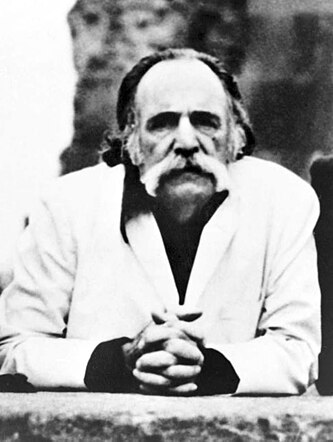




About William Saroyan
William Saroyan (31 August 1908 – 18 May 1981) was an Armenian American author, famous for his novel The Human Comedy (1943) and other works dealing with the comedies and tragedies of everyday existence.
Best William Saroyan Quotes
Shortest
Earliest
Explore our curated collection of the most famous and impactful William Saroyan quotes.


“Art is what is irresistible.”


“All things lie dark in possibility.”

“Illness must be considered to be as natural as health.”

“Everything begins with inhale and exhale, and never ends.”

“I do not believe in races. I do not believe in governments.”
“I am enormously wise and abysmally ignorant.”


William Saroyan Quotes by Topic
Find exactly what you are looking for by browsing this categorized list of William Saroyan quotes by topic.
William Saroyan on Life 2 quotes
View all 2 quotes on Life →William Saroyan on Cycling 2 quotes
“Going around the world on a bicycle is no longer enough -- the daredevil has got to go around the moon on a Pogo stick with one arm tied behind him if he wants to get his picture in the paper.”

William Saroyan on Laughter 2 quotes
“Try to learn to breathe deeply, really to taste food when you eat, and when you sleep really to sleep. Try as much as possible to be wholly alive with all your might, and when you laugh, laugh like hell. And when you get angry, get good and angry. Try to be alive. You will be dead soon enough.”

William Saroyan on Hatred
William Saroyan on Now
William Saroyan on Happiness
“The greatest happiness you can have is knowing that you do not necessarily require happiness.”

William Saroyan on Children
“My daughter, before she was sixteen, and especially before she was six, absolutely stunned me every day by the simple beauty and sweetness of her truth.”
William Saroyan on Public speaking
“In the tradition of popular oratory, Trash [a nickname] started a talk at random, moved confidently ahead in no particular direction, and, although he spoke very clearly, said nothing.”

William Saroyan on Truth
“Everything and everybody is sooner or later identified, defined, and put in perspective. The truth as always is simultaneously better and worse than what the popular myth-making has it.”
William Saroyan on Cowardice
“Cowards are nice, they're interesting, they're gentle, they wouldn't think of shooting down people in a parade from a tower. They want to live, so they can see their kids. They're very brave.”

What William Saroyan Said About Others
Discover personal opinions William Saroyan shared regarding contemporaries.
William Saroyan on Arthur Schopenhauer
“I have read Schopenhauer at the age of twelve with no bewilderment and no contempt of his contempt for the world and its strange inhabitants, and no contempt for the strange inhabitant himself.”

William Saroyan on Armenians
“There is a small area of land in Asia Minor that is called Armenia, but it is not so. It is not Armenia. It is a place. There are only Armenians, and they inhabit the earth, not Armenia, since there is no Armenia. There is no America and there is no England, and no France, and no Italy. There is only the earth.”

William Saroyan on George Bernard Shaw
“I found many men to whom I felt deeply grateful — especially Guy de Maupassant, Jack London, and H. L. Mencken — but the first man to whom I felt definitely related was George Bernard Shaw. This is a presumptuous or fatuous thing to mention, perhaps, but even so it must be mentioned. ... I myself, as a person, have been influenced by many writers and many things, and my writing has felt the impact of the writing of many writers, some relatively unknown and unimportant, some downright bad. But probably the greatest influence of them all when an influence is most effective — when the man being influenced is nowhere near being solid in his own right — has been the influence of the great tall man with the white beard, the lively eyes, the swift wit and the impish chuckle. ... I have been fascinated by it all, grateful for it all, grateful for the sheer majesty of the existence of ideas, stories, fables, and paper and ink and print and books to hold them all together for a man to take aside and examine alone. But the man I liked most and the man who seemed to remind me of myself — of what I really was and would surely become — was George Bernard Shaw.”

Quotes About William Saroyan
Gain deeper perspective through quotes about William Saroyan from others.
Source on William Saroyan 6 quotes
“Art can no longer afford to be contemptuous of politics, and it appears to be time politics took a little instruction from art.”
Anonymous editorial on William Saroyan
“I say the time is ripe for a William Saroyan revival... Bill Saroyan, that rollicking elf of an author who knew well of irony and compassion and laughter, wrote first-class original works for television, and the adaptations of his plays invariably hit the mark. I am thinking now in particular of the Playhouse 90 production of "The Time of Your Life." In it Jackie Gleason delivered a tremendous portrayal as Joe the philosopher who had this wistful greeting for everyone who entered the bar: "What's the dream?" ... In one of his last essays you may find a perceptive line that tells of the Saroyan working philosophy: "The purpose of writing is both to keep up with life and to run ahead of it." ... He looked, William Saroyan, exactly the way you would expect him to look. He had a huge mustache and a booming voice and a commanding presence. He was exuberant. He was mischievous. He was fun. … How he could make the English language soar! His words danced. This was writing that was never inhabited by wallflowers. This was Bill Saroyan.”
Stephen Fry on William Saroyan
“He is one of the most underrated writers of the century. He takes his place naturally alongside Hemingway, Steinbeck and Faulkner.”

John Hutchison on William Saroyan 2 quotes
“Saroyan's output from 1934 to 1940 established his reputation. What enthralled critics and readers was the brashness and certainty of his daring: Beginning with his first collection of linked short stories — written in 30 days, a story each day — and mailed off to Whit Burnett at Story Magazine. This was a new, fresh, exuberant kind of writing, intensely personal, prose poems which departed from customary narrative structures and sauntered elliptically with the awe of a young man fully realizing the most self-evident of truths: himself, alive upon the earth. … My recollection of those first Saroyan stories is typical: watching his language mesh the spiritual hunger and the actual physical hunger of the penniless main character was to be in the presence of a breathtaking act of creation. Hope and possibility were mandatory components to the human comedy as Saroyan viewed it. Accepting madness as the only constant in the universe never precluded joy and laughter. Cynicism had no place in the way one approached each day. Whimsy, compassion, a ready smile and the gift of interior and exterior motion were to be the tools.”
Peter H. King on William Saroyan
“One need not have been raised in Fresno to appreciate Saroyan, though I suppose it helps. Certainly he, better than anybody, captured the valley's strange texture: the mishmash landscape of farm, town and deserts; the jostling of so many different peoples, all a bit bewildered at finding themselves thrown together … Certainly Fresnans never forgave Saroyan for his harsher observations about the old hometown. The more political Armenians complained he wasted too many words on the human comedy, and not enough on the tragedy of a lost homeland. That he wrote so personally, and from the heart, gave literary critics their target: He was, they scolded, an undisciplined sentimentalist, mawkish. … For whatever reasons, Saroyan today is held under book-land quarantine. Few of his titles are in print. He's barely taught in schools. His own plans for literary legacy — a writers-in-residence program, posthumous publication of many works — have been scrapped or stalled. They did name a theater after him in Fresno, the one thing he expressly requested not be done. Those who remain under the Saroyan spell can only hope that the world will come around. His work simply seems too extraordinary, and universal, to be cleared from the shelves...”
José Quintero on William Saroyan
“A great man for the arts should be celebrated not because of the past, but for the future.”
Richard Rodriguez on William Saroyan
“He was the first writer I fell in love with, boyishly in love. I was held by his unaffected voice, his sentimentality, his defiant individualism. I found myself in the stories he told... I learned from Saroyan that you do not have to live in some great city — in New York or Paris — in order to write... When I was a student at Stanford, a generation ago, the name of William Saroyan was never mentioned by any professor in the English Department. William Saroyan apparently was not considered a major American talent. Instead, we undergraduates set about the business of psychoanalyzing Hamlet and deconstructing Lolita. In my mind Saroyan belongs with John Steinbeck, a fellow small town Californian and of the same generation. He belongs with Thornton Wilder, with those writers whose aching love of America was formed by the Depression and the shadow of war. … Saroyan's prose is as plain as it is strong. He talks about the pleasure of drinking water from a hose on a summer afternoon in California's Central Valley, and he holds you with the pure line. My favorite is his novel The Human Comedy... In 1943, The Human Comedy became an MGM movie starring Mickey Rooney, but I always imagined Homer Macaulay as a darker, more soulful boy, someone who looked very much like a young William Saroyan...”
Virginia Scardigli in a letter to The William Saroyan Society (October 1995) on William Saroyan
“Always, Bill talked about being and becoming a writer, of all the stories and ideas inside him that had to come out. We knew he had been sending out stories all along and collecting rejection slips but the day in 1934 when Joe Danysh and I arrived at the front door of the gallery and found the envelope addressed to us both, we knew it had really begun. Inside were two one dollar bills, two street car transfers and a card which read "One for the, money / one for the show / one For Virginia / and one for Joe." Signed William Shakespeare.”
About William Saroyan
William Saroyan (31 August 1908 – 18 May 1981) was an Armenian American author, famous for his novel The Human Comedy (1943) and other works dealing with the comedies and tragedies of everyday existence.