Walter R. Borneman on Douglas MacArthur
← Back to Walter R. Borneman Profile
“George Marshall may well have sighed at the results of the March 1945 poll- not at his own place but at MacArthur's. Marshall, more than most, knew the whole story of MacArthur's war. It is a mark of Marshall's own greatness that he so deftly managed MacArthur's fiery comet and unselfishly used its brilliance to accomplish the objectives of a global war.”
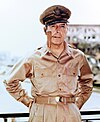
“Douglas MacArthur has been dead for over fifty years yet he remains one of the most controversial military figures of the twentieth century. His well-polished reputation was far from unanimously accepted among his contemporaries, and a half-century has done nothing to smooth the contradictions of his personality and his career. There remains no middle ground with Douglas MacArthur.”
“Most importantly, in a fragile period of the American psyche when the general American public, still stunned by the shock of Pearl Harbor and uncertain what lay ahead in Europe, desperately needed a hero, they wholeheartedly embraced Douglas MacArthur—good press copy that he was. There simply were no other choices that came close to matching his mystique, not to mention his evocative lone-wolf stand—something that has always resonated with Americans.”
“Ironically, during four years of war, MacArthur may have owed the most to the very people he was certain were out to discredit and disparage him. While never among his fans, Franklin Roosevelt and George Marshall nonetheless consistently supported MacArthur within the framework of their global priorities, from the first efforts to resupply the Philippines to MacArthur's appointment as Allied supreme commander. Even then, where would MacArthur's Southwest Pacific Area have been had not Ernie King urged the Joint Chiefs to pour resources into the Pacific and wage a two-front war?”
“On a raw November day in 1863, the Twenty-Fourth Wisconsin formed beneath Missionary Ridge outside Chattanooga, Tennessee. Union troops were trying to lift the siege of the town, but Confederate defenders were proving stubborn. Quite suddenly, without orders, Union regiments in the center of the line began to move up the ridge. When their wild advance was over, among the battle flags atop the crest was the standard of the Twenty-Fourth Wisconsin, carried there by its eighteen-year-old "boy colonel," Arthur MacArthur, whose son, Douglas, would spend most of his own military career trying to emulate his father's charge.”
“On September 2, 1945, after four years of war, one thing was certain about Douglas MacArthur and his place in history. His rhetoric, however hyperbolic at times, and his characterization of events, however embellished his facts, had served to generate an enormous rallying cry for the American people in the dark days of 1942. Responsible though he was for much of the debacle in the Philippines, he had miraculously escaped on presidential orders, and the great majority in the Allied world was left with no doubt that he would return. He was their inspiration, their hope, and their synonym for victory over Japan. They saw only his stage-managed resolve, not the man behind the curtain.”
“Douglas MacArthur never acknowledged the basic tenet of American constitutional government: that the military is subordinate to civilian control. He moved quite easily between civil and military worlds because he saw himself at the apex of both. Indeed, Douglas MacArthur fought many military and political battles over the course of his career- winning some, losing others- but his greatest loss came in a campaign he waged his entire life: the one against himself. He was brilliant, charismatic, and decisive, but he was also manipulative, deceitful, and as egocentric as any military leader in American history- the "George trio" of George McClellan, George Armstrong Custer, and George S. Patton being his only close competition.”
“MacArthur carried with him an indomitable will to win. It was ingrained in his genes. It was his most laudable quality. There is, as he would say, no substitute for victory, a concept that was much clearer in World War II than it would become even five short years later in Korea. He fit the times perfectly. Douglas MacArthur's most important contribution to history was to be the hero who rallied America and its allies when they were at a low ebb and to become the symbol of determined resolve so desperately needed in the grim months of 1942. It was the role of a lifetime and, publicly, he played it brilliantly. That he came to believe more strongly through this experience in his perception of himself, and through this adulation judged it to be unequivocal, is to his discredit.”
“Popular perception has long suggested that FDR favored the Navy over the Army, but when it came to budgets, deployments, and promotions, he was evenhanded as a commander in chief. On an emotional level, however, Roosevelt's combination inspection-fishing-vacation trips — such as he enjoyed aboard the cruiser Houston — were among his favorite occasions. And his long-standing relationships with the Navy's admirals, particularly the duty-minded Leahy, made him more comfortable having them around. This contrast is underscored by remembering that the Army Chief of Staff from 1930 to 1935 was Douglas MacArthur. The general was still trying to emulate his father's advance up to Missionary Ridge during the Civil War, and his visits to the White House often took on the aura of a state visit. FDR was not intimidated by MacArthur — or anyone else — but neither was he terribly comfortable with him. When MacArthur left Washington for the Philippines and Malin Craig, whom Roosevelt did not know well, became Army Chief of Staff, it was only natural that Roosevelt gravitated toward the loyal and understated Leahy as his chief military adviser.”
“Nine hours later, after other Japanese air attacks against northern Luzon were reported, several hundred Mitsubishi bombers and Zero fighters roared over Clark Field outside Manila and destroyed the bulk of American airpower in the Philippines — MacArthur's air force — as it sat on the ground. Even after years of increasingly hostile Japanese intentions and fair evidence that something was building to a head in the Far East, some might be tempted to forgive MacArthur for being the victim of a surprise attack. But how could he still have his airplanes lined up wingtip to wingtip nine hours after being notified of the attack on Pearl Harbor? Two days later, with the Philippine skies largely void of defending planes, another Japanese air attack destroyed the American naval base at Cavite. MacArthur "might have made a better showing at the beaches and passes, and certainly he should have saved his planes on December 8," a newly appointed brigadier general who had long served as the general's aide confided to his diary. "But," wrote Dwight D. Eisenhower, "he's still the hero." The man was clearly fallible, but the legend was not. In the dark days of early 1942, when rallying cries and heroes were in short supply, the legend had to be preserved at all costs. FDR knew it. Leahy appears to have blindly affirmed it. King, Nimitz and Halsey would all come to grips with it in their own ways. But for now, America desperately needed a hero, and Douglas MacArthur was the man of the hour.”