Link Copied!
Roger Penrose Quotes (1931-)
Physicist, King, Mathematician
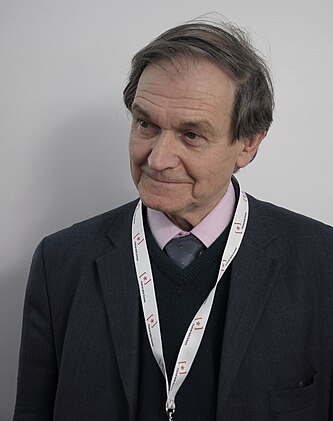
About Roger Penrose
Sir Roger Penrose (born 8 August 1931) is an English mathematical physicist and Professor of Mathematics at the Mathematical Institute, University of Oxford, famous for his work in mathematical physics, cosmology, general relativity, and his musings on the nature of consciousness.
Best Roger Penrose Quotes
Shortest
Earliest
Explore our curated collection of the most famous and impactful Roger Penrose quotes.
“General relativity is certainly a very beautiful theory, but how does one judge the elegance of physical theories generally?”
“Understanding is, after all, what science is all about — and science is a great deal more than mindless computation.”

“I have been arguing that such 'God-given' mathematical ideas should have some kind of timeless existence, independent of our earthly selves.”

“The 2nd law of thermodynamics... tells you that randomness increases with time. It's a sort of depressing law... It depends on how you look at it, really...”

“It is hard to see how one could begin to develop a quantum-theoretical description of brain action when one might well have to regard the brain as "observing itself" all the time!”

“Do not seek for reasons in the specific patterns of stars, or of other scattered arrangements of objects; look, instead, for a deeper universal order in the way that things behave.”
“[C]razy ideas are the sort of thing one needs when talking about the Big Bang. ...All the ideas I'm going to show you... are put forward by very... respectable cosmologists. It doesn't make the ideas any less crazy...”

“What the anthropic principle depends upon is the idea that whatever is the nature of the universe, or universe portion that we see about us, being subject to whatever dynamical laws govern its actions, this must be strongly favourable to our very existence.”

“It is quite likely that the 21st century will reveal even more wonderful insights than those that we have been blessed with in the 20th. But for this to happen, we shall need powerful new ideas, which will take us in directions significantly different from those currently being pursued. Perhaps what we mainly need is some subtle change in perspective—something that we all have missed....”
“The idea of having an ambient space-time of some specific dimension seems to play less of a role of string theory than in conventional physics, and certainly less than the kind of role that I would myself feel comfortable with. It is particularly difficult to assess the functional freedom that is involved in a physical theory unless one has a clear idea of its actual space-time dimensionality.”

“I'm not sure what Friedmann actually said, but he... produced a model in which the universe... started in a Big Bang... expanded to a maximum size... then would shrink down to a crunch, and then start all over again. ...There would be several Big Bangs and before each one, would be a collapsing phase of the universe...”
“In its simplest form, the 2nd law of thermodynamics... You imagine... a glass of wine sitting on a table... it falls off and wine splashes out onto the carpet...[etc.] If you just think of this as a Newtonian situation, as the system evolves the thing proceeds according to Newtonian laws, but Newtonian laws are reversible in time... What's not so agreeable [about the reverse] is that it violates the 2nd law...”

“There are two other words I do not understand — awareness and intelligence. Well, why am I talking about things when I do not know what they really mean? It is probably because I am a mathematician and mathematicians do not mind so much about that sort of thing. They do not need precise definitions of the things they are talking about, provided they can say something about the connections between them.”

“It's a very plausible thing now that the entropy should increase all the time... [T]hese volumes... are... enormously different in scale... I can't convey to you in the picture the absolute stupendous difference in the sizes of these volumes. So if you happen to find yourself in one of them, and you wiggle around, the next one you find yourself in will be overwhelmingly likely to be much much larger, and the entropy therefor goes up.”
“It is hard for me to believe, as some have tried to maintain, that such SUPERB theories could have arisen merely by some random natural selection of ideas leaving only the good ones as survivors. The good ones are simply much too good to be the survivors of ideas that have arisen in that random way. There must, indeed, be some deep underlying reason for the accord between mathematics and physics, i.e. between Plato's world and the physical world.”
“Whereas originally the hopes for string theory, and its descendants, were that some kind of uniqueness would be arrived at, whereby the theory would supply mathematical explanations for the measured numbers of experimental physics, the string theorists were driven to find refuge in the strong anthropic argument in an attempt to narrow down an absolutely vast number of alternatives. In my own view, this a very sad and unhelpful place for a theory to find itself.”

“What right do we have to claim, as some might, that human beings are the only inhabitants of our planet blessed with an actual ability to be "aware"? … The impression of a "conscious presence" is indeed very strong with me when I look at a dog or a cat or, especially, when an ape or monkey at the zoo looks at me. I do not ask that they are "self-aware" in any strong sense (though I would guess that an element of self-awareness can be present). All I ask is that they sometimes simply feel!”
“Moreover, the complete details of the complication of the structure of Mandelbrot's set cannot really be fully comprehended by anyone of us, nor can it be fully revealed by any computer. It would seem that this structure is not just part of our minds, but it has a reality of its own. ... The computer is being used in essentially the same way that the experimental physicist uses a piece of experimental apparatus to explore the structure of the physical world. The Mandelbrot set is not an invention of the human mind: it was a discovery. Like Mount Everest, the Mandelbrot set is just there!”
“It seems to me that we must make a distinction between what is "objective" and what is "measurable" in discussing the question of physical reality, according to quantum mechanics. The state-vector of a system is, indeed, not measurable, in the sense that one cannot ascertain, by experiments performed on the system, precisely (up to proportionality) what the state is; but the state-vector does seem to be (again up to proportionality) a completely objective property of the system, being completely characterized by the results it must give to experiments that one might perform.”

“One is left with the uneasy feeling that even if supersymmetry is actually false, as a feature of nature, and that accordingly no supersymmetry partners are ever found by the LHC or by any later more powerful accelerator, then the conclusion that some supersymmetry proponents might come to would not be that supersymmetry is false for the actual particles of nature, but merely that the level of supersymmetry breaking must be greater even that the level reached at that moment, and that a new even more powerful machine would be required to observe it!”

“...the entire physical world is depicted as being governed according to mathematical laws. We shall be seeing in later chapters that there is powerful (but incomplete) evidence in support of this contention. On this view, everything in the physical universe is indeed governed in completely precise detail by mathematical principles — perhaps by equations, such as those we shall be learning about in chapters to follow, or perhaps by some future mathematical notions fundamentally different from those which we would today label by the term ‘equations’. If this is right, then even our own physical actions would be entirely subject to such ultimate mathematical control, where ‘control’ might still allow for some random behaviour governed by strict probabilistic principles.”
“[T]he randomness is measured... by... entropy, and it's telling us that this entropy is increasing with time. ...[I]t can be given a clearer definition ...the idea due to Boltzmann ...we imagine... a phase space... a space... of a very large number of dimensions, where each point in the space represents a state of the system at one moment. In fact it contains both the positions of all the particles and the momenta (or velocities) of all the particles. So if you know where the point is in this large dimensional space at any moment that describes a particular thing... then the dynamics will tell you where that point moves. So that there will be a unique path through that point, wiggling around somewhere through this phase space.”
“Gödel's theorem shows that this point of view is not really a tenable one in a fundamental philosophy of mathematics. The notion of mathematical truth goes beyond the whole concept of formalism. There is something absolute and 'God-given' about mathematical truth. This is what mathematical Platonism, as discussed at the end of the last chapter, is about. Any particular formal system has a provisional and 'man-made' quality about it. Such systems indeed have very valuable roles to play in mathematical discussions, but they can supply only a partial (or approximate) guide to truth. Real mathematical truth goes beyond mere man-made constructions.”
“[S]ome of these regions may be... indistinguishable, for example the air in the room. We might have molecules in some other places. You might like to say we don't care where the individual molecules are. We just care about overall parameters, and so we lump together the systems which look very much the same. ...[L]et's say with regard to macroscopic parameters we lump them together, and so we have these things called course graining cells in the phase space... [Y]ou then say, well let's measure the volume of these regions... ... and the logarithm of that volume is the entropy. This is a marvelous formula due to Boltzmann. This [] is Boltzmann's constant, the only thing in the formula that wasn't due to Boltzmann... This was named afterwards. I don't think he was particularly interested in constants...”
“Somewhat more exotic is the idea... by Lee Smolin in his book... [T]hese pictures are a little hard to draw... The difficulty seems... a... drawback. It may mean... something... troublesome about the geometry. ...[W]e have black holes forming ...You must imagine each one of these forming ...take this funnel ...that's supposed to represent the universe ...which expands from the Big Bang and ...its expansion accelerates because of ...dark energy or, if you're more boring like me, the cosmological constant ...and according to Smolin, all these black holes, which form at various places, could be the origins of new universes, and you see them sprouting off at various places... [Y]ou can adopt the Wheeler idea of maybe having the constants of nature changing to reach one of these phases.”
Roger Penrose Quotes by Topic
Find exactly what you are looking for by browsing this categorized list of Roger Penrose quotes by topic.
Roger Penrose on Anthropic principle 2 quotes
“What the anthropic principle depends upon is the idea that whatever is the nature of the universe, or universe portion that we see about us, being subject to whatever dynamical laws govern its actions, this must be strongly favourable to our very existence.”

Roger Penrose on Vacuum
“It's illegal to make superpositions with different vacua. That's one of the rules of quantum field theory.”

Roger Penrose on Spacetime
“The idea of having an ambient space-time of some specific dimension seems to play less of a role in string theory than in conventional physics, and certainly less than the kind of role that I would myself feel comfortable with. It is particularly difficult to assess the functional freedom that is involved in a physical theory unless one has a clear idea of its actual space-time dimensionality.”
Roger Penrose on Animal rights
“What right do we have to claim, as some might, that human beings are the only inhabitants of our planet blessed with an actual ability to be "aware"? [...] The impression of a "conscious presence" is indeed very strong with me when I look at a dog or a cat or, especially, when an ape or monkey at the zoo looks at me. I do not ask that they are "self-aware" in any strong sense (though I would guess that an element of self-awareness can be present). All I ask is that they sometimes simply feel!”

Roger Penrose on Quantum mechanics
“I should begin by expressing my general attitude to present-day quantum theory, by which I mean standard non-relativistic quantum mechanics. The theory has, indeed, two powerful bodies of fact in its favour, and only one thing against it. First, in its favour are all the marvellous agreements that the theory has had with every experimental result to date. Second, and to me almost as important, it is a theory of astonishing and profound mathematical beauty. The one thing that can be said against it is that it makes absolutely no sense!”

Roger Penrose on Mandelbrot set
“Moreover, the complete details of the complication of the structure of Mandelbrot's set cannot really be fully comprehended by anyone of us, nor can it be fully revealed by any computer. It would seem that this structure is not just part of our minds, but it has a reality of its own. ... The computer is being used in essentially the same way that the experimental physicist uses a piece of experimental apparatus to explore the structure of the physical world. '''The Mandelbrot set is not an invention of the human mind: it was a discovery. Like Mount Everest, the Mandelbrot set is just ''there'''''!”
Roger Penrose on Wick rotation
“The Wick rotation idea is now so commonly used in quantum field theory that it is often taken as an automatic procedure in numerous different kinds of situation, with barely a mention, and its validity is hardly ever questioned. It does, in fact, have a broad applicability, but it is not a universally valid procedure. Most particularly. it is highly questionable in the context of the curved space-times arising in general relativity, when in normal circumstances the procedure cannot even be applied, because there is no natural time coordinate. In string theory, this is a problem both in the 10-dimensional space-time, in general curved-space situations, and also in the string world-sheet ...”
Roger Penrose on Mathematical Platonism
“How is it that mathematical ideas can be communicated in this way? I imagine that whenever the mind perceives a mathematical idea, it makes contact with Plato's world of mathematical concepts. ... When one 'sees' a mathematical truth, one's consciousness breaks through into this world of ideas, and makes direct contact with it ('accessible via the intellect'). I have described this 'seeing' in relation to Gödel's theorem, but it is the essence of mathematical understanding. When mathematicians communicate, this is made possible by each one having a direct route to truth, the consciousness of each being in a position to perceive mathematical truths directly, through this process of 'seeing'. (Indeed, often this act of perception is accompanied by words like 'Oh, I see'!) Since each can make contact with Plato's world directly, they can more readily communicate with each other than one might have expected. The mental images that each one has, when making this Platonic contact, might be rather different in each case, but communication is possible because each is directly in contact with the same externally existing Platonic world!”
What Roger Penrose Said About Others
Discover personal opinions Roger Penrose shared regarding contemporaries.
Roger Penrose on John von Neumann
“Remarkable mathematician.”
Roger Penrose on John Stewart Bell
“In my opinion, John Bell performed an extremely important role then, and also later, in generally supporting - thereby making respectable - the apparently "fringe" activities of such people as Karolyhazy, Bohm, [Philip M.] Pearle, Ghirardi, and many others (including myself) in suggesting schemes that go beyond standard quantum mechanics, in the intended direction of realism. No physicist could doubt the scientific credentials of John Bell. The fact that he was prepared to go out of his way to support research of this kind gave it a previously unaccustomed status.”
Quotes About Roger Penrose
Gain deeper perspective through quotes about Roger Penrose from others.
Julian Baggini on Roger Penrose
“Reading about the lives of geniuses can be a powerful antidote against any envy we might feel for not being among their number. Almost invariably they turn out not only to have had the same flaws, trials and heartbreaks as the rest of us but to be deeply weird to boot. The Nobel Prize-winning British physicist Roger Penrose certainly fits the template.”

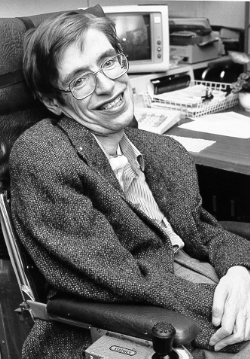
Stephen Hawking on Roger Penrose
“Although I'm regarded as a dangerous radical by particle physicists for proposing that there may be loss of quantum coherence, I'm definitely a conservative compared to Roger. I take the positivist viewpoint that a physical theory is just a mathematical model and that it is meaningless to ask whether it corresponds to reality. All that one can ask is that its predictions should be in agreement with observation. I think Roger is a Platonist at heart but he must answer for himself.”
Clifford Martin Will on Roger Penrose
“[I]n the June, 1960 issue of... the Annals of Physics, there appeared a paper by... Roger Penrose with the esoteric title "A Spinor Approach to General Relativity." Although the paper was highly mathematical, it outlined a very elegant and streamlined technique for solving certain problems in general relativity. ...this new method made some computations almost easy.”
About Roger Penrose
Sir Roger Penrose (born 8 August 1931) is an English mathematical physicist and Professor of Mathematics at the Mathematical Institute, University of Oxford, famous for his work in mathematical physics, cosmology, general relativity, and his musings on the nature of consciousness.