Robert T. Bakker on Tyrannosaurus
← Back to Robert T. Bakker Profile
“The scene has been portrayed in paintings, drawings, and illustrations hundreds of times, but it remains thrilling. Tyrannosaurus, the greatest dinosaur toreador, confronts Triceratops, the greatest set of dinosaur horns. No matchup between predator and prey has ever been more drammatic. It's somehow fitting that those two massive antagonists lived out their co-evolutionary belligerence through the very last days of the very last epoch in the Age of Dinosaurs. Tyrannosaurus stood over twenty feet tall when fully erect, and a large adult was as heavy as a small elephant - five tons. No predatory dinosaur, no predatory land animal of any sort, had more powerful jaws. Withstanding a Tyrannosaurus'''s attack required either tanklike armor - the approach taken by Ankylosaurus - or most powerful defensive weapons - the approach taken by Triceratops''.”
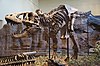
“The rex bite is unique among better known dinosaurs. Instead of inflicting a long, shallow wound, rex jaws would thrust a few crowns deep into bone armor, killing a Triceratops with a single blow. We see close-linked co-evolution here, a terminal Cretaceous arms race. Triceratops is the commonest horned dino of the time, the final dinosaurian Age, the Lancian. T’tops departs from the ceratopsian tradition of frill construction. Torosaurus, very rare during the Lancian Age of the Cretaceous, retains that basic design: the frill is composed of thin bone rods that make a frame, with huge holes in the middle. Triceratops fills in the holes with greatly thickened bone. Why would Triceratops invest in five times as much bone volume in its frill? Well…to me the answer is obvious. Because the commonest predator has evolved great, armor-penetrating teeth. The argument goes in the other direction – T. rex evolved swollen, tall tooth crowns to deal with the unusual protection of the commonest horned herbivore.”