Link Copied!
Rajiv Malhotra Quotes (1950-)
Author, Activist





About Rajiv Malhotra
Rajiv Malhotra (born 15 September 1950) is an Indian-American author and Hindu activist who, after a career in the computer and telecom industries, took early retirement in 1995 to establish The Infinity Foundation. Through this organization Malhotra has promoted philanthropic and educational activities in the area of Hinduism studies.
Best Rajiv Malhotra Quotes
Shortest
Earliest
Explore our curated collection of the most famous and impactful Rajiv Malhotra quotes.
“These are the consequences when Indians decide to imitate Harvard rather than re-building our own Nalanda.”
“Wikipedia biases in my entry (just as one example) which it prevents being corrected. It is re-colonizing Indians.”

“The contradiction between Christian exclusivism and true liberalism is seldom discussed openly (and perhaps even privately).”

“The point being that the influence of dharmic philosophy on Western culture runs deep and yet consistently goes unacknowledged.”

“What many Indians are unaware of is that public trust in the Gates Foundation and its intentions are being questioned in the US.”
“A classical concept in Hinduism has been that a true proposition has to be consistent with sruti, yukti (reason/logic) and anubhava.”
“Such attacks and provocations on indigenous spiritual traditions never find their way into international media or the reports about freedom of religion.”
“India is the world largest territory, both geographically and by population, that is up for grabs by the expansionist, predatory ideological movements in the world.”

“I began to see the beginnings of what was later to crystallize as my thesis that history-centrism is the key difference between Judeo-Christian and dharma traditions.”
“There is a new awakening in India that is challenging the ongoing westernization of the discourse about India and the intellectual machinery that produces it.”

“The modern academics find it politically incorrect to criticize the devastation under Islamic rule, even though post-colonial scholars have amply exposed the ruin created by the British.”
“I am not alone in making this point. At least one European Indologist accuses Pollock of relocating Orientalism 'to the "New Raj" across the deep blue sea'.Reference is to Gruenendahl 2012”

“A religion with an ever-growing line of enlightened masters, such as exists in the dharma traditions, is less likely to become fossilized into institutional dogma and therefore more difficult to control.”
“It matters little whether such ideas have any basis in fact. Once an idea becomes entrenched in the institutional machinery and eventually in the collective imagination of the public, it can be used for all sorts of exploitation.”

“Unfortunately, Hindu nationalism today sometimes seems to be mimicking the worst things about the West, by becoming obsessively history-centric. But this is different than the past of Hinduism, and is atypical amongst Hindus even today.”

“I believe in science, I believe in evidence, if there are other treatments that the modern medicine doesn't support those should also be brought to the table, whether its ayurveda, whether its Naturopathy... and should be evaluated in clinical trials.”

“For example, Cambridge University established a prize named for an essay competition on the topic: 'The best means of civilizing the subjects of the British Empire in India, and of diffusing the light of the Christian religion throughout the eastern world.'”

“The dangers of allowing foreign ownership of India’s critical infrastructure and foreign control over information flow on that infrastructure cannot be overstated. Especially when the foreign hand has a history of facilitating civil wars and regime changes.”
“The LGBTQ movement also has legitimate gripes in the West. The same framework for activism, however, cannot be blindly applied to India where the tradition has had a far more complex posture on homosexuality that is vastly different from the closedmindedness in the Abrahamic religions. I”

“Of course, the West has occasionally dabbled in countercultural revolts against normative conventions, and these have enriched its society with a new context-sensitivity. In general, however, its dominant ideal is the privileging of certainty and uniformity, which it touts as universalism.”
“Contrary to Indians’ self-congratulatory notion that India is vishwa guru (guru to the world), in reality it is Harvard that is the vishwa guru. And India is vishwa shishya (student), with many of its people serving as vishwa coolie (laborer), and vishwa sepoy (soldier) in this ecosystem.”

“The Gita ... explains the basis for the Hindu principle of charity as Narayana-seva, i.e., serving God by serving one's fellow human... This is also the basis for Gandhi's concept of ahimsa. Krishna asserts that generosity (dana) and compassion (daya) are qualities that arise 'from me alone'.”
“Ashoka could have been India’s answer to Western liberal arts. It could have been the go-to place for putting Indian civilization on the global stage. But both the elite businessmen that funded the institution, and the government that sought its advice, didn’t care to do basic due diligence.”

Rajiv Malhotra Quotes by Topic
Find exactly what you are looking for by browsing this categorized list of Rajiv Malhotra quotes by topic.
Rajiv Malhotra on Sanskrit 3 quotes
“Besides the large number of schools at that time, there were also approximately a hundred institutions of higher learning in each district of Bengal and Bihar. Unfortunately, these numbers rapidly dwindled all across India during the nineteenth century under British rule. The British also noted that Sanskrit books were being widely used to teach grammar, lexicology, mathematics, medical science, logic, law and philosophy. ....Furthermore, in the early British period in India, British officials noted that education for the masses was more advanced and widespread in India than it was in England. ....According to Dharampal, the British later replaced this Sanskrit-based system with their own English-based one, the goal being to produce low-level clerks for the British administration.”

Rajiv Malhotra on Historical negationism 2 quotes
“The modern academics find it politically incorrect to criticize the devastation under Islamic rule, even though post-colonial scholars have amply exposed the ruin created by the British.”

Rajiv Malhotra on Education in India 2 quotes
“The report praised the traditional pathashala system for its 'remarkably close contact between the teacher and the pupil' in which there was a transmission from human to human whereas in the modern system it is a mass production method of teaching. In the traditional system, education was personalized and 'there was no rigidity regarding time-table and curriculum'.”

Rajiv Malhotra on Hinduphobia in academia
“Hinduism studies has produced ridiculous caricatures that could easily be turned into a Bollywood movie or a TV serial.”
Rajiv Malhotra on Caste system in India
“In fact, there is no record that Indian society on a large scale decided to abandon identities based on varna or jati as a result of the teachings of the Buddha.”
Rajiv Malhotra on Political correctness
“The modern academics find it politically incorrect to criticize the devastation under Islamic rule, even though post-colonial scholars have amply exposed the ruin created by the British.”

Rajiv Malhotra on British Raj
“Cambridge University established a prize named for an essay competition on the topic: 'The best means of civilizing the subjects of the British Empire in India, and of diffusing the light of the Christian religion throughout the eastern world.'”

Rajiv Malhotra on Christianity in India
“Cambridge University established a prize named for an essay competition on the topic: 'The best means of civilizing the subjects of the British Empire in India, and of diffusing the light of the Christian religion throughout the eastern world.'”

Rajiv Malhotra on Charity
“The Gita ... explains the basis for the Hindu principle of charity as Narayana-seva, i.e., serving God by serving one's fellow human... This is also the basis for Gandhi's concept of ahimsa. Krishna asserts that generosity (dana) and compassion (daya) are qualities that arise 'from me alone'.”

Rajiv Malhotra on Indian philosophy
“The link between this new physics and dharma has been noted since the discovery of quantum mechanics by Heisenberg and Schrodinger (both Nobel Laureates in physics). Each of these pioneers cited the Upanishads as the only source of philosophy known to them that was consistent with the paradoxical nature of reality according to quantum mechanics.”
Rajiv Malhotra on Human rights in India
“Western human rights activists and non-Westerners trained and funded by them, go around the world creating new categories of ‘victims’ that can be used in divide-and-conquer strategies against other cultures. In India’s case, the largest funding of this type goes to middlemen who can deliver narratives about ‘abused’ Dalits and native (especially Hindu) women.”

Rajiv Malhotra on Panchatantra
“[Arvind] Sharma recommends introducing the study of Arthashastra in all schools in all languages. ....Some others suggest that Panchatantra ought to be taught at very young ages as a popular version of strategic thinking. It is interesting that the Arabs took the Panchatantra and translated/adapted it into their children's stories, which reached Europe as Aesop's Fables.”

What Rajiv Malhotra Said About Others
Discover personal opinions Rajiv Malhotra shared regarding contemporaries.
Rajiv Malhotra on Sheldon Pollock 2 quotes
“One of his [Pollock's] goals is to critique and expunge what he sees as deeply entrenched static social hierarchies, barbarisms and poisons. I do not see anything inherently wrong with this intention by itself; most Hindus welcome improvements and the evolution of their culture. The issue worth debating is that Pollock sees these ills as deeply rooted in the Vedas themselves and as requiring the abandonment of core metaphysical and sacred perspectives.”

Rajiv Malhotra on Erwin Schrödinger
“The unity and continuity of Vedanta are reflected in the unity and continuity of wave mechanics. In 1925, the world view of physics was a model of a great machine composed of separable interacting material particles. During the next few years, Schrödinger and Heisenberg and their followers created a universe based on superimposed inseparable waves of probability amplitudes. This new view would be entirely consistent with the Vedantic concept of All in One.”

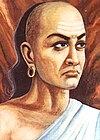
Rajiv Malhotra on Chanakya
“[Arvind] Sharma speculates that a reason for India's downfall was the eclipse of the category of Chakravarti as mentionned in the Arthashastra. A Chakravarti's domain was from ocean to ocean; he was above all the other kings who were local. He feels that the Arthashastra at some point ceased to be taught for learning realpolitik. There appears to have been an attack on it by liberal passivism. It is ironic, he says, that during British rule the Arthashastra text had disappeared until a copy suddenly surfaced with a farmer in Kerala in the early twentieth century... Sharma recommends introducing the study of Arthashastra in all schools in all languages.”
Rajiv Malhotra on Dharampal
“Dharampal, the noted Gandhian, used British data during the colonial period to show that in the ninetheenth century, the shudras comprised a larger student body than any other community did. ... Besides the large number of schools at that time, there were also approximately a hundred institutions of higher learning in each district of Bengal and Bihar. Unfortunately, these numbers rapidly dwindled all across India during the nineteenth century under British rule. The British also noted that Sanskrit books were being widely used to teach grammar, lexicology, mathematics, medical science, logic, law and philosophy. ....Furthermore, in the early British period in India, British officials noted that education for the masses was more advanced and widespread in India than it was in England. ....According to Dharampal, the British later replaced this Sanskrit-based system with their own English-based one, the goal being to produce low-level clerks for the British administration.”

Quotes About Rajiv Malhotra
Gain deeper perspective through quotes about Rajiv Malhotra from others.
G Larson on Rajiv Malhotra
“The book is one of the few attempts by an Indian intellectual to challenge seriously the assumptions and presuppositions of the field of India and/or South Asian studies tout ensemble , including not only the work of European and American scholarship but as well the neocolonialist, postmodernist and subaltern ressentiment so typical of contemporary Indian intellectuals... The book will be controversial on many different levels and will undoubtedly elicit rigorous critical response'.”
D. Wiebe on Rajiv Malhotra
“Malhotra writes with passion from within an avowedly dharmic stance, undermining the attempts to domesticate and expropriate Indian traditions in a process of inter-religious dialogue that is ultimately based on a Western cosmological framework. This book is essential reading for Western scholars.”
N. Grier on Rajiv Malhotra
“Rajiv Malhotra has been a leading spokesperson defending the Indian philosophical and religious traditions as he views them.... I strongly affirm Malhotra’s preference for a Dharma humanism as opposed to the Abrahamic traditions based on divine revelation in history. He is correct to claim that there is no special providence in the Indian traditions, and no religious group—except for recent Christian missionar- ies and their converts—have had a vision of being a chosen people on the basis of their own revelation. 1 I believe that the absence of a doctrine of special revelation is the primary reason why there have been so few religiously motivated acts of violence (until recently) in South Asia.”
Source on Rajiv Malhotra 6 quotes
“TBFS is a book about Sanskrit written in English by an author who is not a Sanskrit scholar. For such a book, to receive endorsements from some of the finest contemporary Sanskrit scholars from India is quite an achievement, even more so when some of them co-opt the terminology of the author in their endorsements. Any Indian Sanskrit author would love to get endorsements from scholars like Dayananda Bhargava, 45 Ramesh Kumar Pandey, 46 K. S. Kannan, 47 Sampadananda Mishra, 48 K. Ramasubramanian, 49 and Kapil Kapoor. 50 Co- opting Malhotra’s terminology, Bhargava, who has been interpreting Sanskrit works for the last sixty years, writes that the book ‘promotes a debate between the “insiders” and “outsiders” of our heritage’ and states, ‘... most insiders are either blissfully unaware ... or are living in isolation’. Kannan, who translated Malhotra’s Being Different into Kannada as Vibhinnate, says ‘the responsibility now lies squarely on traditional Indian scholars to take on the issues between insiders and outsiders which this book has framed’ and that Malhotra’s contribution is ‘this valuable role as the prime initiator of this dialogue’.”
Enter Dhṛṣṭadyumna on Rajiv Malhotra
“After its publication, TBFS was released in multiple cities around the end of January and the beginning of February by some of India’s most well-known personalities: Subhash Chandra (Chairman of Zee Media) in Mumbai, Sri Sri Ravi Shankar (eminent spiritual leader and humanitarian) in Bengaluru, and Dr. Najma Akbarali Heptulla (Minority Affairs Minister, Government of India) in New Delhi. Prominent educational, spiritual, and social institutes in India hosted Malhotra during this period: Delhi University and Jawaharlal Nehru University (New Delhi); Ramakrishna Mission and IIT Madras (Chennai); Vedic Gurukulam (Bidadi); The Art of Living Ashram and Karnataka Sanskrit University (Bangalore); and Chinmaya Mission, IIT Bombay, and TISS (Mumbai). Malhotra also participated in a panel discussion at the Jaipur Literature Festival along with Amish Tripathi (bestselling fiction writer). This kind of reception is rarely seen in India for non-fiction books.”
Elst on Rajiv Malhotra 3 quotes
“So Pollock, like Hernán Cortés subduing the Aztecs with the help of the Mexican subalterns, champions the Muslims along with the low-castes and Dravidians against Rama’s wicked aggression, thus to dislodge whatever remains of the oppressive Sanskrit tradition’s power and prestige.”
Arun Shourie on Rajiv Malhotra
“One final reason for being confident is that because of the work of Ram Swarup, Sita Ram Goel, Koenraad Elst, David Frawley, and Rajiv Malhotra the corpus is now reaching a critical mass. So, that we can think that within few years we will have a library for India and a library of India.”

About Rajiv Malhotra
Rajiv Malhotra (born 15 September 1950) is an Indian-American author and Hindu activist who, after a career in the computer and telecom industries, took early retirement in 1995 to establish The Infinity Foundation. Through this organization Malhotra has promoted philanthropic and educational activities in the area of Hinduism studies.