Link Copied!
Pete Seeger Quotes (1919-2014)
Author, Musician, Activist
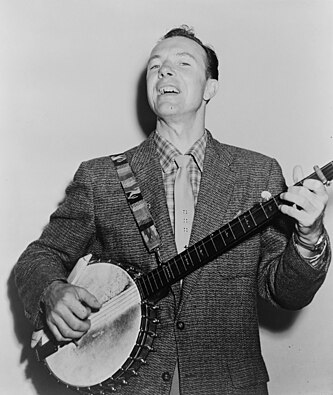

About Pete Seeger
Peter Seeger (3 May 1919 – 27 January 2014) was a U.S. musician, political activist, and author; usually known as Pete Seeger.
Best Pete Seeger Quotes
Shortest
Earliest
Explore our curated collection of the most famous and impactful Pete Seeger quotes.
“All songwriters are links in a chain.”


“Technology will save us if it doesn't wipe us out first.”


“The key to the future of the world, is finding the optimistic stories and letting them be known.”
“If it can't be … reused, repaired … then it should be … redesigned or removed from production.”

“... And this is the origin of pop music: it's a professional music which draws upon both folk music and fine arts music as well.”

“The world would never amount to a hill of beans if people didn't use their imaginations to think of the impossible.”
“To everything (turn, turn, turn)
There is a season (turn, turn, turn)
And a time for every purpose under heaven.”
There is a season (turn, turn, turn)
And a time for every purpose under heaven.”


“A productive mistake is: (1) made in the service of mission and vision; (2) acknowledged as a mistake; (3) learned from; (4) considered valuable; (5) shared for the benefit of all.”
“Shh. Listen to the sounds that surround you. Notice the pitches, the volume, the timbre, the many lines of counterpoint. As light taught Monet to paint, the earth may be teaching you music.”
“A good song can only do good, and I am proud of the songs I have sung. I hope to be able to continue singing these songs for all who want to listen, Republicans, Democrats, and independents.”
“At the audition, your assignment is to find something new in the song. Something you've never noticed before. A breath carried over, a thought that ties the whole thing together. Then take the risk and do it.”
“In the largest sense, every work of art is protest. … A lullaby is a propaganda song and any three-year-old knows it. … A hymn is a controversial song — sing one in the wrong church: you'll find out. …”


“I like to say I'm more conservative than Goldwater. He just wanted to turn the clock back to when there was no income tax. I want to turn the clock back to when people lived in small villages and took care of each other.”

Pete Seeger Quotes by Topic
Find exactly what you are looking for by browsing this categorized list of Pete Seeger quotes by topic.
Pete Seeger on Pop Chronicles 2 quotes
“... And this is the origin of pop music: it's a professional music which draws upon both folk music and fine arts music as well.”

Pete Seeger on Pittsburgh
“Pittsburgh town is a smoky ol' town Solid iron from McKeesport down Pittsburgh, Lord God, Pittsburgh”

Pete Seeger on Heaven
“To everything (turn, turn, turn) There is a season (turn, turn, turn) And a time for every purpose under heaven.”
Pete Seeger on Turn
“To everything (turn, turn, turn) There is a season (turn, turn, turn) And a time for every purpose under heaven.”
Pete Seeger on Pop music
“... And this is the origin of pop music: it's a professional music which draws upon both folk music and fine arts music as well.”

Pete Seeger on Persuasion
“I have sung for Americans of every political persuasion, and I am proud that I never refuse to sing to an audience, no matter what religion or color of their skin, or situation in life.”

Pete Seeger on Auditions
“At the audition, your assignment is to find something new in the song. Something you've never noticed before. A breath carried over, a thought that ties the whole thing together. Then take the risk and do it.”
Pete Seeger on Art
“In the largest sense, every work of art is protest. … A lullaby is a propaganda song and any three-year-old knows it. … A hymn is a controversial song — sing one in the wrong church: you'll find out. ...”

Pete Seeger on Watergate scandal
“When I meet people who say, "Oh, there's no hope, Peter, look at the things that are going wrong, and those stupid people in Bosnia, there are going to be things like that all around the world, power-hungry people says I know how to handle this, just give me the bomb. There's no hope." But I say to them, I said, "Did you ever think that our great Watergate president would leave office the way he did?" "No, I guess I didn't think that." I said, "Did you think that the Berlin Wall would come down so peacefully?" "No, I didn't think that would happen, yeah." I said, "Did you think Mandela would be president of South Africa?" "No, I didn't predict that." "Well, if you couldn't predict those three things, then don't be so confident that there's no hope." And I give them a bumper sticker. It says, "There's No Hope, But I May Be Wrong."”

What Pete Seeger Said About Others
Discover personal opinions Pete Seeger shared regarding contemporaries.
Pete Seeger on Víctor Jara
Pete Seeger on Irene Levine Paull
“Irene Paull was a great person, as these selections of her writings make clear. She had no pretensions and great honesty with herself and others. If the world is still here in a hundred years, it will be because of people like her.”

Pete Seeger on Woody Guthrie
“I remember the night he wrote the song "Tom Joad." He said, "Pete, do you know where I can get a typewriter?" I said, "I'm staying with someone who has one." "Well, I got to write a ballad," he said. "I don't usually write ballads to order, but Victor wants me to do a whole album of Dust Bowl songs, and they say they want one about Tom Joad in The Grapes of Wrath." … Woody had a half-gallon jug of wine with him, sat down and started typing away. He would stand up every few seconds and test out a verse on his guitar and sit down and type some more. About one o'clock my friend and I got so sleepy we couldn't stay awake. In the morning we found Woody curled up on the floor under the table; the half gallon of wine was almost empty and the completed ballad was sitting near the typewriter. And it is one of his masterpieces.”
Quotes About Pete Seeger
Gain deeper perspective through quotes about Pete Seeger from others.
Joan Baez on on Pete Seeger
“my first experience with Pete Seeger was weaning me from rhythm and blues, which — as my parents badly wanted to do. They were horrified. They thought all rhythm and blues singers were dope addicts, even though they didn’t know what dope addicts were. So my auntie — they spirited me away with my auntie to a Pete Seeger show. And it was like a vaccine. Either it was going to take or not. And it took. And I loved the music, and I discovered that this man did what my family, in a sense, had done for many years, which was, having become Quakers when I was eight years old, fused everything with their politics. And this was music and politics in a way that I had never known. But it was so natural to me, his music and what he did with his life. And I understood that very quickly. And when I found out at an early age — I don’t know if this is myth or not, but when the press went to his house for an interview at one point, that he was on the roof tacking a few of the last shingles on, and he wouldn’t come down, and he was ready. I knew this was a man I wanted to follow for his political and musical events that he did. And so, I did. There was Harry Belafonte, Odetta and Pete. And I listened to Pete’s music endlessly and heard the stories about him and learned his songs and followed him.”
Bernice Johnson Reagon on on Pete Seeger
“the first time I heard Pete Seeger was on TV with the Weavers doing the Hootenanny. But I didn’t know him as Pete Seeger...I met him as a human being because of the Albany, Georgia civil rights movement in the 1960s. And he actually thought the singing in Southwest Georgia was so powerful that they should organize a singing group. And he talked about the Almanac Singers and the Weavers and said to Jim Forman of SNCC, “If you organized a group, you would have a group that could travel all over the country singing songs about the movement, and they might also bring financial support to the movement”...The other thing that Seeger taught me was the idea of a working singer, that you did not have to be a star. You had to know you were a singer. You had to know what your music was. And you had to be willing to do it for the rest of your life, as long as you had voice. And people would keep up with you. They would catch up with you if you did not go away. And it was a very important model for a young singer. And as a Freedom Singer, we made $10 a week. It was the perfect way to start my career as a musician, but it was looking at Pete Seeger and his years and years of doing music as a part of struggle that really inspired me. He was a very important model. And what’s incredible is that he has not — he has not broken stride in any way.”
Howard Zinn on Pete Seeger
“There was a new popular music of protest. Pete Seeger had been singing protest songs since the forties, but now he came into his own, his audiences much larger. Bob Dylan and Joan Baez, singing not only protest songs, but songs reflecting the new abandon, the new culture, became popular idols. A middle-aged woman on the West Coast, Malvina Reynolds, wrote and sang songs that fit her socialist thinking and her libertarian spirit, as well as her critique of the modern commercial culture.”

Misattributed Quotes
Quotes mistakenly credited to Pete Seeger
“If I had a hammer,
I'd hammer in the morning
I'd hammer in the evening,
All over this land.
I'd hammer out danger,
I'd hammer out a warning,
I'd hammer out love between my brothers and my sisters,
All over this land...
Well I got a hammer,
And I got a bell,
And I got a song to sing, all over this land.
It's the hammer of Justice,
It's the bell of Freedom,
It's the song about Love between my brothers and my sisters,
All over this land.”
About Pete Seeger
Peter Seeger (3 May 1919 – 27 January 2014) was a U.S. musician, political activist, and author; usually known as Pete Seeger.