Link Copied!
Pearl S. Buck Quotes (1892-1973)
Writer, Poet


About Pearl S. Buck
Pearl Sydenstricker Buck (born Pearl Comfort Sydenstricker; Chinese: 赛珍珠; Pinyin: Sài Zhēnzhū; 26 June 1892 – 6 March 1973), primarily known as Pearl S. Buck, was a prolific American writer. In 1938, she became the first American woman to win the Nobel Prize for Literature.
Best Pearl S. Buck Quotes
Shortest
Earliest
Explore our curated collection of the most famous and impactful Pearl S. Buck quotes.


“Men and women should own the world as a mutual possession.”

“Praise out of season, or tactlessly bestowed, can freeze the heart as much as blame.”

“The secret of joy in work is contained in one word — excellence. To know how to do something well is to enjoy it.”

“Chinese are wise in comprehending without many words what is inevitable and inescapable and therefore only to be borne.”
“None who have always been free can understand the terrible fascinating power of the hope of freedom to those who are not free.”

“All things are possible until they are proved impossible — and even the impossible may only be so, as of now.”
“Euthanasia is a long, smooth-sounding word, and it conceals its danger as long, smooth words do, but the danger is there, nevertheless.”

“The young do not know enough to be prudent, and so they attempt the impossible, and achieve it, generation after generation.”



“Yet somehow our society must make it right and possible for old people not to fear the young or be deserted by them, for the test of a civilization is in the way that it cares for its helpless members.”

“An intelligent, energetic, educated woman cannot be kept in four walls — even satin-lined, diamond-studded walls — without discovering sooner or later that they are still a prison cell.”
Pearl S. Buck Quotes by Topic
Find exactly what you are looking for by browsing this categorized list of Pearl S. Buck quotes by topic.
Pearl S. Buck on Mistakes
Pearl S. Buck on Machine
“It is difficult not to wonder whether that combination of elements which produces a machine for labor does not create also a soul of sorts, a dull resentful metallic will, which can rebel at times.”

Pearl S. Buck on Civilization
“Yet somehow our society must make it right and possible for old people not to fear the young or be deserted by them, for the test of a civilization is in the way that it cares for its helpless members.”
Pearl S. Buck on Ageing
“Yet somehow our society must make it right and possible for old people not to fear the young or be deserted by them, for the test of a civilization is in the way that it cares for its helpless members.”

Pearl S. Buck on Cowardice
“Questions at home and school should be decided in the light of the future. It is a process of toughening, but not the sort of false physical thing that we have called toughening. Our boys and girls ought to know that the bully type, the false "tough," has been the first to break down under the actual fire of battle. The quiet, the calm, the determined have made the best soldiers. Why? Obviously the bully is insecure in himself- he blusters to muster his own courage. Children ought to know that. They ought to be taught to retort to the bully, "You're a coward or you wouldn't make such a noise about being brave. The really brave man simply acts brave- he doesn't have to talk about it."”

Pearl S. Buck on Courage
“Questions at home and school should be decided in the light of the future. It is a process of toughening, but not the sort of false physical thing that we have called toughening. Our boys and girls ought to know that the bully type, the false "tough," has been the first to break down under the actual fire of battle. The quiet, the calm, the determined have made the best soldiers. Why? Obviously the bully is insecure in himself- he blusters to muster his own courage. Children ought to know that. They ought to be taught to retort to the bully, "You're a coward or you wouldn't make such a noise about being brave. The really brave man simply acts brave- he doesn't have to talk about it."”

Pearl S. Buck on Bullying
“Questions at home and school should be decided in the light of the future. It is a process of toughening, but not the sort of false physical thing that we have called toughening. Our boys and girls ought to know that the bully type, the false "tough," has been the first to break down under the actual fire of battle. The quiet, the calm, the determined have made the best soldiers. Why? Obviously the bully is insecure in himself- he blusters to muster his own courage. Children ought to know that. They ought to be taught to retort to the bully, "You're a coward or you wouldn't make such a noise about being brave. The really brave man simply acts brave- he doesn't have to talk about it."”

Pearl S. Buck on Guru Granth Sahib
“Shri Guru Granth Sahib is a source book, an expression of man's loneliness, his aspiration, his longings, his cry to God and his hunger for communication with that being. I have studied the scriptures of other great religions, but I do not find elsewhere the same power of appeal to the heart and mind as I feel here in these volumes. They are compact in spite of their length, and are a revelation of the vast reach of the human heart varying from the most noble concept of God to the recognition and indeed the insistence upon the practical needs of the human body. There is something strangely modern about these scriptures and this puzzled me until I learnt that they are in fact comparatively modern, compiled as late as the sixteenth century, when explorers were beginning to discover the globe upon which we all live as a single entity divided only by arbitrary lines of our own making. Perhaps this sense of unity is a source of power I find in these volumes. They speak to persons of any religion or of none. They speak for the human heart and the searching mind...”

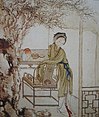
Pearl S. Buck on Dream of the Red Chamber
“Hung Lou Meng, or The Dream of the Red Chamber...was written originally as an autobiographical novel by Ts'ao Hsüeh Ching, an official highly in favor during the Manchu regime and indeed considered by the Manchus as one of themselves. ... He never finished his novel, and the last forty chapters were added by another man, probably named Kao O. The thesis that Ts'ao Hsüeh Ching was telling the story of his own life has been in modern times elaborated by Hu Shih, and in earlier times by Yuan Mei. Be this as it may, the original title of the book was Shih T'ou Chi [The Story of the Stone], and it came out of Peking about 1765 of the Western era, and in five or six years, an incredibly short time in China, it was famous everywhere. Printing was still expensive when it appeared, and the book became known by the method that is called in China, «You-lend-me-a-book-and-I-lend-you-a-book». The story is simple in its theme but complex in implication, in character study and in its portrayal of human emotions. It is almost a pathological study, this story of a great house, once wealthy and high in imperial favor, so that indeed one of its members was an imperial concubine. But the great days are over when the book begins. The family is already declining. Its wealth is being dissipated and the last and only son, Chia Pao Yü, is being corrupted by the decadent influences within his own home, although the fact that he was a youth of exceptional quality at birth is established by the symbolism of a piece of jade found in his mouth. The preface begins, «Heaven was once broken and when it was mended, a bit was left unused, and this became the famous jade of Chia Pao Yü.» Thus does the interest in the supernatural persist in the Chinese people; it persists even today as a part of Chinese life. This novel seized hold of the people primarily because it portrayed the problems of their own family system, the absolute power of women in the home, the too great power of the matriarchy, the grandmother, the mother, and even the bondmaids, so often young and beautiful and fatally dependent, who became too frequently the playthings of the sons of the house and ruined them and were ruined by them. Women reigned supreme in the Chinese house, and because they were wholly confined in its walls and often illiterate, they ruled to the hurt of all. They kept men children, and protected them from hardship and effort when they should not have been so protected. Such a one was Chia Pao Yü, and we follow him to his tragic end in Hung Lou Meng. I cannot tell you to what lengths of allegory scholars went to explain away this novel when they found that again even the emperor was reading it and that its influence was so great everywhere among the people. I do not doubt that they were probably reading it themselves in secret. A great many popular jokes in China have to do with scholars reading novels privately and publicly pretending never to have heard of them. At any rate, scholars wrote treatises to prove that Hung Lou Meng was not a novel but a political allegory depicting the decline of China under the foreign rule of the Manchus, the word Red in the title signifying Manchu, and Ling Tai Yü, the young girl who dies, although she was the one destined to marry Pao Yü, signifying China, and Pao Ts'ai, her successful rival, who secures the jade in her place, standing for the foreigner, and so forth. The very name Chia signified, they said, falseness. But this was a farfetched explanation of what was written as a novel and stands as a novel and as such a powerful delineation, in the characteristic Chinese mixture of realism and romance, of a proud and powerful family in decline. Crowded with men and women of the several generations accustomed to living under one roof in China, it stands alone as an intimate description of that life.”
What Pearl S. Buck Said About Others
Discover personal opinions Pearl S. Buck shared regarding contemporaries.
Pearl S. Buck on Abraham Lincoln 4 quotes
“I suppose Abraham Lincoln knew that was what would happen. He was very wise in the ways of men. He knew how people think and feel. Doubtless he knew that deeper than anything else in the hearts of men everywhere is the wish for simple freedom- freedom without any promises even of protection, of food, of security- just freedom. He knew that those people, so long bond, would leave even comfortable sheltered places where masters were kind, if they could only be free.”

Pearl S. Buck on Lin Yutang
“[My Country and My People] is, I think, the truest, the most profound, the most complete, the most important book yet written about China. And, best of all, it is written by a Chinese, a modern, whose roots are firmly in the past, but whose rich flowering is in the present.”

Quotes About Pearl S. Buck
Gain deeper perspective through quotes about Pearl S. Buck from others.
Peter Conn in "Rediscovering Pearl Buck" from on Pearl S. Buck
“Buck's efforts on behalf of equality included tireless support for women's rights. She promoted modern birth control and called her friend Margaret Sanger "one of the most courageous women of our times," a person whose name "would go down in history" as a modern crusader for justice. In the 1930s and 1940s, Buck also spoke out repeatedly in support of an Equal Rights Amendment for women, at a time when opposition to it included the majority of organized women's groups.”
Peter Conn on Pearl S. Buck
“How does a woman of this magnitude and range slip away from our national consciousness? She has not exactly disappeared. Rather, as one reader of an earlier draft of this book shrewdly put it, she has been "hidden in plain sight," obscured beneath a caricature that belies her complexity and her achievement. … In the years after World War II, Buck's literary reputation shrunk to the vanishing point. She stood on the wrong side of virtually every line drawn by those who constructed the lists of required reading in the 1950s and 1960s.”
James Michener on Pearl S. Buck
“She was a spokesman on all sorts of issues: freedom of the press, freedom of religion, the adoptability of disadvantaged children, the future of China, especially the battle for women's rights, for education. If you followed in her trail, as I did, you were put in touch with almost every major movement in the United States — intellectual, social, and political.”
Misattributed Quotes
Quotes mistakenly credited to Pearl S. Buck
“We should so provide for old age that it may have no urgent wants of this world to absorb it from meditation on the next.”
About Pearl S. Buck
Pearl Sydenstricker Buck (born Pearl Comfort Sydenstricker; Chinese: 赛珍珠; Pinyin: Sài Zhēnzhū; 26 June 1892 – 6 March 1973), primarily known as Pearl S. Buck, was a prolific American writer. In 1938, she became the first American woman to win the Nobel Prize for Literature.