Link Copied!
Paul-Henri Spaak Quotes (1899-1972)


About Paul-Henri Spaak
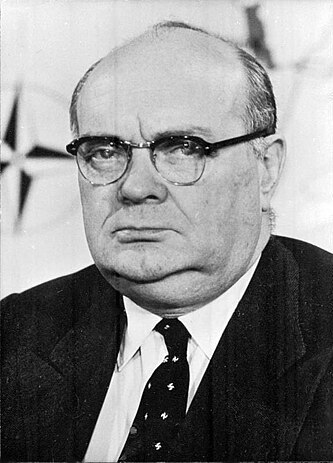
Paul-Henri Spaak (25 January 1899 – 31 July 1972) was the second Secretary General of NATO.
Paul-Henri Spaak Quotes
Shortest
Earliest
Explore our curated collection of the most famous and impactful Paul-Henri Spaak quotes.

Paul-Henri Spaak Quotes by Topic
Find exactly what you are looking for by browsing this categorized list of Paul-Henri Spaak quotes by topic.
Paul-Henri Spaak on Prague 2 quotes
“The determining factor in international politics after the second world war-was the coup d'etat at Prague, the disappearance of a democratic progressive policy and its replacement by a totalitarian government with a Communist minority. It will have a singularly important place devoted to it when the time comes to write the post-war history of international politics. The coup d'etat at Prague, the disappearance of Czechoslovakia as a free democratic State, was the last straw on the camel's back, or, if you prefer, the flash of lightning which opened the most stubborn eyes. Everyone understood in Western Europe, and fortunately also in the New World, that if we wanted to prevent the continuing unbounded development of Soviet imperialism, if we wanted to prevent its repetition in other capitals or in other more or less similar ways, yet following the same pattern, the same political procedure, that if we wanted to avoid the repetition of the events of Prague, then the Western countries had got to unite, to draw together and give Soviet Russia clearly to under- stand that Prague represented the last manifestation of this imperialism which we could permit without far more important and serious results.”

Paul-Henri Spaak on Europe
Paul-Henri Spaak on Belgrade
“Because the Russians, thanks to the second world war, have quite simply annexed the three Baltic States, taken a piece of Finland, a piece of Rumania, a piece of Poland, a piece of Germany and, thanks to a well thought-out policy composed of internal subversion and external pressure, have established Governments justifiably styled as Satellites, in Warsaw, Prague, Budapest, Sofia, Bucharest, Tirana and East Berlin - I except Belgrade where the regime is unique thanks to the energy and courage of Marshal Tito.”

Paul-Henri Spaak on Yugoslavia
“Because the Russians, thanks to the second world war, have quite simply annexed the three Baltic States, taken a piece of Finland, a piece of Rumania, a piece of Poland, a piece of Germany and, thanks to a well thought-out policy composed of internal subversion and external pressure, have established Governments justifiably styled as Satellites, in Warsaw, Prague, Budapest, Sofia, Bucharest, Tirana and East Berlin - I except Belgrade where the regime is unique thanks to the energy and courage of Marshal Tito.”

Paul-Henri Spaak on Bucharest
“To my mind, imperialism is something very simple and clear and it exists as a fact when one country, a large country, seizes a certain strip of territory and subjects to its laws a certain number of men and women against their will. Soviet policy after the beginning of the second world war was precisely this. There is no difficulty in pointing this out, but the difficulty lies in the fact that when one quotes from memory one will forget one or other argument. Because the Russians, thanks to the second world war, have quite simply annexed the three Baltic States, taken a piece of Finland, a piece of Rumania, a piece of Poland, a piece of Germany and, thanks to a well thought-out policy composed of internal subversion and external pressure, have established Governments justifiably styled as Satellites, in Warsaw, Prague, Budapest, Sofia, Bucharest, Tirana and East Berlin - I except Belgrade where the regime is unique thanks to the energy and courage of Marshal Tito. If all this does not constitute manifestations of imperialism, if all this is not the result of a policy consciously willed and consciously pursued, an imperialist aim, then indeed we shall have to start to go back to a new discussion and a new definition of words.”
What Paul-Henri Spaak Said About Others
Discover personal opinions Paul-Henri Spaak shared regarding contemporaries.
Paul-Henri Spaak on Josip Broz Tito
“Because the Russians, thanks to the second world war, have quite simply annexed the three Baltic States, taken a piece of Finland, a piece of Rumania, a piece of Poland, a piece of Germany and, thanks to a well thought-out policy composed of internal subversion and external pressure, have established Governments justifiably styled as Satellites, in Warsaw, Prague, Budapest, Sofia, Bucharest, Tirana and East Berlin - I except Belgrade where the regime is unique thanks to the energy and courage of Marshal Tito.”
Quotes About Paul-Henri Spaak
Gain deeper perspective through quotes about Paul-Henri Spaak from others.
Ronald Reagan on Paul-Henri Spaak
“NATO was a triumph of organization and effort, but is was also something very new and very different. For NATO derived its strength directly from the moral values of the people it represented, from their high ideals, their love of liberty, and their commitment to peace. But perhaps the greatest triumph of all was not in the realm of a sound defense or material achievement. No, the greatest triumph after the war is that in spite of all of the chaos, poverty, sickness, and misfortune that plagued this continent, the people of Western Europe resisted the call of new tyrants and the lure of their seductive ideologies. Your nations did not become the breeding ground for new extremist philosophies. You resisted the totalitarian temptation. Your people embraced democracy, the dream the Fascists could not kill. They chose freedom. And today we celebrate the leaders who led the way—Churchill and Monnet, Adenauer and Schuman, De Gasperi and Spaak, Truman and Marshall. And we celebrate, too, the free political parties that contributed their share of greatness—the Liberals and the Christian Democrats, the Social Democrats and Labour and the Conservatives. Together they tugged at the same oar, and the great and mighty ship of Europe moved on.”

Odd Arne Westad on Paul-Henri Spaak
“Although most western European leaders had reservations about the concept of a full European federation, a majority of them, especially among Christian Democrats, agreed that the ECSC created a foundation to build on. Even Winston Churchill, back as British prime minister after the 1950 elections, had called for a “United States of Europe,” though he had doubted that the British Commonwealth would be part of it. In 1956 a committee under Belgian foreign minister Paul-Henri Spaak set out proposals for what a year later became the Treaty of Rome, creating the European Economic Community (EEC). The EEC built directly on the ECSC. It had the same member states and the same supranational approach to economic integration. But it had a much wider remit, and would, over the generation that followed, remake western Europe as a unifying economic zone.”
About Paul-Henri Spaak
Paul-Henri Spaak (25 January 1899 – 31 July 1972) was the second Secretary General of NATO.