Niall Ferguson on Russian Revolution
← Back to Niall Ferguson Profile
“On December 16, 1916, the royal couple's charismatic and corrupt holy man Rasputin was murdered by the Tsar's own cousin, Grand Duke Dmitry, aided and abetted by the effete Prince Felix Yusupov and a right-wing politician named V. M. Purishkevich, in the belief that the monk was exerting a malign influence on the Tsar and on Russian foreign policy. But things did not improve. Deserted by his own generals in what amounted to a mutiny in early March 1917, Nicholas agreed to abdicate, complaining bitterly of 'treachery, cowardice and deceit'. Neither he nor his wife ever understood the revolution that was now unfolding. Indeed, Alexandra's comment on its outbreak deserves wider celebrity as one of the great mis-diagnoses of history: 'It's a hooligan movement, young boys & girls running about &c screaming that they have no bread, only to excite - . . . if it were cold they wld. probably stay in doors.'”
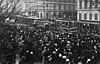
“The Revolution had been made in the name of peace, bread and Soviet power. It turned out to mean civil war, starvation and the dictatorship of the Bolshevik Party's Central Committee and its increasingly potent subcommittee, the Politburo. Workers who had supported the Bolsheviks in the expectation of a decentralized soviet regime found themselves being gunned down if they had the temerity to strike at newly nationalized factories. With inflation rampant, their wages in real terms were just a fraction of what they had been before the war. 'War Communism' reduced hungry city dwellers to desperate bartering expeditions to the country and to burning everything from their neighbours' doors to their own books for heat. As the conscription system grew more effective, more and more young men found themselves drafted into the Red Army, which grew in number from less than a million in January 1919 to five million by October 1920, though desertion rates remained high, especially around harvest time. When the previously pro-Bolshevik sailors of Kronstadt mutinied in February 1921 , they denounced the regime for crushing freedom of speech, press and assembly and filling prisons and concentration camps with their political rivals.”
“The Provisional Government that took the Tsar's place aimed to establish a republic with a liberal constitution and parliamentary institutions. Its prospects were far from bad. However, the determination of its leaders to keep the war going and to postpone decisions on the burning question of land reform until after a Constituent Assembly had been elected created a window of opportunity for more extreme elements. The Bolsheviks had in fact been taken by surprise by the revolution. 'It's staggering!' exclaimed Lenin when he heard the news in Zurich. 'Such a surprise! Just imagine! We must get home, but how?' The German High Command answered that question, providing him not only with a railway ticket to Petrograd but also, through two shady intermediaries named Parvus and Ganetsky, with funds to subvert the new government. Instead of having him and his associates arrested, as they richly deserved to be, the Provisional Government dithered. On August 27, egged on by conservative critics of the new regime, the Supreme Commander of the Russian Army, General Lavr Kornilov, launched an abortive military coup. The unintended effect was to boost support for the Bolsheviks within the soviets, which had sprung up as a kind of parallel government not only in Petrograd (as in 1905) but in other cities too. Two months later, on October 24, 1917, the Bolsheviks staged a coup d'état of their own. At the time, it did not seem like a world-shaking event. Indeed, more people were hurt in Sergei Eisenstein's subsequent reenactment for his film October. Hardly anyone expected the new regime to last.”