Niall Ferguson on Bolsheviks
← Back to Niall Ferguson Profile
“The other epidemic was Bolshevism, which for a time seemed almost as contagious and ultimately proved as lethal as the influenza. With the end of the war, Soviet-style governments were proclaimed in Budapest, Munich and Hamburg. The red flag was even raised above Glasgow City Chambers. Lenin dreamed of a 'Union of Soviet Republics of Europe and Asia'. Trotsky declared that 'the road to Paris and London lies via the towns of Afghanistan, the Punjab and Bengal'. Even distant Buenos Aires was rocked by strikes and street fighting.”
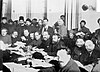
“The Revolution had been made in the name of peace, bread and Soviet power. It turned out to mean civil war, starvation and the dictatorship of the Bolshevik Party's Central Committee and its increasingly potent subcommittee, the Politburo. Workers who had supported the Bolsheviks in the expectation of a decentralized soviet regime found themselves being gunned down if they had the temerity to strike at newly nationalized factories. With inflation rampant, their wages in real terms were just a fraction of what they had been before the war. 'War Communism' reduced hungry city dwellers to desperate bartering expeditions to the country and to burning everything from their neighbours' doors to their own books for heat. As the conscription system grew more effective, more and more young men found themselves drafted into the Red Army, which grew in number from less than a million in January 1919 to five million by October 1920, though desertion rates remained high, especially around harvest time. When the previously pro-Bolshevik sailors of Kronstadt mutinied in February 1921 , they denounced the regime for crushing freedom of speech, press and assembly and filling prisons and concentration camps with their political rivals.”
“The Provisional Government that took the Tsar's place aimed to establish a republic with a liberal constitution and parliamentary institutions. Its prospects were far from bad. However, the determination of its leaders to keep the war going and to postpone decisions on the burning question of land reform until after a Constituent Assembly had been elected created a window of opportunity for more extreme elements. The Bolsheviks had in fact been taken by surprise by the revolution. 'It's staggering!' exclaimed Lenin when he heard the news in Zurich. 'Such a surprise! Just imagine! We must get home, but how?' The German High Command answered that question, providing him not only with a railway ticket to Petrograd but also, through two shady intermediaries named Parvus and Ganetsky, with funds to subvert the new government. Instead of having him and his associates arrested, as they richly deserved to be, the Provisional Government dithered. On August 27, egged on by conservative critics of the new regime, the Supreme Commander of the Russian Army, General Lavr Kornilov, launched an abortive military coup. The unintended effect was to boost support for the Bolsheviks within the soviets, which had sprung up as a kind of parallel government not only in Petrograd (as in 1905) but in other cities too. Two months later, on October 24, 1917, the Bolsheviks staged a coup d'état of their own. At the time, it did not seem like a world-shaking event. Indeed, more people were hurt in Sergei Eisenstein's subsequent reenactment for his film October. Hardly anyone expected the new regime to last.”
“The Bolsheviks promised their supporters 'Peace, Bread and Power to the Soviets'. Peace turned out to mean abject capitulation. At Brest-Litovsk, in the sprawling brick fortress that guards the River Bug, the German High Command demanded sweeping cessions of territory from a motley Bolshevik delegation (to keep up revolutionary appearances, a token peasant named Roman Stashkov had been picked up en route). Trotsky, who was in charge of Bolshevik foreign policy during the negotiations, played for time, defiantly if somewhat opaquely proclaiming 'neither peace nor war'. His hope was that if the negotiations could be spun out for long enough, world revolution might supervene. The Germans simply advanced into the Baltic provinces, Poland and the Ukraine. There was almost no resistance from the demoralized Russian forces. Indeed, for a moment it seemed as if the Germans might even take Petrograd, and the Bolshevik leadership was forced hastily to remove themselves to Moscow, henceforth their capital. When Trotsky finally yielded to Lenin's argument for capitulation - after stormy debates that led the Left Socialist Revolutionaries to quit the revolutionary government - the Bolsheviks had to sign away a third of the pre-war Russian Empire's agricultural land and population, more than half of her industry and nearly 90 per cent of her coalmines. Poland, Finland, Lithuania and the Ukraine became independent, though under German tutelage. The war in the East was the war the Germans won. The money they had used to send Lenin back to Russia had, it seemed, paid a handsome return. Yet the Russian Revolution proved to be not the end of the war, merely its mutation. After Germany's eastern triumph was rendered null and void by her defeat in the West, the war in the East changed into a terrible civil war, in many ways as costly in human life as the conventional war between empires that preceded it.”