Link Copied!
Marcellin Berthelot Quotes (1827-1907)
Author, Politician
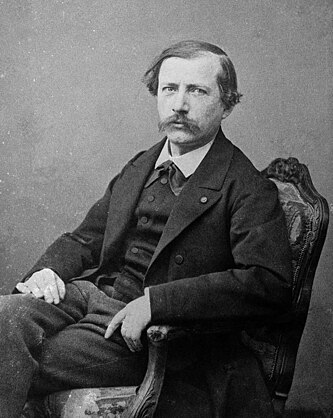


About Marcellin Berthelot
Pierre Eugène Marcellin Berthelot FRS FRSE (25 October 1827 – 18 March 1907) was a French chemist and politician noted for the Thomsen-Berthelot principle of thermochemistry. He synthesized many organic compounds from inorganic substances, providing a large amount of counterevidence to the theory of Jöns Jakob Berzelius that organic compounds required organisms in their synthesis.
Best Marcellin Berthelot Quotes
Shortest
Earliest
Explore our curated collection of the most famous and impactful Marcellin Berthelot quotes.
“Science is the benefactor of humanity.”

“Science is the real moral school; she teaches man the love and respect for the truth, without which all hope is chimerical.”

“In fact, what we are can only be attributed for a small part to our labour and personal individuality, because we owe it almost entirely to our forefathers, both of blood and mind.”
“Science... dominates all things, it alone is of any definite utility. No man, no institution shall henceforth have an enduring authority if they do not conform themselves to its precepts.”
“Science carries its legitimate pretensions further. To-day it claims the material, intellectual, and moral direction of society. Under its impulse modern civilisation marches with an increasingly rapid stride.”

“Each one of us, whatever may have been his individual initiative, ought also to attribute a considerable portion of his success to his contemporaries who are working at the same time as himself at the great common task.”
“A new conception of human destiny results from a profound knowledge of the universe and the physical and moral constitution of man, directed by the fundamental notions of universal solidarity between all classes and all nations.”
“Thus it is that the tangible utility of scientific results has made the public authorities understand that laboratory work should be encouraged and sustained, because it is economically a benefit to all and for the public health.”
“The most interesting of the services rendered by science is perhaps shown by comparing the servile and miserable condition of the popular masses in the past with their present state, already so much raised in dignity and comfort, without prejudice to the hopes which they are gradually realising.”
“If each one of us adds something to the common weal in the domain of science, or art, or morality, the reason is because long series of generations have lived, worked, thought, and suffered before us. The science which you honour to-day has been created by the patient labours of our predecessors.”
“Your sympathy makes the lamp which is on the point of being extinguished in the everlasting night shine with a final brilliancy. The respect which humanity shows to aged persons is the expression of the solidarity which unites the present generations to those which have gone before and to those which will follow.”
“There abides in nature a certain form of matter which, being discovered and brought by art to perfection, converts to itself, proportionally, all imperfect bodies that it touches. ...It rested on the indisputable appearance of an indefinite cycle of transformations, reproducing themselves in chemical operations, without either beginning or end.”
“Hence the rôle of savants, as individuals and as a social class, has unceasingly developed in modern states. But our duties towards other men increase in the same ratio, and let it never be forgotten; let it proclaimed in this hall, in this palace of French science.”
“According as the bonds uniting the peoples of the world together are multiplied and lightened by the progress of science and by unity of the doctrines and precepts that it deducts from facts, and imposes without violence and yet in a relentless manner to all convictions, these ideas have assumed a growing and more and more irresistible importance. They tend to become a purely human basis of nature, morality, and politics.”
“Gentlemen, since the first half of the century that has terminated, without going further back, the world has strangely altered. The men of my generation have seen come into play, beside and above the nature known since antiquity, if not an antithesis, a counter-nature... but a superior nature, and to some extent transcendent, where the power of indıvidual is centupled by the transformation of forces until then unknown or not understood, borrowed from light, magnetism, and electricity.”

“In effect, it may be declared emphatically that no one has a right to claim the exclusive merit of the brilliant discoveries of the past century. Science is essentially a collective work, prosecuted during the course of time by the efforts of a multitude of workers of every age and every nation, succeeding each other and associated in virtue of a tacit understanding for the research of truth in its purity, and for the application of this truth to the continual transformation of the condition of all men.”
“Gentlemen, formerly savants were looked upon as a little group of amateurs and leisured people, maintained at the expense of the labouring classes, and performing a work of luxury for the amusement and distraction of the favourites of fortune. This narrow and unjust view which took so little into account, our services and devotion to truth, this prejudice, ended by disappearing when the development of science showed that Nature's laws were applicable to practical industry, and their effect was to replace the old traditional receipts and empirics by profitable rules founded on observation and experience. To-day who would dare to look upon science as a sterile amusement in presence the general increase of national and private riches which resulted from it?”

“Chemistry is not a primitive science, like geometry or astronomy; it is constructed from the debris of a previous scientific formation; a formation half chimerical and half positive, itself founded on the treasure slowly amassed by the practical discoveries of metallurgy, medicine, industry, and domestic economy. It has to do with alchemy, which pretended to enrich its adepts by teaching them to manufacture gold and silver, to shield them from diseases by the preparation of the panacea, and finally to obtain for them perfect felicity by identifying them with the soul of the world and the universal spirit.”
“It not by reason of the egoistical satisfaction of our private vanity that the world-to-day pays homage to savants. No; it is because it knows that a savant really worthy of the name devotes a disinterested life to the great work of our epoch—I mean to say to the improvement, too slow, alas! for our taste, of the condition of every one, from the richest and happiest to the humble, the poor, and the suffering. That is what the public declared nine years ago in this same hall when honouring Pasteur. That is what my friend Chaplain has tried to express on the beautiful medal which the President of the Republic will presently offer me. I do not know if I have completely fulfilled noble ideal traced by the artist, but I have tried to make it object and end, the directing idea of my existence.”
Marcellin Berthelot Quotes by Topic
Find exactly what you are looking for by browsing this categorized list of Marcellin Berthelot quotes by topic.
Marcellin Berthelot on Chemistry 2 quotes
“Chemistry is not a primitive science, like geometry or astronomy; it is constructed from the debris of a previous scientific formation; a formation half chimerical and half positive, itself founded on the treasure slowly amassed by the practical discoveries of metallurgy, medicine, industry, and domestic economy. It has to do with alchemy, which pretended to enrich its adepts by teaching them to manufacture gold and silver, to shield them from diseases by the preparation of the panacea, and finally to obtain for them perfect felicity by identifying them with the soul of the world and the universal spirit.”

Marcellin Berthelot on Art
“There abides in nature a certain form of matter which, being discovered and brought by art to perfection, converts to itself, proportionally, all imperfect bodies that it touches. ...It rested on the indisputable appearance of an indefinite cycle of transformations, reproducing themselves in chemical operations, without either beginning or end.”

Marcellin Berthelot on Metallurgy
“Chemistry is not a primitive science, like geometry or astronomy; it is constructed from the debris of a previous scientific formation; a formation half chimerical and half positive, itself founded on the treasure slowly amassed by the practical discoveries of metallurgy, medicine, industry, and domestic economy. It has to do with alchemy, which pretended to enrich its adepts by teaching them to manufacture gold and silver, to shield them from diseases by the preparation of the panacea, and finally to obtain for them perfect felicity by identifying them with the soul of the world and the universal spirit.”

Quotes About Marcellin Berthelot
Gain deeper perspective through quotes about Marcellin Berthelot from others.
Jean-Marc Drouin on Marcellin Berthelot
“Marcellin Berthelot... observed ants as a hobby. He published in 1886 under the title Science et philophie... several essays. One... "Les cités animales et leur évolution". ...He was convinced that the same instinct of sociability was active among human races and among animal ones. He considered the hypothesis of the social contract as a chimerical one. ...Ten years later, in another collection of essays... Science et morale... [h]e considered that it is more useful to compare human societies with ant colonies than with beehives, because while in the latter laws are uniform, in the former there is a place for individual intitiatives.”
Louis Pasteur on Marcellin Berthelot
“[Berthelot] is not only a great chemist, but also a great philosopher. He possessed a universal spirit. His discovery of the synthesis of organic materials would be enough to immortalize his name. His work on explosive materials were also invaluable services...”
M. M. Pattison Muir on Marcellin Berthelot
“Berthelot... says that alchemy rested partly on the industrial processes of the ancient Egyptians, partly on the speculative theories of the Greek philosophers, and partly on the mystical reveries of the Gnostics and the Alexandrians.”
Source on Marcellin Berthelot 19 quotes
“In 1851, at the age of twenty-four, he entered the College de France, as préparateur of the lectures on chemistry (under Balard, the discoverer of bromine).”
Note on Marcellin Berthelot
“He also formed methane by passing the vapour of carbon disulphide and sulphuretted hydrogen over hot copper; and by the action of carbon monoxide on a hot solution of caustic potash, potassium formate was produced, the formate yielding formic acid on distillation with hydrochloric acid.”
About Marcellin Berthelot
Pierre Eugène Marcellin Berthelot FRS FRSE (25 October 1827 – 18 March 1907) was a French chemist and politician noted for the Thomsen-Berthelot principle of thermochemistry. He synthesized many organic compounds from inorganic substances, providing a large amount of counterevidence to the theory of Jöns Jakob Berzelius that organic compounds required organisms in their synthesis.