Link Copied!
M. S. Swaminathan Quotes (1925-2023)
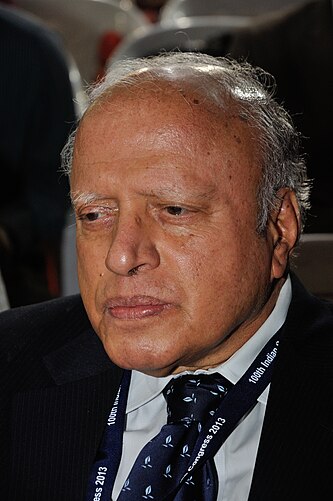
About M. S. Swaminathan
Sambasivan Swaminathan (7 August 1925 – 28 September 2023) was an Indian geneticist and international administrator, renowned for his leading role in India's "Green Revolution," a program under which high-yield varieties of wheat and rice seedlings were planted in the fields of poor farmers.
Best M. S. Swaminathan Quotes
Shortest
Earliest
Explore our curated collection of the most famous and impactful M. S. Swaminathan quotes.

“Developing countries can leapfrog several stages in the development process through the application of bio-technology in agriculture”
“Agriculture is the backbone of the livelihood security system of nearly 700 million people in the country and we need to build our food security on the foundation of home grown food.”

“Norman Borlaug is the living embodiment of the human quest for a hunger free world. His life is his message."”

“Land and water management should be given ‘Number One' priority for achieving evergreen revolution. No less important is to achieve the utmost efficiency in investment as well as in the use of water.”

“When you take up lab-to-land transfer, you should know the socio-economic circumstances of the farmer. You should not do experiments with the farmer, because he is already poor. You must be very sure that whatever you are recommending is both economically and ecologically sound. If farm economics and farm ecology go wrong, nothing else can go right in agriculture.”
“So there is a big transformation. Also if you see the average lifespan, which was 28–29 in 1947, is now 64–65. In Kerala it is 74 or so. I am sure soon it will become 80–90. That is partly also because of food, because without nutrition, it is not possible. So we have had a transformation in our economic wellbeing. But that is not spread evenly in society; there are still very poor people, the highly deprived. In my view, the first task of both science and society is to address this issue”
“The Green Revolution was criticised by social activists on the ground that the high-yield technology involving the use of mineral fertilizers and chemical pesticides is environmentally harmful. Similarly, some economists felt that the new technologies would bypass small and marginal farmers, for although the technologies are scale-neutral, they are not resource-neutral. This led to my coining the term “ever-green revolution,” to emphasise the need to enhance productivity in perpetuity without ecological harm.”

“I followed Swami Vivekananda's teachings when I was young. He said, this life is short, its vanities are transient. He alone lives who lives for others. I think more than any other country, in our country, this is very important today. ‘Others’ also includes family members, because charity begins at home. But if you are an educated person, do something which can help improve the lives and livelihoods of your fellow people. And then towards the latter part of your life, you feel more satisfied that you have one something not only for yourself or for your family, but you have done something which has made a slight difference in the lives of the less privileged.”

Quotes About M. S. Swaminathan
Gain deeper perspective through quotes about M. S. Swaminathan from others.
Stated by on M. S. Swaminathan
“Dr. Swaminathan is a living legend. His contributions to Agricultural Science have made an indelible mark on food production in India and elsewhere in the developing world. By any standards, he will go into the annals of history as a world scientist of rare distinction.”
Atmaram Bhairav Joshi on M. S. Swaminathan
“But for [...] his contributions, India today would have been a decimated, depopulated country as prophesied by the American doom-sayers Paddock Brothers!”
About M. S. Swaminathan
Sambasivan Swaminathan (7 August 1925 – 28 September 2023) was an Indian geneticist and international administrator, renowned for his leading role in India's "Green Revolution," a program under which high-yield varieties of wheat and rice seedlings were planted in the fields of poor farmers.