Link Copied!
Kenneth Waltz Quotes (1924-2013)
King
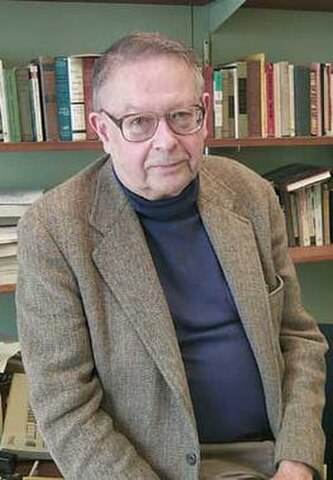

About Kenneth Waltz
Kenneth Neal Waltz (June 8, 1924 – May 12, 2013) was a member of the faculty at the University of California and Columbia University and one of the most prominent scholars of international relations (IR) of the 20th century. He was one of the founders of neorealism, or structural realism, in international relations theory.
Best Kenneth Waltz Quotes
Shortest
Earliest
Explore our curated collection of the most famous and impactful Kenneth Waltz quotes.

“No system of balance functions automatically.”

“Once socialism replaces capitalism, reason will determine the policies of states.”

“War may achieve a redistribution of resources, but labor, not war, creates wealth.”
“In a zero-sum game, the problem is entirely one of distribution, not at all one of production.”

“To build a theory of international relations on accidents of geography and history is dangerous.”
“Is it capitalism or states that must be destroyed in order to get peace, or must both be abolished?”
“The most important causes of political arrangements and acts are found in the nature and behavior of man.”
“Each man does seek his own interest, but, unfortunately, not according to the dictates of reason.”

“States in the world are like individuals in the state of nature. They are neither perfectly good nor are they controlled by law.”
“The transitory interests of royal houses may be advanced in war; the real interests of all people are furthered by the peace.”
“To solve these problems one needs as much an understanding of politics as an understanding of man - and the one cannot be derived from the other.”


“The implication of game theory, which is also the implication of the third image, is, however, that the freedom of choice of any one state is limited by the actions of the others.”


“If we gather more and more data and establish more and more associations, however, we will not finally find that we know something. We will simply end up having more and more data and larger sets of correlations.”
“According to the first image of international relations, the locus of the important causes of war is found in the nature and behavior of man. Wars result from selfishness, from misdirected aggressive impulses, from stupidity.”

“With many sovereign states, with no system of law enforceable among them, with each state judging its grievances and ambitions according to the dictates of its own reason or desire - conflict, sometimes leading to war, is bound to occur.”
“The best critical consideration of the inherent weakness of a federation of states in which the law of the federation has to be enforced on the states who are its members is contained in the Federalist Papers.”

“Each state pursues its own interest's, however defined, in ways it judges best. Force is a means of achieving the external ends of states because there exists no consistent, reliable process of reconciling the conflicts of interest that inevitably arise among similar units in a condition of anarchy.”
“Asking who won a given war, someone has said, is like asking who won the San Francisco earthquake. That in war there is no victory but only varying degrees of defeat is a proposition that has gained increasing acceptance in the twentieth century.”
“I am not saying that such a theory cannot be constructed, but only that I cannot see how to do it in any way that might be useful. The decisive point, anyway, is that a macrotheory of international politics would lack the practical implications of macroeconomic theory. National governments can manipulate system-wide economic variables. No agencies with comparable capabilities exist internationally. Who would act on the possibilities of adjustment that a macrotheory of international politics might reveal?”

Kenneth Waltz Quotes by Topic
Find exactly what you are looking for by browsing this categorized list of Kenneth Waltz quotes by topic.
Kenneth Waltz on International relations 2 quotes
“To build a theory of international relations on accidents of geography and history is dangerous.”

Kenneth Waltz on Anarchism
Kenneth Waltz on Game theory
“The implication of game theory, which is also the implication of the third image, is, however, that the freedom of choice of any one state is limited by the actions of the others.”
Kenneth Waltz on Information
“Data, seeming facts, apparent associations-these are not certain knowledge of something. They may be puzzles that can one day be explained; they may be trivia that need not be explained at all.”
Kenneth Waltz on Power (international relations)
“If power does not reliably bring control, what does it do for you? Four things, primarily. First, power provides the means of maintaining one's autonomy in the face of force that others wield. Second, greater power permits wider ranges of action, while leaving the outcomes of action uncertain. […] Third, the more powerful enjoy wider margins of safety in dealing with the less powerful and have more to say about which games will be played and how. […] Fourth, great power gives its possessors a big stake in their system and the ability to act for its sake. For them management becomes both worthwhile and possible.”

What Kenneth Waltz Said About Others
Discover personal opinions Kenneth Waltz shared regarding contemporaries.
Kenneth Waltz on Niccolò Machiavelli
“The elements of Realpolitik, exhaustively listed, are these: The ruler's, and later the state's, interest provides the spring of action; the necessities of policy arise from the unregulated competition of states; calculation based on these necessities can discover the policies that will best serve a state's interests; success is the ultimate test of policy, and success is defined as preserving and strengthening the state . Ever since Machiavelli, interest and necessity — and raison d'état, the phrase that comprehends them-have remained the key concepts of Realpolitik. From Machiavelli through Meinecke and Morgenthau the elements of the approach and the reasoning remain constant. Machiavelli stands so clearly as the exponent of Realpolitik that one easily slips into thinking that he developed the closely associated idea of balance of power as well . Although he did not, his conviction that politics can be explained in its own terms established the ground on which balance-of-power theory can be built.”

Kenneth Waltz on J. A. Hobson
“This practical condition, together with the failure of international-political theories to provide either convincing explanations or serviceable guidance for research, has provided adequate temptation to pursue reductionist approaches. The economic theory of imperialism developed by Hobson and Lenin is the best of such approaches. By "best" I mean not necessarily correct but rather most impressive as theory. The theory is elegant and powerful. Simply stated and incorporating only a few elements, it claims to explain the most important of international-political events-not merely imperialism but also most, if not all, modem wars-and even to indicate the conditions that would permit peace to prevail. The theory offers explanations and, unlike most theories in the social sciences, predictions as well. Moreover, it has successfully performed the other tasks that a good theory should accomplish: namely, stimulating and guiding research and· provoking counter-theories that claim to account for the same phenomena. All in all, the literature that can be attributed to the Hobson-Lenin theory of imperialism, both in support of the theory and against it, is as extensive and as sophisticated as the literature associated with any other school in the field of international politics.”
Quotes About Kenneth Waltz
Gain deeper perspective through quotes about Kenneth Waltz from others.
Richard K. Betts on Kenneth Waltz
“Like any truly great thinker, Ken Waltz defied stereotypes. The preeminent hard-headed theorist of power politics, he savaged the hopes of those who believe that moral energy, liberal principles, or democratic crusades can end war. But he belied the common assumption that realists are callous hawks who relish the use of force. He opposed the Vietnam War, the Reagan military buildup, and the 2003 invasion of Iraq as overreactions to threats that were exaggerated and could be handled by calm containment and deterrence.”
Ken Booth on Kenneth Waltz
“Waltz is to the study of international relations what Darwin is to the study of biology. I make this claim in terms of the sheer intellectual significance of his theoretical contribution. One cannot make sense of the biological world apart from Darwin’s theory of evolution: equally, Waltz’s structural framework for understanding how states interact under anarchy, with an uneven distribution of power and a desire to survive, offers a powerful theory for making sense of the international system. Neither theory explains everything in their domain — one always needs to know more about particularities — but both provide compelling big-picture explanations of their domains.”
Robert Gallucci on Kenneth Waltz
“We differed on the last point, and sometimes on the key, recurring question of American foreign policy: When is military intervention justified, by which he meant, when is it in the national interest? Waltz had no patience for "liberal intervention," or what we might now call humanitarian intervention, because we could never be sure that we would succeed in making things better over the long-term. And he had little patience for supposed national security arguments that could not identify a threat to vital interests — we are not, and therefore should not act like, an empire. Waltz was not an isolationist, but he was definitely a minimalist when it came to the use of force.”

About Kenneth Waltz
Kenneth Neal Waltz (June 8, 1924 – May 12, 2013) was a member of the faculty at the University of California and Columbia University and one of the most prominent scholars of international relations (IR) of the 20th century. He was one of the founders of neorealism, or structural realism, in international relations theory.