Link Copied!
Joseph Fourier Quotes (1768-1830)
Physicist, King, Mathematician
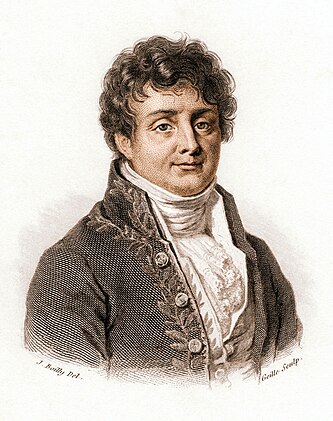
About Joseph Fourier
Jean Baptiste Joseph Fourier (March 21, 1768 – May 16, 1830) was a French mathematician and physicist who is best known for initiating the investigation of Fourier series and their application to problems of heat flow. The Fourier transform is also named in his honor.
Best Joseph Fourier Quotes
Shortest
Earliest
Explore our curated collection of the most famous and impactful Joseph Fourier quotes.
“Profound study of nature is the most fertile source of mathematical discoveries.”
“This distinction of luminous and non-luminous heat, explains the elevation of temperature caused by transparent bodies.”
“From the constitution of the solar system it is... probable that the temperature of the poles... are a little less than that of space... the same for all... although the distances from the sun may be unequal.”
“The mobility of the air, which is rapidly displaced... and... rises when heated... diminish the intensity of the effects... [of] a transparent and solid atmosphere, but do not entirely change their character.”
“We shall now consider that peculiar heat which our globe had at the time of the formation of the planets, and which continues to be dissipated at the surface under the influence of the low temperature of the planetary space.”
“The primitive heat... in the interior of the earth would not increase the external temperature of space... for... the effect of this central heat has long since become insensible at the surface, although it may be very great at a moderate depth.”
“Letter, quoted by Vladimir Dobrushkin, "Biography of Joseph Fourier" & Elena Presitini, The Evolution of Applied Harmonic Analysis (2004) p. 42.”

“The solar system is situated in a region of the universe, every point of which has a common and constant temperature, determined by the rays of light and heat which proceed from the surrounding stars. This low temperature is a little below that of the polar regions of the earth.”
“[I]f all the strata of air of... the atmosphere... preserved their density with their transparency, and lost only the mobility... peculiar to them, this mass of air, thus become solid, on being exposed to the rays of the sun, would produce an effect the same in kind... [as] just described.”

“The earth would have only the same temperature as the heavens, were it not for two causes... One is the internal heat... possessed at its formation... only dissipated through the surface; the other is the continued action of the solar rays... which produce at the surface, the diversities of climate.”
“The question of terrestrial temperature, one of the most remarkable and difficult in natural philosophy... I have... condensed in a single essay... the results of this theory. The analytical details... I have already published. I was specially desirous of presenting... a complete view of the phenomena and the mathematical relations... between them.”
“Primary causes are unknown to us; but are subject to simple and constant laws, which may be discovered by observation, the study of them being the object of natural philosophy.
Heat, like gravity, penetrates every substance of the universe, its rays occupy all parts of space. The object of our work is to set forth the mathematical laws which this element obeys. The theory of heat will hereafter form one of the most important branches of general physics.”
Heat, like gravity, penetrates every substance of the universe, its rays occupy all parts of space. The object of our work is to set forth the mathematical laws which this element obeys. The theory of heat will hereafter form one of the most important branches of general physics.”
“The heat of the earth is derived from three sources...
1. ...[S]olar rays; the unequal distribution of which causes diversities of climate.
2. ...[T]he common temperature of the planetary spaces; being exposed to the radiation from the innumerable stars which surround the solar system.
3. The earth preserves in its interior that primitive heat which it had at the time of the first formation of the planets. ...We will show ...the principle features of these phenomena.”
“Liquids are very poor conductors of heat; but they have, like aeriform media, the property of carrying it rapidly in certain directions. This is the same property which, combining with, combining with the centrifugal force, displaces and mingles all parts of the atmosphere... [and] ocean, and maintains in them, regular and immense currents.”

“We conclude... that there exists a physical cause always present which modifies the temperature at the surface of the earth, and gives this planet a fundamental heat, which is... independent of the action of the sun and that internal heat preserved... It is to be attributed to the radiation from all the bodies in the universe, whose light and heat can reach us... rays which penetrate every part of the planetary regions... [A]ny point of space whatever which contains these bodies acquires a fixed temperature.”
“I am sorry not to have known the mathematician who first made use of this method because I would have cited him. Regarding the researches of d'Alembert and Euler could one not add that if they knew this expansion they made but a very imperfect use of it. They were both persuaded that an arbitrary and discontinuous function could never be resolved in series of this kind, and it does not seem that anyone had developed a constant in cosines of multiple arcs, the first problem which I had to solve in the theory of heat.”
“This temperature of space is not the same in different regions of the universe; but it does not vary in the regions... [of] planetary bodies... [T]he planets of our system... equally participate in the common temperature... augmented for each... by the rays of the sun, according to the distance of the planet from... [it]. ...The intensity and distribution of heat on the surface of these bodies results from the distance from the sun, the inclination of the axes of rotation to the orbit, and the state of the surface...”

“If we consider further the manifold relations of this mathematical theory to civil uses and the technical arts, we shall recognize completely the extent of its applications. It is evident that it includes an entire series of distinct phenomena, and that the study of it cannot be omitted without losing a notable part of the science of nature.
The principles of the theory are derived, as are those of rational mechanics, from a very small number of primary facts, the causes of which are not considered by geometers, but which they admit as the results of common observations confirmed by all experiment.”
The principles of the theory are derived, as are those of rational mechanics, from a very small number of primary facts, the causes of which are not considered by geometers, but which they admit as the results of common observations confirmed by all experiment.”

“The interposition of the air very much modifies the effects of the heat upon the surface of the globe. The solar rays traversing the atmospheric strata, which are condensed by their own weight [at decreasing altitudes], heat them very unequally; those which are rarest are likewise coldest, because they... absorb a smaller part of the rays. The heat of the sun... in the form of light, possesses the property of penetrating transparent solids or liquids, and loses this property... when by... terrestrial bodies, it is turned into heat radiating without light.”
“We shall describe... the principal results of the prolonged action of the solar rays upon the terrestrial globe. ...[T]he state of the mass has varied continually in proportion to the heat received. This variable... internal temperature... has approached... nearer to a final state... subject to no change. Then each point of the solid sphere has acquired, and preserves... a fixed temperature, which depends only on the situation of the point... The final state of the mass, the heat of which has penetrated all... parts, can... be compared to... a vessel which receives by openings at the top, liquid from some constant source, and permits exactly an equal quantity to escape by orifices.
Thus the solar heat has accumulated in the interior of the globe and is... continually renewed.”
Thus the solar heat has accumulated in the interior of the globe and is... continually renewed.”

“I regarded these events as the customary disturbances of a state in which a new usurper tends to pluck the sceptre from his predecessor. ...As the natural ideas of equality were developed it was possible to conceive the sublime hope of establishing among us a free government exempt from kings and priests and to free from this double yoke the long usurped soil of Europe. I readily became enamored of this cause... the greatest and most beautiful which any nation has ever undertaken. ...You will judge whether it is I or my adversaries who are terrorists and persecutors. ...I accuse them of having violated ...all the rules of natural justice, of being ignorant and evil, of profaning the words of humanity and justice in invoking them, just as tyranny was organized in the name of liberty. Finally, of having given themselves up to a boundless revolutionary fury which ought to cover then with disgrace and scorn.”

“The analytical equations, unknown to the ancient geometers, which Descartes was the first to introduce into the study of curves and surfaces, are not restricted to the properties of figures, and to those properties which are the object of rational mechanics; they extend to all general phenomena. There cannot be a language more universal and more simple, more free from errors and from obscurities, that is to say more worthy to express the invariable relations of natural things.
Considered from this point of view, mathematical analysis is as extensive as nature itself; it defines all perceptible relations, measures times, spaces, forces, temperatures; this difficult science is formed slowly, but it preserves every principle which it has once acquired; it grows and strengthens itself incessantly in the midst of the many variations and errors of the human mind.
Its chief attribute is clearness; it has no marks to express confused notions. It brings together phenomena the most diverse, and discovers the hidden analogies which unite them.”
“It is difficult to know how far the atmosphere influences the mean temperature of the globe... It is to... M. de Saussure that we are indebted for a capital experiment which appears to throw... light on this... The theory of the instrument is... 1st... the acquired heat is concentrated, because it is not dissipated immediately by renewing the air; 2d, that the heat of the sun, has properties different from those of [invisible] heat... The rays... are transmitted in considerable quantity through the glass plates... They heat the air and the partitions which contain it. Their heat thus communicated ceased to be luminous, and preserves only the properties of non-luminous radiating heat. In this state it cannot pass through the plate of glass covering the vessel. ...It is necessary to consider attentively this order of facts, and the results of the calculus when we would ascertain the influence of the atmosphere and waters upon the thermometrical state of our globe.”
“We... now consider the second cause of terrestrial heat, which... resides in the planetary spaces. ...[A]scertain what would be the thermometrical state of the terrestrial mass, if it received only the heat of the sun. To facilitate... first leave the atmosphere out of the account. ...[I]f the earth and all the bodies of the solar system, were placed in space deprived of all heat ...The polar regions would be subject to intense cold and the decrease of temperature from... equator to... poles would be incomparably more rapid and extended.
In this hypothesis of the absolute cold of space, all the effects of heat... at the surface of the earth, should be attributed to... the sun. The least variance in... [its] distance... from the earth, would occasion... considerable changes in temperature. The interruption of day and night would produce effects sudden... [B]odies, would be exposed... at commencement of night, to a cold of infinite intensity. Animals and vegetables could not resist... the sudden and powerful change... produced at the rising of the sun.”
In this hypothesis of the absolute cold of space, all the effects of heat... at the surface of the earth, should be attributed to... the sun. The least variance in... [its] distance... from the earth, would occasion... considerable changes in temperature. The interruption of day and night would produce effects sudden... [B]odies, would be exposed... at commencement of night, to a cold of infinite intensity. Animals and vegetables could not resist... the sudden and powerful change... produced at the rising of the sun.”
Joseph Fourier Quotes by Topic
Find exactly what you are looking for by browsing this categorized list of Joseph Fourier quotes by topic.
Joseph Fourier on Mathematical analysis 2 quotes
“The effects of heat are subject to constant laws which cannot be discovered without the aid of mathematical analysis. The object of the theory is to demonstrate these laws; it reduces all physical researches on the propagation of heat, to problems of the integral calculus, whose elements are given by experiment. No subject has more extensive relations with the progress of industry and the natural sciences; for the action of heat is always present, it influences the processes of the arts, and occurs in all the phenomena of the universe.”

Joseph Fourier on Thermodynamics
“The effects of heat are subject to constant laws which cannot be discovered without the aid of mathematical analysis. The object of the theory is to demonstrate these laws; it reduces all physical researches on the propagation of heat, to problems of the integral calculus, whose elements are given by experiment. No subject has more extensive relations with the progress of industry and the natural sciences; for the action of heat is always present, it influences the processes of the arts, and occurs in all the phenomena of the universe.”

Joseph Fourier on Numerical analysis
“Problems relative to the uniform propagation, or to the varied movements of heat in the interior of solids, are reduced ... to problems of pure analysis, and the progress of this part of physics will depend in consequence upon the advance which may be made in the art of analysis. The differential equations . . . contain the chief results of the theory; they express, in the most general and concise manner, the necessary relations of numerical analysis to a very extensive class of phenomena; and they connect forever with mathematical science one of the most important branches of natural philosophy.”

Joseph Fourier on Mathematics
“The analytical equations, unknown to the ancient geometers, which Descartes was the first to introduce into the study of curves and surfaces, are not restricted to the properties of figures, and to those properties which are the object of rational mechanics; they extend to all general phenomena. There cannot be a language more universal and more simple, more free from errors and from obscurities, that is to say more worthy to express the invariable relations of natural things. Considered from this point of view, mathematical analysis is as extensive as nature itself; it defines all perceptible relations, measures times, spaces, forces, temperatures; this difficult science is formed slowly, but it preserves every principle which it has once acquired; it grows and strengthens itself incessantly in the midst of the many variations and errors of the human mind. Its chief attribute is clearness; it has no marks to express confused notions. It brings together phenomena the most diverse, and discovers the hidden analogies which unite them.”

What Joseph Fourier Said About Others
Discover personal opinions Joseph Fourier shared regarding contemporaries.
Joseph Fourier on François Arago 3 quotes
“In the experimental sciences, the epochs of the most brilliant progress are almost always separated by long intervals of almost absolute repose.”

Quotes About Joseph Fourier
Gain deeper perspective through quotes about Joseph Fourier from others.
François Arago on Joseph Fourier
“In a military school directed by monks, the minds of the pupils necessarily waver only between two careers in life—the church and the sword. Like Descartes, Fourier wished to be a soldier; like that philosopher he would doubtless have found the life of a garrison very wearisome. But he was not permitted to make the experiment. His demand to undergo the examination for the artillery, although strongly supported by our illustrious colleague Legendre, was rejected with a severity of expression of which you may judge yourselves: "Fourier," replied the minister, "not being noble, could not enter the artillery, although he were a second Newton."”
Eric Temple Bell on Joseph Fourier
“Fourier's analytical theory of heat (final form, 1822), devised in the Galileo-Newton tradition of controlled observation plus mathematics, is the ultimate source of much modern work in the theory of functions of a real variable and in the critical examination of the foundation of mathematics.”

Florian Cajori on Joseph Fourier 3 quotes
“At the age of twenty-one he went to Paris to read before the Academy of Sciences a memoir on the resolution of numerical equations, which was an improvement on Newton's method of approximation. This investigation of his early youth he never lost sight of. He lectured upon it... he developed it... it constituted a part of a work entitled Analyse des equations determines (1831), which was in press when death overtook him. This work contained "Fourier's theorem" on the number of real roots between two chosen limits. Budan had published this result as early as 1807, but there is evidence to show that Fourier had established it before Budan's publication. These brilliant results were eclipsed by the theorem of Sturm, published in 1835.”

Carl Gustav Jacob Jacobi on Joseph Fourier
“It is true that M. Fourier had the opinion that the principal end of mathematics was the public utility and the explanation of natural phenomena; but such a philosopher as he is should have known that the unique end of science is the honor of the human mind, and that from this point of view a question of number is as important as a question of the system of the world.”

Source on Joseph Fourier 4 quotes
“He started as a convinced Jacobin... and ended up a cautious liberal.”
About Joseph Fourier
Jean Baptiste Joseph Fourier (March 21, 1768 – May 16, 1830) was a French mathematician and physicist who is best known for initiating the investigation of Fourier series and their application to problems of heat flow. The Fourier transform is also named in his honor.