Link Copied!
Joseph Beuys Quotes (1921-1986)
Artist

About Joseph Beuys
Joseph Beuys (May 12, 1921 – January 23, 1986) was a German conceptual artist, who produced work in a number of forms including sculpture, performance art, video art and installations. He was inspired by the ideas of Rudolf Steiner and the French artist Yves Klein. Beuys was an important teacher of famous neo-expressionist German artists as Jörg Immendorff, Walter Dahn, Anselm Kiefer and Blinky Palermo. Beuys held a lot of lectures in the U.S. Beuys enlarged the area of art to the whole life of mankind; everybody is an artist. He introduced the notion of social sculpture.
Best Joseph Beuys Quotes
Shortest
Earliest
Explore our curated collection of the most famous and impactful Joseph Beuys quotes.
“Even the act of peeling a potato can be an artistic act if it is consciously done.”
“I try to go further on over the threshold where modern art ends and anthropological art has to start.”
“This is precisely what the shaman does in order to bring about change and development: his nature is therapeutic.”
“Art alone makes life possible – this is how radically I should like to formulate it. I would say that without art man is inconceivable in physiological terms.”
“This most modern art discipline - Social Sculpture / Social Architecture - will only reach fruition when every living person becomes a creator, a sculptor, or architect of the social organism.”
“My intention: healthy chaos, healthy amorphousness in a known medium which consciously warmed a cold, torpid form from the past, a convention of society, and which makes possible future forms.”
“EVERY HUMAN BEING IS AN ARTIST who -
from his state of freedom -
the position of freedom that he experiences at first-hand -
learns to determine the other positions in the TOTAL ARTWORK OF THE FUTURE SOCIAL ORDER!”
from his state of freedom -
the position of freedom that he experiences at first-hand -
learns to determine the other positions in the TOTAL ARTWORK OF THE FUTURE SOCIAL ORDER!”
“my art cannot be understood primarily by thinking. My art touches people who are in tune with my mode of thinking. But it is clear that people cannot understand my art by intellectual processes alone, because no art can be experienced in that way.”
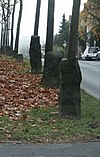
“I think the tree is an element of regeneration which in itself is a concept of time. The oak is especially so because it is a slowly growing tree with a kind of really solid heartwood. It has always been a form of sculpture, a symbol for this planet.”
“I believe that planting these oaks is necessary not only in biospheric terms, that is to say, in the context of matter and ecology, but in that it will raise ecological consciousness-raise it increasingly, in the course of the years to come, because we shall never stop planting.”
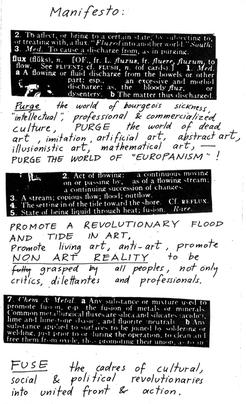
“Only then would the insistence on participation of the action art of FLUXUS and Happening be fulfilled; only then would democracy be fully realized. Only a conception of art revolutionized to this degree can turn into a politically productive force, coursing through each person, and shaping history.”
“He [ Marcel Duchamp ] entered this object [the 'Urinal' ready-made] into the museum and noticed that its transportation from one place to another made it into art. But he failed to draw the clear and simple conclusion that every man is an artist.”
“To be a teacher is my greatest work of art. The rest is the waste product, a demonstration. If you want to express yourself you must present something tangible. But after a while this has only the function of a historic document. Objects aren't very important any more. I want to get to the origin of matter, to the thought behind it.”

“I think art is the only political power, the only revolutionary power, the only evolutionary power, the only power to free humankind form all repression. I say not that art has already realized this, on the contrary, and because it has not, it has to be developed as a weapon, at first there are radical levels, then you can speak about special details.”

“I am interested in the creativity of the criminal attitude because I recognize in it the existence of a special condition of crazy creativity. A creativity without morals fired only by the energy of freedom and the rejection of all codes and laws. For freedom rejects the dictated roles of the law and of the imposed order and for this reason is isolated.”

“Only on condition of a radical widening of definitions will it be possible for art and activities related to art [to] provide evidence that art is now the only evolutionary-revolutionary power. Only art is capable of dismantling the repressive effects of a senile social system that continues to totter along the death-line: to dismantle in order to build 'A SOCIAL ORGANISM AS A WORK OF ART'.”
“I wished to go completely outside and to make a symbolic start for my enterprise of regenerating the life of human kind within the body of society and to prepare a positive future in this context... I can see such a use for the future as representing the really progressive character of the idea of understanding art when it is related to the life of humankind within the social body in the future.”

“The outward appearance of every object I make is the equivalent of some aspect of inner human life.. .My feelings then had this special kind of darkness – almost black like this mixture of rubber and tar. It is certainly an equivalent of the pathological state mentioned before, and expresses the need to create a space in the mind from which all disturbances were moved: an empty insulated space.”
“This is why we believe that a well-ordered idea of ecology and professionalism can stem only from art – art in the sense of the sole, revolutionary force, capable of transforming the earth, humanity, the social order etc.. ..Art is, then, a genuinely human medium for revolutionary change in the sense of completing the transformation from a sick world to a healthy one. In my opinion only art is capable of doing it.”
“'Fat' traverses the path from a chaotically dispersed, undirected energy form to a form. Then it appears in the famous fat corner.. ..now [a wedge of fat in the angle between seat and back of the wooden old Chair, Beuys used in the fat-sculpture, like 'Stuhl mit Fett' (Fet Chair), 1964] intersects the human body in the region that houses certain emotional forces [Beuys laughed, and so did everyone else of the public].”

“The idea of creativity is for me the problem of the future. Since the creative power is not a simple thing. It has a rich structure. It is divided into a lot of different principles and represented by figures, and these figures you can also write down in a kind of symbolic mantra. It is important to work on every point of creativity and see how the human being stands in the energy that comes out from the surrounding world.”
“I don't know what they call mysticism, it is in truth perhaps the interest of the spirit; that the work expresses the spirit, and not the formal aspect. While in the United States a lot of art production runs along the line of formalist art; what one could call the post-modernism, a kind of formalist intention like Don Judd, Carl Andre, Robert Morris, and these.”
“It is a kind of vehicle, you know. It's a kind of making, spreading out ideas, that is what I think. It spreads out the idea. You must care for information and I personally try to make information available not only in a written way.. .I try also to work with images, with fantasy, with jokes, with humor. It accelerates the discussion of the problem of a new society.. ..so I work coming from the idea of art as the most important means to transform the society.”
“But I saw the relationship between people, I saw their thoughts, I saw their kind of expressionistic behavior in every difficult situation. I saw all the time the unclearness in the psychological condition of the people. You know, that was the time called the 'Roaring Twenties' and I felt that this expressionistic behavior, this unformed quality of soul power and emotion of life.. .I saw it, that it would lead to a kind of catastrophe. That was my general feeling.”
“I had the feeling that another kind of life -- perhaps in a transcendental area -- would give me a better possibility to influence, or to work, or to act within this contradiction. So, this was my general feeling: on the one side, this beautiful undamaged nature form which I took a lot and had a lot of possibilities for contemplation, meditation, research, collecting things, making a kind of system; and on the other side, this social debacle that I felt already as a coming dilemma.”
Joseph Beuys Quotes by Topic
Find exactly what you are looking for by browsing this categorized list of Joseph Beuys quotes by topic.
Joseph Beuys on Social sculpture 2 quotes
“This most modern art discipline - Social Sculpture / Social Architecture - will only reach fruition when every living person becomes a creator, a sculptor, or architect of the social organism.”
Joseph Beuys on Fluxus 2 quotes
“My first concert - apart from Beethoven at School and Satie at the opening of my exhibition in Kleve in 1960 - was at the gallery Parnass in Wuppertal in 1963. Dressed like a regular pianist in dark grey flannel, black tie and no hat, I played the piano all over – not just the keys – with many pairs of old shoes until it disintegrated. My intention was neither destructive nor nihilistic. “Heal like with like” – similia similibus curantur – in the homeopathic sense. The main intention was to indicate a new beginning.. ..or simply a revolutionary act. This was my first public Fluxus appearance.”
Joseph Beuys on Visual art education
“To be a teacher is my greatest work of art. The rest is the waste product, a demonstration. If you want to express yourself you must present something tangible. But after a while this has only the function of a historic document. Objects aren't very important any more. I want to get to the origin of matter, to the thought behind it.”
Joseph Beuys on Intention
“My first concert - apart from Beethoven at School and Satie at the opening of my exhibition in Kleve in 1960 - was at the gallery Parnass in Wuppertal in 1963. Dressed like a regular pianist in dark grey flannel, black tie and no hat, I played the piano all over – not just the keys – with many pairs of old shoes until it disintegrated. My intention was neither destructive nor nihilistic. “Heal like with like” – similia similibus curantur – in the homeopathic sense. The main intention was to indicate a new beginning.. ..or simply a revolutionary act. This was my first public Fluxus appearance.”
Joseph Beuys on Performance art
“My first concert - apart from Beethoven at School and Satie at the opening of my exhibition in Kleve in 1960 - was at the gallery Parnass in Wuppertal in 1963. Dressed like a regular pianist in dark grey flannel, black tie and no hat, I played the piano all over – not just the keys – with many pairs of old shoes until it disintegrated. My intention was neither destructive nor nihilistic. “Heal like with like” – similia similibus curantur – in the homeopathic sense. The main intention was to indicate a new beginning.. ..or simply a revolutionary act. This was my first public Fluxus appearance.”

What Joseph Beuys Said About Others
Discover personal opinions Joseph Beuys shared regarding contemporaries.
Joseph Beuys on Andy Warhol
“I think he [Andy Warhol] would be very interested in the moment that the Dalai Lama appears, being involved in such a kind of idea. Andy has always difficulties with this kind of political activities, because he works in another kind of world, but he is always.. .Also when he was here (in Germany) last week, he is very interested to hear a lot of new information. He has a kind of observing sense in the back of his mind. So, he is always interested to follow the development, and there is really a kind of imaginative process going on, I think.”

Joseph Beuys on Heinrich Böll
“Creativity is not limited to people practising one of the traditional forms of art, and even in the case of artists, creativity is not confined to the exercise of their art. Each one of us has a creative potential, which is hidden by competitiveness and success-aggression. To recognize, explore and develop this potential is the task of the School. Creation – whether it be a painting, sculpture, symphony or novel – involves not merely talent, intuition, powers of imagination and application, but also the ability to shape material that could be expanded to other socially relevant spheres.”
Quotes About Joseph Beuys
Gain deeper perspective through quotes about Joseph Beuys from others.
Source on Joseph Beuys 8 quotes
“Yes, now we are at the starting-point again. Now we are at our real issue: that we understand ourselves first as sites of education, for information for democracy, for tree-part structure, and so on.”
Carl Andre on Joseph Beuys
“I mean artists like Joseph Beuys, who is really a tough, strong artist. B E U Y S. He's been working in Germany for years. He doesn't bother with the burden of ideas. What he desires to do is fill your house with margarine. Let you live encased in fat, die encased in fat. He would take three hundred pounds of margarine and put it exactly where Pat Kelly is now, and then leave it there. That's sort of the tenor of his work.”
Götz Adriani on Joseph Beuys
“The milieu in which creativity can be developed is principally the field of culture, and Beuys starts his sociopolitical program in the area of culture, in order to develop from this special angle the concept of equality as well as of democracy and socialism as a genetic process. The intellectual life, which education must should be structured, stands most definitely at the beginning of this evolutionary process of development. Next to it is equality as the democratic principle of law, meaning concrete socialism and fraternity in relation to the economic area. Within these three areas there is no qualitative ranking system. The primary necessity in Beuys' concept of direct democracy is freedom, meaning that every man should be able to completely realize his liberty, for example, his right to a free and equal unfolding of his personality, as is firmly established as a fundamental law in the organization's statutes.”
Hans Beck on Joseph Beuys
“Beuys complained that the [art] teachers didn't exhibit [during the winter semester's Open Week, 1964] any of their own works. He then brought along an old kitchen chair and a large quantity of margarine and patted the margarine on the seat of the chair with a wooden paddle so that it sloped like a wedge. We [students of Düsseldorf Art Academy, 1964] saw nothing unusual in this and none of us realized that we had before us a incunabulum of art. At that time Beuys had told us nothing about his 'energy-concept' or the like. We simply considered the making of this 'Fat Chair' to be a rather unspectacular action.”
Benjamin H. D. Buchloh on Joseph Beuys
“Unlike his European peers from the late 1950's — Piero Manzoni, Arnian, or even Yves Klein — Beuys does not change the state of the object with the discourse itself. Quite to the contrary, he dilutes and dissolves the conceptual precision of Marcel Duchamp's readymade by reintegrating the object into the most traditional context of literary and referential representation: this object stands for that idea, and that idea is represented in this object.”
Isa Genzken on Joseph Beuys

Alastair Mackintosh on Joseph Beuys
“Once again the lack of a convenient language makes for the creation of a series of separate versions or myths, and it is this difficulty of precise description or discussion that leads to the 'Beuys cult'. His actions do have the quality of myths, the same invisible logic as a myth and one must, I think, accept the performance as it stands rather than inquiry into its origins.”
Anon. on Joseph Beuys
“The Fluxus movement.. ..developed its 'anti-art', anti-commercial aesthetics under the leadership of George Maciunas. Fluxus staged a series of festivals in Paris, Copenhagen, Amsterdam, London and New York, with avantgarde performances often spilling out into the street. Most of the experimental artists of the period, including Joseph Beuys, Yoko Ono and Nam June PaikNam June Paik, took part in Fluxus events. The movement, which still continues, played an important role in the opening up of definitions of what art can be.”
About Joseph Beuys
Joseph Beuys (May 12, 1921 – January 23, 1986) was a German conceptual artist, who produced work in a number of forms including sculpture, performance art, video art and installations. He was inspired by the ideas of Rudolf Steiner and the French artist Yves Klein. Beuys was an important teacher of famous neo-expressionist German artists as Jörg Immendorff, Walter Dahn, Anselm Kiefer and Blinky Palermo. Beuys held a lot of lectures in the U.S. Beuys enlarged the area of art to the whole life of mankind; everybody is an artist. He introduced the notion of social sculpture.