Link Copied!
John Ruysbroeck Quotes (1293-1381)

About John Ruysbroeck
The Blessed John of Ruysbroeck (1293 or 1294 – 2 December 1381), "the Admirable" also known as John Ruusbroec, Jan van Ruusbroec or Jan van Ruysbroeck, was one of the Flemish mystics of the medieval Catholic Church.
Best John Ruysbroeck Quotes
Shortest
Earliest
Explore our curated collection of the most famous and impactful John Ruysbroeck quotes.
“All our ways end in superessential Being”

“My words are strange, but those who love will understand.”

“God in the depths of us receives God who comes to us: it is God contemplating God.”

“Our work is the love of God. Our satisfaction lies in submission to the Divine Embrace”
“God contemplates Himself and all things in an Eternal Now that has neither beginning nor end.”
“Spiritual inebriation is this: that a man receives more sensible joy and sweetness than his heart can either contain or desire.”

“Now, if the spirit is to contemplate God with God, without intermediary, in this divine light, three things are necessary for a person.”
“The incomprehensible richness and loftiness of the Divine Nature, its outpouring generosity toward all in common, fills a man with wonder.”

“Compassion is a wound in the heart whence flows a common love to all mankind and which cannot be healed so long as any suffering lives in man.”

“Finally, and beyond all else, ravished out of self into the Glory of God, without limit, incomprehensible, immense, we are to enjoy Him for ever and ever”
“Then are we ravished out of self by purified Love, even to the Face of God, freed and emptied of every event and illusion. This is the contemplative life of highest price.”
“And the Light floweth forth in similitude,
And indraweth Itself in unity;
Which we perceive, beyond the reason,
In that high point of our understanding
Which is bare and turned within.”
And indraweth Itself in unity;
Which we perceive, beyond the reason,
In that high point of our understanding
Which is bare and turned within.”

“The Will of God, which is free - indeed freedom itself - takes from us the spirit of fear and makes us free, disengaged from and emptied of self, and of every fear that might oppress us in time or eternity.”

“God's transcending nature must be understood as oneness and simplicity,
unscalable height and unfathomable depth,
incomprehensible breadth and infinite length,
dark silence and ferocious energy.”
unscalable height and unfathomable depth,
incomprehensible breadth and infinite length,
dark silence and ferocious energy.”
“Secondly, he must cleave to God within by devoted intention and love, just like a kindled, blazing fire that can no longer be extinguished. During the time that he feels himself to be in this state, he can contemplate.”
“Even though the eagle,
King of birds,
Can with his powerful sight
Gaze steadfastly upon
The brightness of the sun;
Yet do the weaker eyes of the bat
Fail and falter in the same.”
King of birds,
Can with his powerful sight
Gaze steadfastly upon
The brightness of the sun;
Yet do the weaker eyes of the bat
Fail and falter in the same.”
“The Love of God is a consuming Fire,
Which draws us out of ourselves
And swallows us up in unity with God,
Where we are satisfied and overflowing,
And with Him, beyond ourselves,
Eternally fulfilled.”
Which draws us out of ourselves
And swallows us up in unity with God,
Where we are satisfied and overflowing,
And with Him, beyond ourselves,
Eternally fulfilled.”
John Ruysbroeck Quotes by Topic
Find exactly what you are looking for by browsing this categorized list of John Ruysbroeck quotes by topic.
John Ruysbroeck on Mirror 4 quotes
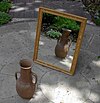
“The shining forth of That which is Unconditioned is as a fair mirror. Wherein shines the Eternal Light of God. It has no attributes, And here all the works of Reason fail. It is not God, But it is the Light whereby we see Him. Those who walk in the Divine Light of it Discover in themselves the Unwalled.”
John Ruysbroeck on Godhead 3 quotes
“There is a distinction and differentiation, According to our reason, Between God and the Godhead, Between action and rest. The fruitful nature of the Persons (Trinity) Ever worketh in a living differentiation. But the simple Being of God, According to the nature thereof, Is an eternal Rest of God And of all created things.”

John Ruysbroeck on Essence 2 quotes
“See, here the beatitude is so simple and so without mode that therein all essential gazing, inclination and distinction of creatures pass away. For all spirits thus raised up melt away and are annihilated by reason of enjoyment in God’s essence, which is the superessence of all essence. There they fall away from themselves and are lost in a bottomless unknowing.”
John Ruysbroeck on Now
“God contemplates Himself and all things in an Eternal Now that has neither beginning nor end.”

John Ruysbroeck on Clarity
“There their naked understanding is in penetrated with eternal clarity as the air is penetrated by the light of the sun.”

John Ruysbroeck on Beatitude
“The indrawing attraction drags us out of ourselves, And calls us to be melted away and naughted in the Unity. And in this indrawing attraction we feel that God wills that we should be His, And for this we must abnegate ourselves and let our beatitude be accomplished in Him. But when He attracts us by flowing out towards us, He gives us over to ourselves and makes us free, And sets us in Time.”
Quotes About John Ruysbroeck
Gain deeper perspective through quotes about John Ruysbroeck from others.
Reginald Garrigou-Lagrange on John Ruysbroeck
“Ruysbroeck is certainly one of the greatest mystics, but he can be comprehended only by advanced souls.”
Harvey D Egan on John Ruysbroeck
“John Ruusbroec, "the Admirable," has been called the "second Dionysius the Areopagite," the West's most articulate Trinitarian mystic, and even the greatest mystical writer in the Christian tradition. This spiritual titan not only reached the summit of mystical contemplation but also possessed the theological profundity and the limpid prose to express it - especially that of the unitive life.”
Carl McColman on John Ruysbroeck
“John Ruusbroec (1293-1381) is one of the greatest of the Christian mystics. His masterpiece, The Spiritual Espousals (sometimes translated as The Adornment of the Spiritual Marriage) in my opinion belongs on the short list of “must read” classics of western mysticism.”
Evelyn Underhill on John Ruysbroeck 3 quotes
“In the history of the spiritual adventures of man, we find at intervals certain great mystics, who appear to gather up and fuse together in the crucible of the heart the diverse tendencies of those who have preceded them, and, adding to these elements the tincture of their own rich experience, give to us an intensely personal, yet universal, vision of God and man. These are constructive spirits, whose creations in the spiritual sphere sum up and represent the best achievement of a whole epoch; as in other spheres the great artist, musician, or poet—always the child of tradition as well as of inspiration—may do. John Ruysbroeck is such a mystic as this. His career, which covers the greater part of the fourteenth century—that golden age of Christian mysticism—seems to exhibit within the circle of a single personality, and carry up to a higher term than ever before, all the best attainments of the Middle Ages in the realm of Eternal Life. Rooted firmly in history, faithful to the teachings of the great Catholic mystics of the primitive and mediæval times, Ruysbroeck does not merely transmit, but transfigures, their principles: making from the salt, sulphur, and mercury of their vision, reason, and love, a new and living jewel—or, in his own words, a ‘sparkling stone’—which reflects the actual radiance of the Uncreated Light. Absorbing from the rich soil of the Middle Ages all the intellectual nourishment which he needs, dependent too, as all real greatness is, on the human environment in which he grows—that mysterious interaction and inter-penetration of personalities without which human consciousness can never develop its full powers—he towers up from the social and intellectual circumstances that conditioned him: a living, growing, unique and creative individual, yet truly a part of the earth from which he springs.”

James A. Wiemann on John Ruysbroeck
“The greatest of the Flemish mystics, Jan van Ruusbroec was conversant not only with the main currents of mystical theology in the medieval Low Countries and the Rhineland but also with the patristic heritage of both the East and the West. His personal appropriation of this legacy, together with a keen sensitivity to the needs of all the members of the church of his day and a rare gift for describing the highest levels of mystical experience, enabled Ruusbroec to produce treatises of unsurpassed beauty, perspicuity, and synthetic power.”
Dom Cuthbert Butler on John Ruysbroeck
“John Ruysbroeck, 'the Admirable', is in some ways the most wonderful of the mystics. As a descriptive mystic he stands alongside of St John of the Cross in the daring and eloquence with which he ventures to utter in human language the experiences of union and knowledge to which he, was admitted. If he lacks St John's Latin clarity of thought and expression, he more than makes up for it by a certain massive mysteriousness that may be called Teutonic he was a Fleming of Brabant through which we seem ever and anon to catch glimpses of realities deeply impressive though at times bewildering. But there is a consistency and a sanity through it all, and a restraint due to his sound theological formation, which make an overwhelming impression of truth and reality. It may with all probability be said, that than him there has been no greater contemplative; and certainly there has been no greater mystical writer. His contemplation is highly intellectual, and at the same time fully mystical. Whether in the sublimity of his elevations or in the power of recording his experiences, Ruysbroeck stands as one of the very greatest of the mystics.”
Bede Griffiths on John Ruysbroeck
“[Ruysbroeck] comes very near to the doctrine of Ibn al-'Arabi. He expresses almost the same view in his teaching that everything in creation and everything in man exists eternally in God. Creation comes forth eternally in God as God, without any difference, and then it comes forth differentiated in time and space. Originally it is God in God. So the image of God exists eternally in God, in its archetype. Ruysbroeck says, "God utters himself in the Spirit eternally without intermediary and in this Word he utters himself and all things." In the utterance of the Word which comes forth from the Father eternally the whole creation, the whole of humanity, you and I and all created things, are present. Everything and all beings are present in that eternal Word, eternally present with God, in God and as God. We are all participating in the Infinite at that stage, beyond creation. This is what is meant by our uncreated being in the Godhead. Eckhart had the same idea but he expressed it less carefully while Ruysbroeck puts it extremely well. He speaks of "a waylessness and darkness in which we never find ourselves again in a creaturely way." We lose ourselves in that divine darkness. And he goes on to speak of God, this "God beyond", as it were, as "a simple nudity, an incomprehensible light". The one who has reached this point " finds himself and feels himself to be that light, gazing at that light, by that light, in that light. Here one has entered totally into the Godhead and one knows in the light and by the light". This is exactly how it is put in the Upanishads and in the 'Bhagavad Gita', where it is said that one knows the 'atman', through the 'atman'. The 'atman' cannot be known by any other means. God is grasped and held through God.”
Quoted on John Ruysbroeck
“'There are more answers than questions, and lots of people have found answers that were perfectly satisfactory for them. Old Ruysbroeck for one...' 'Who was he?' 'He was a Flemish mystic who lived in the fourteenth century'”
Dag Hammarskjöld on John Ruysbroeck
“[T]he counterpoint to this enormously exposed and public life is Eckhart and Jan van Ruysbroek. They really give me balance and a more necessary sense of humor.”
About John Ruysbroeck
The Blessed John of Ruysbroeck (1293 or 1294 – 2 December 1381), "the Admirable" also known as John Ruusbroec, Jan van Ruusbroec or Jan van Ruysbroeck, was one of the Flemish mystics of the medieval Catholic Church.