Link Copied!
John Quincy Adams Quotes (1767-1848)
President









About John Quincy Adams
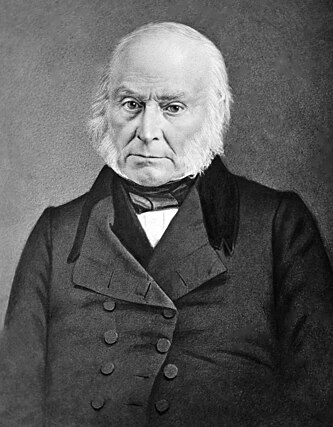
John Quincy Adams (July 11, 1767 – February 23, 1848) was an American statesman who served as the sixth president of the United States from 1825 to 1829. He also served as a diplomat, a senator and member of the House of Representatives. He was a member of the Federalist, Democratic-Republican, National Republican, and later Anti-Masonic and Whig parties. John Quincy Adams was the son of former President John Adams and Abigail Adams.
Best John Quincy Adams Quotes
Shortest
Earliest
Explore our curated collection of the most famous and impactful John Quincy Adams quotes.

“I told him that I thought it was law logic — an artificial system of reasoning, exclusively used in Courts of justice, but good for nothing anywhere else.”
“This house will bear witness to his piety; this town, his birthplace, to his munificence; history to his patriotism; posterity to the depth and compass of his mind.”

“All the public business in Congress now connects itself with intrigues, and there is great danger that the whole government will degenerate into a struggle of cabals.”

“In charity to all mankind, bearing no malice or ill will to any human being, and even compassionating those who hold in bondage their fellow men, not knowing what they do.”

“The highest, the transcendent glory of the American Revolution was this — it connected, in one indissoluble bond, the principles of civil government with the precepts of Christianity.”

“The first steps of the slaveholder to justify by argument the peculiar instutitions is to deny the self-evident truths of the Declaration of Independence. He denies that all men are created equal. He denies that he has inalienable rights.”
“Individual liberty is individual power, and as the power of a community is a mass compounded of individual powers, the nation which enjoys the most freedom must necessarily be in proportion to its numbers the most powerful nation.”

“Courage and perseverance have a magical talisman, before which difficulties disappear and obstacles vanish into air. These qualities have ever been displayed in their mightiest perfection, as attendants in the retinue of strong passions.”

“Slavery is the great and foul stain upon the North American Union... A dissolution, at least temporary, of the Union, as now constituted, would now be certainly necessary... The Union might then be reorganized on the fundamental principle of emancipation.”

“''Who but shall learn that freedom is the prize
Man still is bound to rescue or maintain;
That nature's God commands the slave to rise,
And on the oppressor's head to break the chain.
'''Roll, years of promise, rapidly roll round,
Till not a slave shall on this earth be found.'''''”
Man still is bound to rescue or maintain;
That nature's God commands the slave to rise,
And on the oppressor's head to break the chain.
'''Roll, years of promise, rapidly roll round,
Till not a slave shall on this earth be found.'''''”
“The barbarian chieftain, who defended his country against the Roman invasion, driven to the remotest extremity of Britain, and stimulating his followers to battle, by all that has power of persuasion upon the human heart, concludes his exhortation by an appeal to these irresistible feelings — "Think of your forefathers and of your posterity."”
“I can never join with my voice in the toast which I see in the papers attributed to one of our gallant naval heroes. I cannot ask of heaven success, even for my country, in a cause where she should be in the wrong. Fiat justitia, pereat coelum. My toast would be, may our country always be successful, but whether successful or otherwise, always right.”

“The conflict between the principle of liberty and the fact of slavery is coming gradually to an issue. Slavery has now the power, and falls into convulsions at the approach of freedom. That the fall of slavery is predetermined in the counsels of Omnipotence I cannot doubt; it is a part of the great moral improvement in the condition of man, attested by all the records of history. But the conflict will be terrible, and the progress of improvement perhaps retrograde before its final progress to consummation.”

“Pronounce him one of the first men of his age, and you have yet not done him justice. Try him by that test to which he sought in vain to stimulate the vulgar and selfish spirit of Napoleon; class him among the men who, to compare and seat themselves, must take in the compass of all ages; turn back your eyes upon the records of time; summon from the creation of the world to this day the mighty dead of every age and every clime — and where, among the race of merely mortal men, shall one be found, who, as the benefactor of his kind, shall claim to take precedence of Lafayette?”
“Among the sentiments of most powerful operation upon the human heart, and most highly honorable to the human character, are those of veneration for our forefathers, and of love for our posterity. They form the connecting links between the selfish and the social passions. By the fundamental principle of Christianity, the happiness of the individual is Later-woven, by innumerable and imperceptible ties, with that of his contemporaries: by the power of filial reverence and parental affection, individual existence is extended beyond the limits of individual life, and the happiness of every age is chained in mutual dependence upon that of every other.”

“The duties of man consist in alternate action and meditation, mutually aiding and relieving each other; and both, directed with undeviating aim, to the progressive improvement of himself and his fellow creatures. Heaven has given him in charge, to promote the happiness and well-being of himself, his wife, his children, his kindred, his neighbors, his fellow citizens, his country, and his kind; and the great problem of legislation is, so to organize the civil government of a community, that this gradation of duties, may be made to harmonize in all its parts — that in the operation of human institutions upon social action, self-love and social may be made the same.”
“The discussion of this Missouri question has betrayed the secret of their souls. In the abstract they admit that slavery is an evil, they disclaim it, and cast it all upon the shoulder of…Great Britain. But when probed to the quick upon it, they show at the bottom of their souls pride and vainglory in their condition of masterdom. They look down upon the simplicity of a Yankee’s manners, because he has no habits of overbearing like theirs and cannot treat negroes like dogs. It is among the evils of slavery that it taints the very sources of moral principle. It establishes false estimates of virtue and vice: for what can be more false and heartless than this doctrine which makes the first and holiest rights of humanity to depend upon the color of the skin?”
John Quincy Adams Quotes by Topic
Find exactly what you are looking for by browsing this categorized list of John Quincy Adams quotes by topic.
John Quincy Adams on Christianity 2 quotes
“The law given from Sinai was a civil and municipal as well as a moral and religious code...”
John Quincy Adams on Progress
John Quincy Adams on Posterity
“Think of your forefathers! Think of your posterity!”
John Quincy Adams on The Bible
John Quincy Adams on Leadership
John Quincy Adams on Charity
“In charity to all mankind, bearing no malice or ill-will to any human being, and even compassionating those who hold in bondage their fellow-men, not knowing what they do.”
John Quincy Adams on Peace
John Quincy Adams on Slavery
“The first steps of the slaveholder to justify by argument the peculiar institutions is to deny the self-evident truths of the Declaration of Independence. He denies that all men are created equal. He denies that he has inalienable rights.”
John Quincy Adams on Wishes
John Quincy Adams on Cuba
“If an apple, severed by the tempest from its native tree, cannot choose but fall to the ground, Cuba, forcibly disjoined from its unnatural connexion with Spain, and incapable of self-support, can only gravitate towards the North American Union.”

John Quincy Adams on Reverence
“The happiness of the individual is interwoven with that of his contemporaries: by the power of filial reverence and parental affection, individual existence is extended beyond the limits of individual love, and the happiness of every age is chained in mutual dependence upon that of every other.”

John Quincy Adams on United States Declaration of Independence
“Is it not that the Declaration of Independence first organized the social compact on the foundation of the Redeemer’s mission upon earth? That it laid the corner stone of human government upon the first precepts of Christianity, and gave to the world the first irrevocable pledge of the fulfillment of the prophecies, announced directly from Heaven at the birth of the Savior and predicted by the greatest of the Hebrew prophets six hundred years before?”

What John Quincy Adams Said About Others
Discover personal opinions John Quincy Adams shared regarding contemporaries.
John Quincy Adams on Gilbert du Motier, Marquis de Lafayette 3 quotes
“Pronounce him one of the first men of his age, and you have yet not done him justice. Try him by that test to which he sought in vain to stimulate the vulgar and selfish spirit of Napoleon; class him among the men who, to compare and seat themselves, must take in the compass of all ages; turn back your eyes upon the records of time; summon from the creation of the world to this day the mighty dead of every age and every clime — and where, among the race of merely mortal men, shall one be found, who, as the benefactor of his kind, shall claim to take precedence of Lafayette?”
John Quincy Adams on John Adams
“Think of your forefathers! Think of your posterity!”
John Quincy Adams on Thomas Paine
“He has no country, no affections that constitute the pillars of patriotism.”

John Quincy Adams on James Monroe
John Quincy Adams on Lucius Accius
“Accius was a writer of tragedies, and being once asked why he, whose dialogue was celebrated for its energy, did not engage in the practice at the bar, answered, because in his tragedies he could make his characters say what he pleased; but that at the bar he should have to contend with persons who would say anything but what he pleased.”

John Quincy Adams on Jesus
“Why is it that, next to the birthday of the Savior of the world, your most joyous and most venerated festival returns on this day [the Fourth of July]? Is it not that, in the chain of human events, the birthday of the nation is indissolubly linked with the birthday of the Savior? That it forms a leading event in the progress of the Gospel dispensation? Is it not that the Declaration of Independence first organized the social compact on the foundation of the Redeemer's mission upon earth? That it laid the cornerstone of human government upon the first precepts of Christianity?”

Quotes About John Quincy Adams
Gain deeper perspective through quotes about John Quincy Adams from others.
Bettina Aptheker on John Quincy Adams
“Opposition to the slaveholding interests was led by the Massachusetts representative and former president of the United States, John Quincy Adams. He not only denounced slavery, but advanced progressive views on the right of women to engage in political activity.”

David Brion Davis on John Quincy Adams
“John Quincy Adams, born in 1767, was the last surviving American leader with strong ties to America’s founding: As a young diplomat he had been praised and respected by Washington, Jefferson, and Madison; under President Monroe he had been one of America’s greatest secretaries of state (perhaps the greatest). Though party politics had undermined the goals of his own presidency, as an aging congressman he led the ultimately successful nine-year battle against Southerners to defeat the House of Representatives’ “gag rule” against the reception of antislavery petitions. In the midst of this battle, Adams served as the key legal adviser to Roger Sherman Baldwin, before becoming the senior defense attorney in the Amistad trial before the U.S. Supreme Court. At ages seventy-three and seventy-four, as Adams fought slavery on two fronts, he exemplified the noblest meaning of the Revolutionary heritage. As he told William Jay, the abolitionist son of the first chief justice, John Jay, the blacks had “vindicated their own right to liberty” by “executing the justice of Heaven” upon a “pirate murderer, their tyrant and oppressor.” Adams’s view that the Africans had freed themselves by “self-emancipation” won surprising support from the Northern press.”

William A. DeGregorio on John Quincy Adams
“Because he was both introspective and uncommonly candid in admitting his own shortcomings, Adams remains the best source for a description of his personality. "I am a man of reserved, cold, austere and forbidding manners," he confided to his diary, "my political adversaries say, a gloomy misanthropist, and my personal enemies, an unsocial savage. With a knowledge of the actual defect in my character, I have not the pliability to reform it." In a letter to his wife he admitted, "I never was and never shall be what is commonly termed a popular man, being as little qualified by nature, education, or habit for the arts of a courtier as I am desirous of being courted by others... I am certainly not intentionally repulsive in my manners and deportment, and in my public station I never made myself inaccessible to any human being. But I have no powers of fascination; none of the honey which the profligate proverb says is the true fly-catcher. Ironically, a man famous for his cold demeanor was the most successful American diplomat of his time. In the ticklist art of negotiation, Adams assiduously checked his temper and performed the diplomatic amenities.”
Peter Meade on John Quincy Adams
Ted Widmer on John Quincy Adams
“John Quincy Adams may have been gratified by the result, but he, too, was disturbed by the way it had been achieved, through chicanery and cheap political slogans and unchecked hostility between the parties. He considered it "a revolution in the habits and manners of the people," and being an Adams, he worried about what it portended for the future. "Their manifest destiny is to civil war," he concluded glumly. Some -those who won- saw it as the vindication of democracy. But the tawdriness of this campaign, with its false claims and easy sound bites, signaled what Henry Adams would later call the degradation of the democratic dogma. Out on the Illinois prairie, a young friend of Lincoln's, Albert T. Bledsoe, worried that "pandemonium had been let loose upon earth."”
Disputed Quotes
Quotes attributed to John Quincy Adams that are questionable.
“The precept of the Koran is, perpetual war against all who deny, that Mahomet is the prophet of God. The vanquished may purchase their lives, by the payment of tribute; the victorious may be appeased by a false and delusive promise of peace; and the faithful follower of the prophet, may submit to the imperious necessities of defeat: but the command to propagate the Moslem creed by the sword is always obligatory, when it can be made effective. The commands of the prophet may be performed alike, by fraud, or by force.”
Misattributed Quotes
Quotes mistakenly credited to John Quincy Adams
“Posterity: you will never know how much it has cost my generation to preserve your freedom. I hope you will make good use of it.”
About John Quincy Adams
John Quincy Adams (July 11, 1767 – February 23, 1848) was an American statesman who served as the sixth president of the United States from 1825 to 1829. He also served as a diplomat, a senator and member of the House of Representatives. He was a member of the Federalist, Democratic-Republican, National Republican, and later Anti-Masonic and Whig parties. John Quincy Adams was the son of former President John Adams and Abigail Adams.