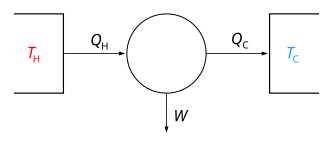
The whole science of heat is founded Thermometry and Calorimetry, and when these operations are understood we may proceed to the third step, which is the investigation of those relations between the thermal and the mechanical properties of substances which form the subject of Thermodynamics. The whole of this part of the subject depends on the consideration of the Intrinsic Energy of a system of bodies, as depending on the temperature and physical state, as well as the form, motion, and relative position of these bodies. Of this energy, however, only a part is available for the purpose of producing mechanical work, and though the energy itself is indestructible, the available part is liable to diminution by the action of certain natural processes, such as conduction and radiation of heat, friction, and viscosity. These processes, by which energy is rendered unavailable as a source of work, are classed together under the name of the Dissipation of Energy.
What It Means
This is a placeholder explanation generated by the low-overhead model. It interprets "The whole science of heat is founded Thermometry and Calorimetry, and when these operations are understood we may proceed to the third step, which is the investigation of those relations between the thermal and the mechanical properties of substances which form the subject of Thermodynamics. The whole of this part of the subject depends on the consideration of the Intrinsic Energy of a system of bodies, as depending on the temperature and physical state, as well as the form, motion, and relative position of these bodies. Of this energy, however, only a part is available for the purpose of producing mechanical work, and though the energy itself is indestructible, the available part is liable to diminution by the action of certain natural processes, such as conduction and radiation of heat, friction, and viscosity. These processes, by which energy is rendered unavailable as a source of work, are classed together under the name of the Dissipation of Energy." in the context of "James Clerk Maxwell, Theory of Heat (1871), "Preface"" to mean that wisdom is timeless.
Tags

About James Clerk Maxwell